
Most people who lose weight gain it back. Not because they lack willpower, but because they never fixed the thinking patterns that led them to overeat in the first place. If you’ve tried every diet, tracked every calorie, and still ended up right back where you started, the problem isn’t your discipline-it’s your thoughts. Behavioral weight loss therapy, specifically Cognitive Behavioral Therapy (CBT), isn’t another diet. It’s a reset button for how you relate to food, your body, and yourself.
Why Diets Fail and CBT Works
Diets promise quick results but ignore the real engine behind weight gain: the mind. You eat because you’re stressed. You skip workouts because you feel like a failure. You binge after one cookie because you think, "I’ve already blown it." These aren’t choices. They’re automatic reactions shaped by years of negative thinking.
CBT cuts through that noise. Developed in the 1960s and adapted for obesity in the 1980s, it doesn’t tell you what to eat. It teaches you how to think differently about food. A 2023 meta-analysis of 9 studies with over 900 participants showed people using CBT lost an average of 1.6 BMI points more than those on standard diets. That’s not dramatic-but it’s real, lasting, and backed by science.
The 6 Cognitive Strategies That Actually Change Weight Loss Outcomes
Not all CBT is the same. The most effective programs use six core techniques, each targeting a specific mental trap.
- Cognitive Restructuring: This is the heart of CBT. It’s about catching thoughts like, "I can never eat what I want," or "One slip means I’ve failed," and replacing them with balanced ones: "I can enjoy a treat without losing control," or "A mistake doesn’t erase progress." Studies show this alone reduces emotional eating by 63%.
- Self-Monitoring: Writing down what you eat and how you feel isn’t just for trackers-it’s for awareness. People who log meals consistently lose 5-10% more weight than those who don’t. It’s not about perfection. It’s about noticing patterns. Did you snack after work? Were you tired? Bored? Angry? The journal isn’t a report card. It’s a mirror.
- Stimulus Control: Your environment is setting you up. Keep cookies on the counter? You’ll eat them. Keep your gym clothes in the closet? You’re less likely to work out. CBT helps you redesign your space: store snacks out of sight, prep meals ahead, leave walking shoes by the door. Small changes, big impact.
- SMART Goal Setting: "I want to lose weight" doesn’t work. "I will walk 30 minutes, 4 days a week, starting Monday" does. Specific, measurable, achievable, relevant, time-bound goals give your brain a clear target. No vagueness. No guilt. Just action.
- Problem-Solving for High-Risk Situations: What do you do when your boss takes the team out for pizza? When your partner eats ice cream while watching TV? CBT doesn’t avoid these moments-it prepares you. Role-play them. Plan your response. "I’ll have one slice and save the rest for tomorrow," or "I’ll order a salad and join the conversation."
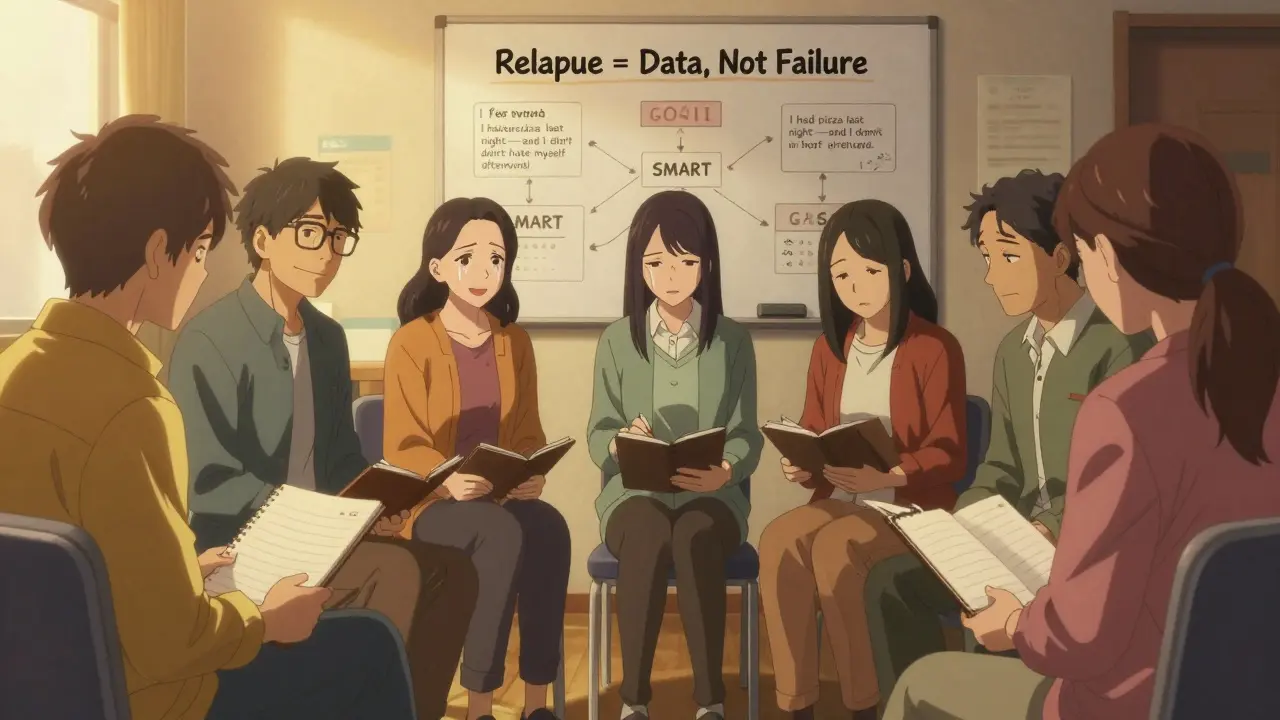
- Relapse Prevention: Most people think relapse means failure. CBT says it’s data. What triggered it? What thought popped up? What could you do differently next time? This turns setbacks into learning, not shame.
CBT vs. Dieting: The Numbers Don’t Lie
Let’s compare what actually works. In a 2018 study, people using CBT lost 8.2% of their body weight in six months. Those on standard diet-and-exercise plans lost 5.1%. That’s a 60% higher success rate.
And it’s not just about weight. People in CBT programs report 40% fewer symptoms of depression and anxiety. They sleep better. They feel less guilt. They stop seeing food as the enemy.
But here’s the catch: CBT doesn’t work in isolation. The NIH admits CBT alone rarely produces "clinically significant" weight loss. It needs support. Nutrition advice. Movement. Sometimes medication. But without CBT, those other tools often fail because the mind keeps sabotaging them.
Who Benefits Most From CBT for Weight Loss?
CBT isn’t for everyone-but it’s life-changing for some.
- People with binge eating disorder (BED): More than half of BED patients no longer meet diagnostic criteria five years after CBT. That’s not just weight loss-it’s freedom.
- People who feel trapped by "all-or-nothing" thinking: "If I can’t eat perfectly, I might as well quit." CBT teaches you that progress isn’t binary. One good day doesn’t erase three bad ones. One bad day doesn’t ruin your whole journey.
- People who’ve tried everything: If you’ve been through keto, intermittent fasting, WeightWatchers, and still feel stuck, CBT addresses the root cause: your inner dialogue.
It’s also effective after bariatric surgery. Studies show patients who get CBT before and after surgery rate their ability to stay on track 2.5 times higher than those who don’t.
How It’s Delivered: In-Person, Online, or Group?
CBT isn’t one-size-fits-all in delivery either.
In-person therapy still has the strongest results. Face-to-face sessions with a trained therapist lead to 37% better outcomes than phone or app-based versions. The human connection matters. Trust. Accountability. Real-time feedback.
Online CBT (ICBT) is a solid alternative. A 2024 study showed structured digital programs reduced BMI and stress levels. But they’re not as effective as human-led therapy. Apps like Noom and WeightWatchers Beyond the Scale use CBT principles, but users lose an average of 3.2% of body weight-less than half of what therapist-led programs achieve.
Group CBT is the rising star. A 2022 study found group sessions matched individual therapy results at one-third the cost. You get peer support, shared struggles, and collective motivation-all without the $150-per-session price tag.
The Hard Truth: Why CBT Isn’t Everywhere
CBT works. So why don’t more doctors offer it?
First, training is expensive. Certified CBT specialists need 40+ hours of specialized education. In the U.S., there’s only one specialist for every 125,000 people who could benefit. In rural areas, it’s worse-only 15% of counties have access.
Second, insurance rarely covers it. Only 32% of U.S. plans pay for more than 12 sessions a year. Most people can’t afford 16-26 weekly sessions out of pocket.
Third, it takes time. It’s not a quick fix. It takes 8-12 weeks to learn how to restructure thoughts. Many people quit before they see results. Only 45% master cognitive restructuring by session six without extra support.

What You Can Do Right Now
You don’t need a therapist to start using CBT tools. Here’s how to begin today:
- Keep a food and mood journal for three days. Write down what you ate, when, and how you felt before and after.
- Identify one recurring thought. "I always mess up." "I’ll never be thin." Write it down.
- Challenge it. Ask: "Is this 100% true? What’s a more balanced version?" "I’ve had setbacks, but I’ve also had successes."
- Change one environmental trigger. Move snacks out of sight. Put your shoes by the door. Unplug the TV after dinner.
- Set one SMART goal. "I will walk 20 minutes after dinner, Monday, Wednesday, Friday."
These steps won’t melt 20 pounds. But they’ll change how you think about your body-and that’s where real, lasting change begins.
Combining CBT With Other Tools
The future of weight loss isn’t just CBT or just medication. It’s both.
The NIH is investing $14.7 million in 2024 to test CBT combined with GLP-1 agonists like semaglutide. Why? Because drugs help you lose weight. CBT helps you keep it off.
CBT also pairs well with Motivational Interviewing (MI). A 2018 study showed CBT + MI led to 12.7% weight loss at 18 months-nearly 50% better than CBT alone. MI’s non-judgmental style helps you find your own reasons to change, instead of being told what to do.
If you’re considering medication, don’t skip the therapy. The weight will come back without it.
Final Thought: It’s Not About Willpower
You’re not broken. You’re not lazy. You’re not failing because you don’t have enough discipline.
You’re stuck because your brain keeps replaying the same old scripts: "I can’t," "It’s not fair," "I’ve ruined it."
Behavioral weight loss therapy doesn’t give you a new diet. It gives you a new way of thinking. And that’s the only thing that lasts.
If you’ve tried everything else and still feel trapped, CBT isn’t your next step. It’s your first real one.