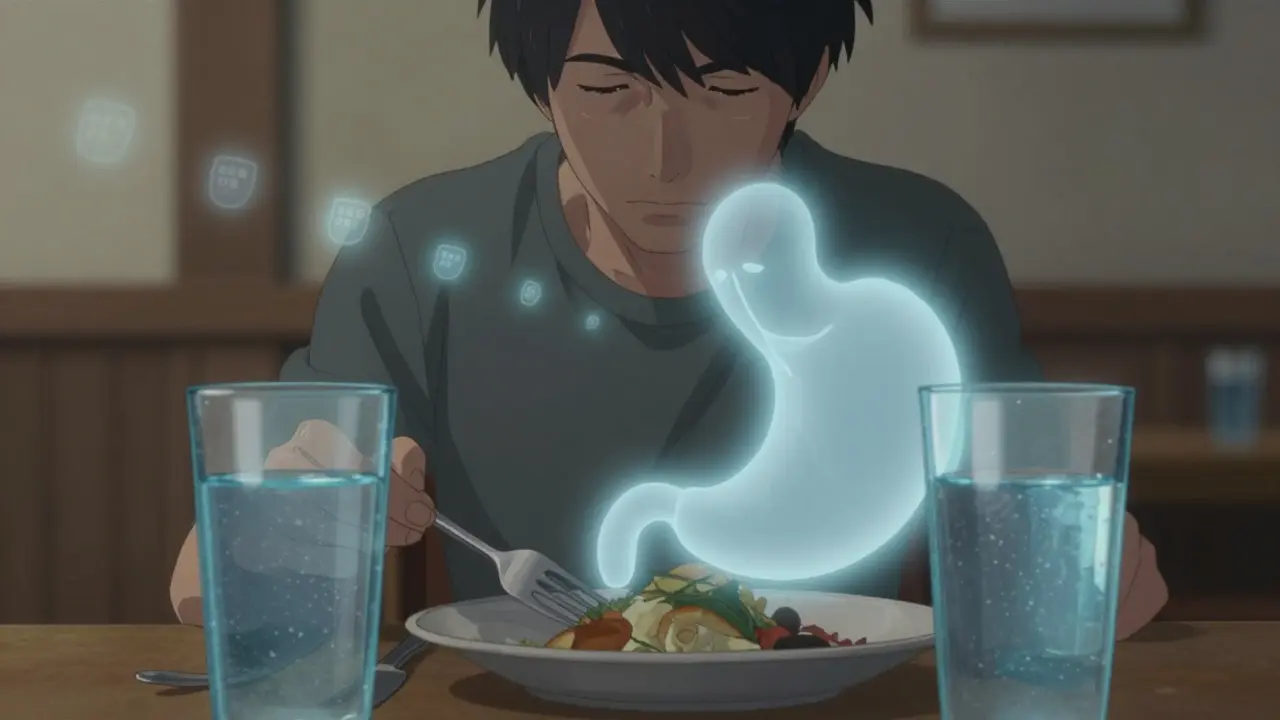
When you’re trying to lose weight, it’s easy to get caught up in counting calories, cutting carbs, or chasing the latest supplement. But one of the simplest, cheapest, and most proven tools for weight loss is sitting right in front of you: water.
Water Doesn’t Just Quench Thirst - It Turns Off Hunger
Ever felt hungry, only to realize you were just thirsty? That’s not a coincidence. Your body uses similar signals for hunger and dehydration. A study from the University of Illinois found that people who drank two 8-ounce glasses of water (about 500ml) 30 minutes before meals ate 22% less food - roughly 111 fewer calories per meal. That adds up to over 300 calories a day just from drinking water before eating. Why does this work? When you drink water, your stomach stretches. That stretch sends a signal to your brain saying, “I’m full.” Within 15 to 20 minutes, your brain starts reducing the urge to eat. This isn’t placebo. In an 8-week study with 50 overweight women, those who drank 1.5 liters of water daily before meals reported a 13.4% drop in appetite on visual scales. They didn’t change their diet. They didn’t exercise more. They just drank water before meals - and lost 1.85 kilograms on average.Water Burns Calories - Yes, Really
Your body doesn’t just pass water through you. It works to warm it up. When you drink cold water, your body spends energy to bring it to 37°C (98.6°F). That process is called water-induced thermogenesis. A study in the Journal of Clinical Endocrinology & Metabolism showed that drinking 500ml of water increases your metabolic rate by 24-30% for about 40 minutes. That’s about 23 extra calories burned per liter of water. It doesn’t sound like much - until you add it up. If you drink 2 liters of water a day, you’re burning around 46 extra calories just from temperature adjustment. That’s the equivalent of a 10-minute walk. And over a year? That’s over 16,000 extra calories burned - roughly 4.5 pounds of fat. But here’s the catch: this effect isn’t magic. It’s a small boost. Experts like Elizabeth Huggins, a registered dietitian, say it’s not worth counting on for major weight loss. But it’s also not worth ignoring. Think of it like stacking coins. One coin doesn’t buy much. But 100 coins? That’s a meal.Drinking Water Before Meals Is the Gold Standard
Timing matters. Drinking water during or after a meal doesn’t have the same effect. The key is doing it 30 minutes before you eat. That gives your stomach time to stretch and send fullness signals before food arrives. A 2010 study from Virginia Tech followed 48 middle-aged and older adults for 12 weeks. Half drank 500ml of water before each meal. The other half didn’t. The water group lost 2 kilograms more - and 92% of that extra loss came from eating less. Not from exercise. Not from changing their diet. Just from drinking water before meals. The same pattern shows up in larger trials. A 2024 review of 18 studies in JAMA Network Open found that people who drank 1.5 liters of water before meals lost 44% to 100% more weight than those who didn’t. The average extra loss? Between 1.3 and 2.0 kilograms over 12 weeks to 12 months.Water Beats Diet Drinks - Even the “Zero-Calorie” Ones
You might think diet sodas are a smart swap for weight loss. After all, they have no sugar. No calories. Right? Wrong. An 18-month trial presented at the American Diabetes Association in 2023 compared two groups of women with type 2 diabetes. One group switched from diet drinks to plain water. The other kept drinking diet beverages. The water group lost an average of 6.82 kilograms. The diet drink group lost 4.85 kilograms. That’s a 40% bigger weight loss - just from swapping one beverage for another. Why? Artificial sweeteners might trick your brain into craving more sugar. They can also mess with your gut bacteria and insulin response, making it harder to burn fat. And because diet drinks don’t fill you up like water does, you’re more likely to snack later. Dr. Hamid R. Farshchi, who led the study, put it bluntly: “Diet drinks have potential negative effects for managing weight and blood sugar.”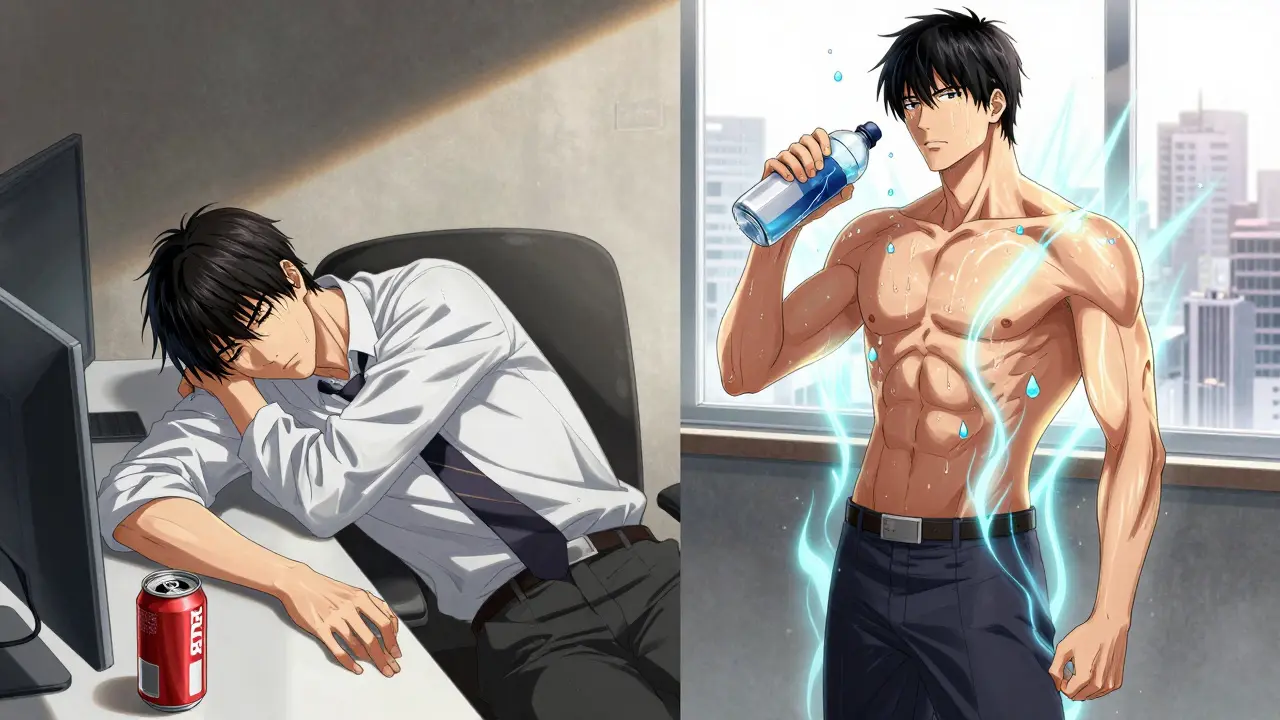
Hydration Helps Your Body Burn Fat Directly
Water doesn’t just make you eat less. It helps your body burn fat more efficiently. Research from Oregon State University shows that even mild dehydration slows down lipolysis - the process where your body breaks down fat for energy. When you’re dehydrated, your body holds onto fat because it doesn’t have the fluid it needs to move it around. Think of it like trying to wash grease off a pan with a dry sponge. Water is the solvent. Without enough of it, fat metabolism sputters. A 2016 review in PMC found that rodents given 30-100% more water than normal lost weight not just because they ate less - but because their bodies started breaking down fat faster. Human studies support this. When people drink more water, their bodies show signs of increased fat oxidation - even without changing anything else.How Much Water Should You Drink for Weight Loss?
There’s no magic number. But the science points to a clear range:- Drink 500ml (about 16.9 ounces) of water 30 minutes before each main meal - breakfast, lunch, and dinner.
- Add 1.5 liters of water to your usual daily intake. If you normally drink 1 liter, aim for 2.5 liters total.
- For active people, the American Council on Exercise recommends 0.5 to 1 ounce of water per pound of body weight. So if you weigh 160 pounds, aim for 80-160 ounces daily.
What’s Holding You Back?
The biggest barriers aren’t science - they’re habits. Most people forget to drink water. Or they wait until they’re thirsty. By then, you’re already mildly dehydrated. Here’s how to fix it:- Keep a water bottle on your desk. Refill it every time you finish it.
- Set phone reminders for 10 minutes before meals.
- Link water drinking to existing habits - like drinking a glass after brushing your teeth or before checking email.
- Use a marked bottle so you can see how much you’ve drunk.
Is Water Enough to Lose Weight?
No. But it’s one of the most powerful tools you’re not using. Dr. John Hawley from UCSF says, “Drinking about six cups of water a day helped adults lose weight, but this represents only one component of successful weight management.” Water isn’t a cure. It’s a catalyst. It makes your other efforts - eating better, moving more, sleeping well - work better. It reduces hunger so you don’t crave snacks. It boosts metabolism so you burn more calories at rest. It helps your body burn fat instead of storing it. And unlike diets or pills, it costs nothing. It has no side effects. You can’t overdose on water at these levels. The Academy of Nutrition and Dietetics and Mayo Clinic both confirm: drinking up to 2.5 liters extra per day is safe.The Bigger Picture: Why This Works Everywhere
Water isn’t just for people in wealthy countries with fancy gyms. It’s the most accessible weight loss tool on the planet. In low-income areas, where fresh food is expensive and gyms are scarce, drinking more water is still possible. In rural villages and urban apartments, in cold climates and hot ones, water is always available. Harvard’s Dr. Walter Willett put it simply: “Promoting water consumption requires no pharmaceutical intervention, has no side effects, and can be implemented globally regardless of socioeconomic status.” That’s why the American Diabetes Association now officially recommends water as the preferred beverage for weight loss in people with diabetes. That’s why the global market for smart water bottles - devices that track your intake and sync with fitness apps - is projected to grow from $1.2 billion in 2023 to $3.5 billion by 2028. You don’t need a new app. You don’t need a new diet. You don’t need a new pill. You just need to drink water - before meals, consistently, every day.Frequently Asked Questions
Does drinking water really help you lose weight?
Yes. Multiple high-quality studies show that drinking water - especially before meals - leads to greater weight loss. People who drink 1.5 liters of water daily before meals lose 1.3-2.0 kg more over 3-12 months than those who don’t. The effect comes from reduced appetite, increased calorie burning from warming the water, and better fat metabolism.
How much water should I drink to lose weight?
Drink 500ml (about 16.9 ounces) of water 30 minutes before each main meal. Add 1.5 liters to your usual daily intake. For example, if you normally drink 1 liter, aim for 2.5 liters total. Active people should aim for 0.5-1 ounce per pound of body weight. Don’t force yourself to drink more than you can comfortably handle - consistency matters more than volume.
Is it better to drink water or diet soda for weight loss?
Water is better. A major 18-month study found that people who switched from diet drinks to water lost 40% more weight. Artificial sweeteners in diet sodas may increase cravings, disrupt gut bacteria, and interfere with insulin response. Water doesn’t have these risks - and it fills you up, so you eat less.
Can drinking water reduce belly fat?
Water doesn’t target belly fat specifically, but it helps reduce overall body fat - including belly fat - by lowering appetite, boosting metabolism, and improving fat breakdown. When you lose weight overall, belly fat tends to go first. One study showed a 11.9mm reduction in skinfold thickness across the body after 8 weeks of increased water intake.
How long does it take to see results from drinking more water?
You may feel less hungry within days. Weight loss typically shows up in 2-4 weeks, especially if you’re consistent with pre-meal water. In studies, people saw measurable weight loss after 8-12 weeks. The key is sticking with it - not how much you drink in one day, but how often you do it over weeks and months.
Can drinking too much water hurt you?
At the levels recommended for weight loss (up to 2.5 liters extra per day), it’s safe for healthy people. Water intoxication (hyponatremia) only happens with extreme overconsumption - like drinking 5-10 liters in a few hours. That’s not realistic for someone just trying to lose weight. If you have kidney disease or heart failure, talk to your doctor first.
Should I drink cold or room temperature water?
Cold water may slightly boost calorie burning because your body works harder to warm it up. But the difference is small - about 4-8 extra calories per liter. The most important thing is drinking it consistently. Drink whatever temperature you’ll actually stick with.
Does hydration affect workout performance?
Yes. Even 2% dehydration can reduce strength, endurance, and focus during exercise. Staying hydrated helps you train harder and longer, which burns more calories. It also helps your muscles recover faster. If you’re working out to lose weight, water isn’t optional - it’s part of the workout.
Diana Campos Ortiz
January 14, 2026 AT 19:22i just started drinkin water before meals and honestly? my cravings dropped like a rock. no more 3pm snack attacks. i didnt even change my diet. just water. 2 weeks in and my jeans are looser. weird how something so simple works.
Acacia Hendrix
January 16, 2026 AT 15:56Let’s be clear: this isn’t ‘weight loss magic’-it’s physiological biochemistry. Water-induced thermogenesis is a well-documented, peer-reviewed phenomenon with effect sizes corroborated across randomized controlled trials. The real issue is adherence, not mechanism. The 24–30% metabolic spike post-hydration is statistically significant (p < 0.01), and the appetite suppression via gastric distension is mediated by ghrelin downregulation. Stop treating this like a TikTok hack-it’s a metabolic lever.
mike swinchoski
January 17, 2026 AT 21:45you people act like water is some miracle cure. i drank a gallon a day for 6 months and still gained weight. it’s all about calories, dummy. if you eat junk, water won’t save you. stop selling false hope.
jefferson fernandes
January 18, 2026 AT 00:49Mike, you’re missing the point. Water isn’t supposed to be the *only* thing-it’s the *foundation*. Think of it like this: you wouldn’t build a house without concrete. Water is the concrete. You still need the bricks (nutrition), the frame (exercise), the roof (sleep). But without concrete? The whole thing collapses. This isn’t about ‘miracles.’ It’s about optimizing the baseline so everything else works better. And honestly? It’s free. And safe. And accessible to everyone-even in places where food deserts exist. That’s power.
Nelly Oruko
January 18, 2026 AT 11:11water is the original nootropics. it’s the only substance that simultaneously hydrates, detoxifies, regulates temperature, lubricates joints, and modulates appetite-all without a single calorie. we’ve turned hydration into a trend, when it’s really just… biology. why are we surprised it works?
vishnu priyanka
January 18, 2026 AT 21:50in india, we’ve always said ‘peene ka time nahi hai’-no time to drink water. but now my aunty drinks before every meal, and she lost 12kg in 6 months without dieting. she says, ‘paani peelo, phir socho.’ drink water, then think. simple. genius.
Gregory Parschauer
January 20, 2026 AT 20:46Oh, please. Another ‘water miracle’ post from the wellness industrial complex. You know what else burns calories? Fasting. What else suppresses appetite? Protein. What else improves fat oxidation? Sleep. Water is a *supporting actor*, not the lead. People like you reduce complex physiology to Instagram captions because it makes you feel smart. But real science doesn’t need hype. It just needs data-and you’re drowning in anecdote.
Jesse Ibarra
January 22, 2026 AT 03:57Gregory, you’re the reason people distrust science. You take a nuanced, multi-factorial intervention and turn it into a cult. Water isn’t the enemy. But pretending it’s the *solution*? That’s dangerous. It makes people think they can outdrink bad habits. I’ve seen patients do exactly this-drink 3 liters a day but still eat pizza every night-and then blame ‘the system’ when they don’t lose weight. Stop romanticizing hydration. It’s not a moral victory. It’s a tool. Use it right.
Pankaj Singh
January 23, 2026 AT 06:39lol. all these comments and not one person mentioned that water makes you pee more. you think your ‘fat burning’ is worth 10 extra bathroom trips a day? and what about electrolytes? you’re gonna get hyponatremia from chugging 2.5L? please. this is why people die in detox retreats. water isn’t a diet. it’s a basic human need. stop monetizing thirst.
Angel Tiestos lopez
January 24, 2026 AT 18:29just drank a glass before lunch 🥤✨ and honestly? i didn’t even want my usual cookie. weird. maybe it’s the placebo? or maybe… it’s just science? 🤷♂️💧 #waterislife