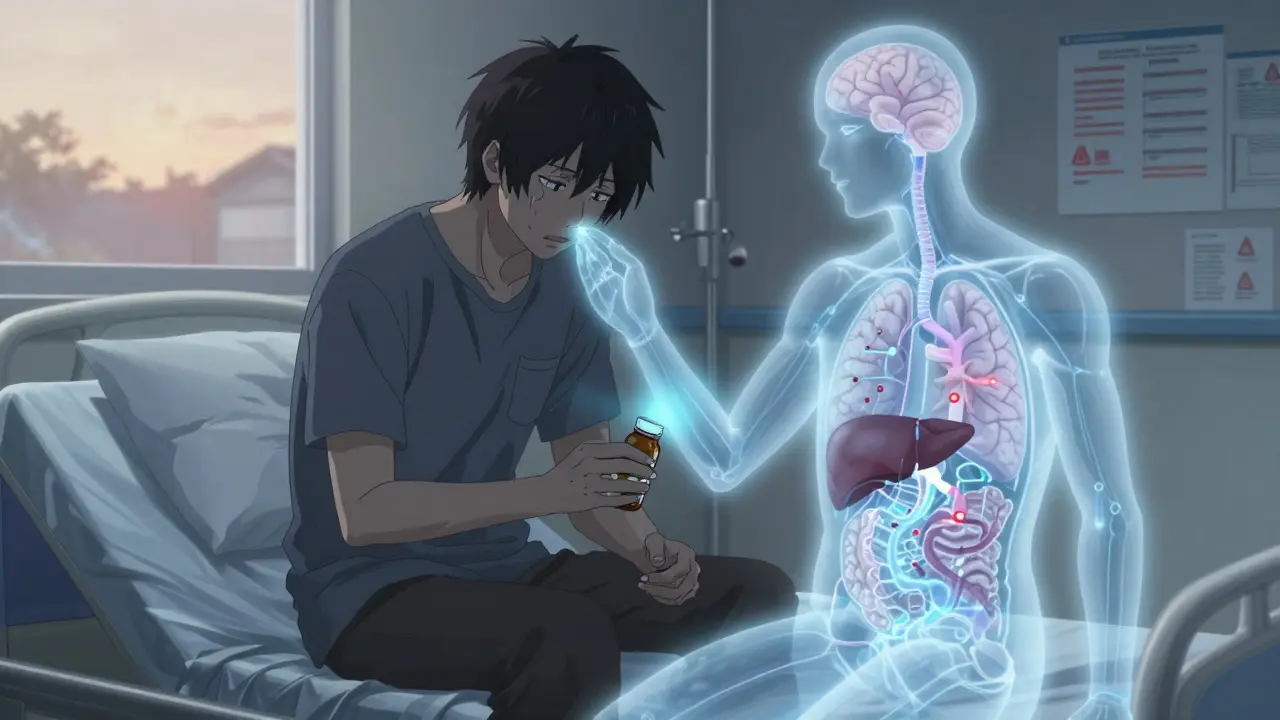
When you stop taking a medication-even for a few days-and then start again, your body doesn’t remember how to handle the same dose. That’s not a myth. It’s a medical reality that kills people every year. Many assume if they took 10 mg of a drug before, they can take 10 mg again. But after even a short break, your tolerance drops fast. Your lungs, your brain, your liver-they’ve reset. And that’s when overdose happens.
Why Your Body Can’t Handle the Same Dose
Think of tolerance like a muscle. If you stop lifting weights for a month, you lose strength. The same thing happens with medications like opioids, benzodiazepines, or even some antidepressants. Your body stops adapting to the drug’s presence. When you take the same dose again, it hits harder. Harder than before. Harder than you expect.
This isn’t just about opioids. It’s true for methadone, clonazepam, quetiapine, and even some antidepressants like paroxetine. The Medicines Learning Portal (2017) says: "A patient who has been without medication for more than a few days may need to be initiated on therapy again from scratch." That means starting at a fraction of your old dose.
Take the case of Philip Seymour Hoffman. After 23 years of sobriety, he relapsed and took a dose he used to handle easily. His body had forgotten how to process it. He died from an overdose. It’s not rare. The National Institute on Drug Abuse calls this one of the biggest drivers of opioid deaths. People who’ve been in treatment, jail, or rehab often return to their old dose-and die because their system can’t handle it anymore.
How Fast Does Tolerance Really Fade?
It’s faster than you think.
- For short-acting opioids like heroin or oxycodone: tolerance drops within 3-5 days.
- For methadone: it’s gone in 3-5 days too. Washington State Department of Health confirms this.
- For benzodiazepines like diazepam: even a week off can make you sensitive to half your usual dose.
- For MAOIs (like phenelzine): you need 2-5 weeks before restarting any other antidepressant. Otherwise, you risk serotonin syndrome-a dangerous, sometimes fatal, overstimulation of brain chemicals.
There’s no universal timer. But if you’ve been off a medication for more than a few days, assume your tolerance is gone. Don’t guess. Don’t hope. Assume you’re starting over.
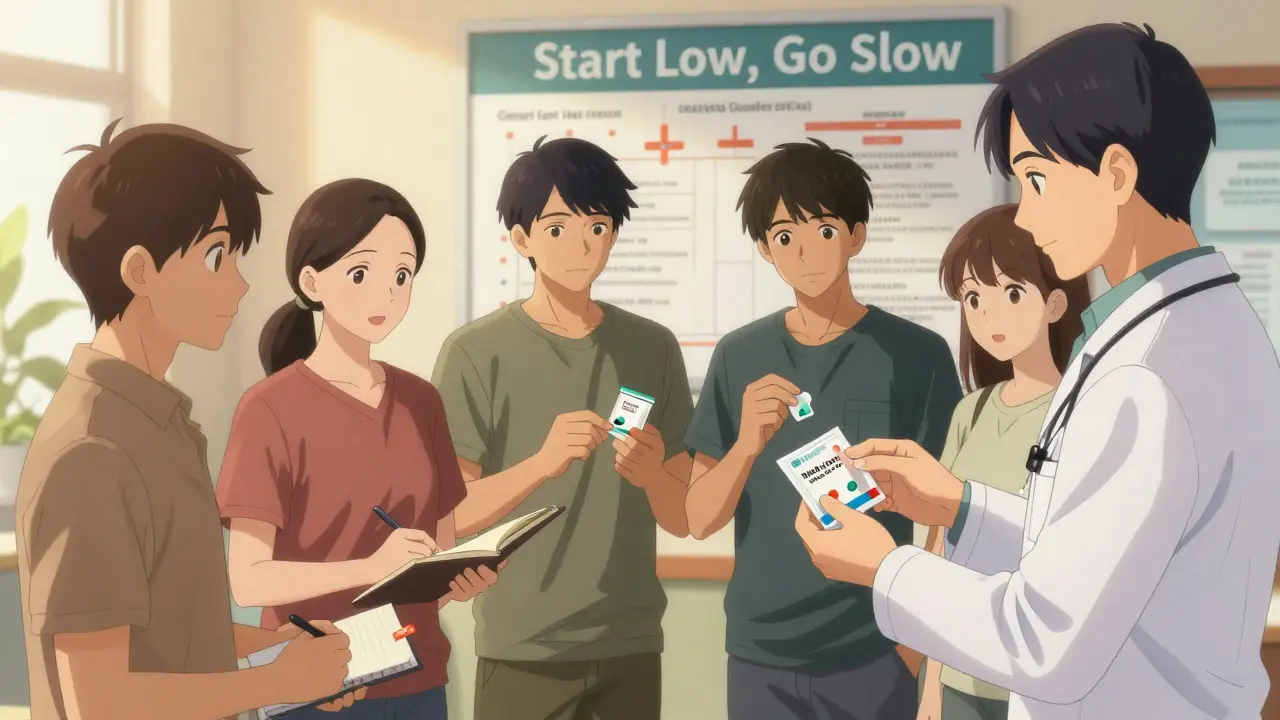
The Only Safe Way to Restart: Start Low, Go Slow
The medical community agrees: start low, go slow. This isn’t a suggestion. It’s the standard of care.
Here’s how it works in practice:
- Never restart at your old dose. Even if you feel fine. Even if you "just want to get back on track."
- Start at 25-50% of your previous dose. For opioids, Washington State guidelines say start at 25-50%. For quetiapine, Medicines Learning Portal recommends 25% of the old dose.
- Wait at least 24-48 hours before increasing. Your body needs time to adjust. Rushing this step is how people end up in the hospital.
- Monitor closely. Watch for signs of overdose: slow breathing (under 12 breaths per minute), extreme drowsiness, pinpoint pupils, confusion, or unresponsiveness. If you’re restarting opioids, have naloxone on hand-and make sure someone you trust knows how to use it.
The Calgary Clinical Pharmacology service (2020) says the first question you must ask is: "Do they even need this medication?" Sometimes, the answer is no. Maybe your condition improved. Maybe a safer alternative exists. Don’t assume you need to restart just because you used to.
What Medications Are Most Dangerous to Restart?
Not all meds carry the same risk. Here’s a quick breakdown:
| Medication Class | Example Drugs | Risk Level | Recommended Restart Protocol |
|---|---|---|---|
| Opioids | Methadone, oxycodone, fentanyl | Very High | Start at 25-50% of previous dose; monitor for 24-72 hours; have naloxone available |
| Benzodiazepines | Clonazepam, diazepam, alprazolam | High | Start at 25-50%; increase slowly over days; avoid alcohol or sleep aids |
| MAOIs | Phenelzine, selegiline | Extremely High | Wait 2-5 weeks before restarting SSRIs or SNRIs; risk of serotonin syndrome |
| Antidepressants (SSRIs/SNRIs) | Paroxetine, venlafaxine | Moderate | Start at 25% of previous dose; wait 3-7 days before increasing |
| Antipsychotics | Quetiapine, olanzapine | High | Start at 25% of previous dose; monitor for dizziness or low blood pressure |
Notice something? Almost all of these require you to start at a fraction of your old dose. And none of them say "just go back to what you were taking."
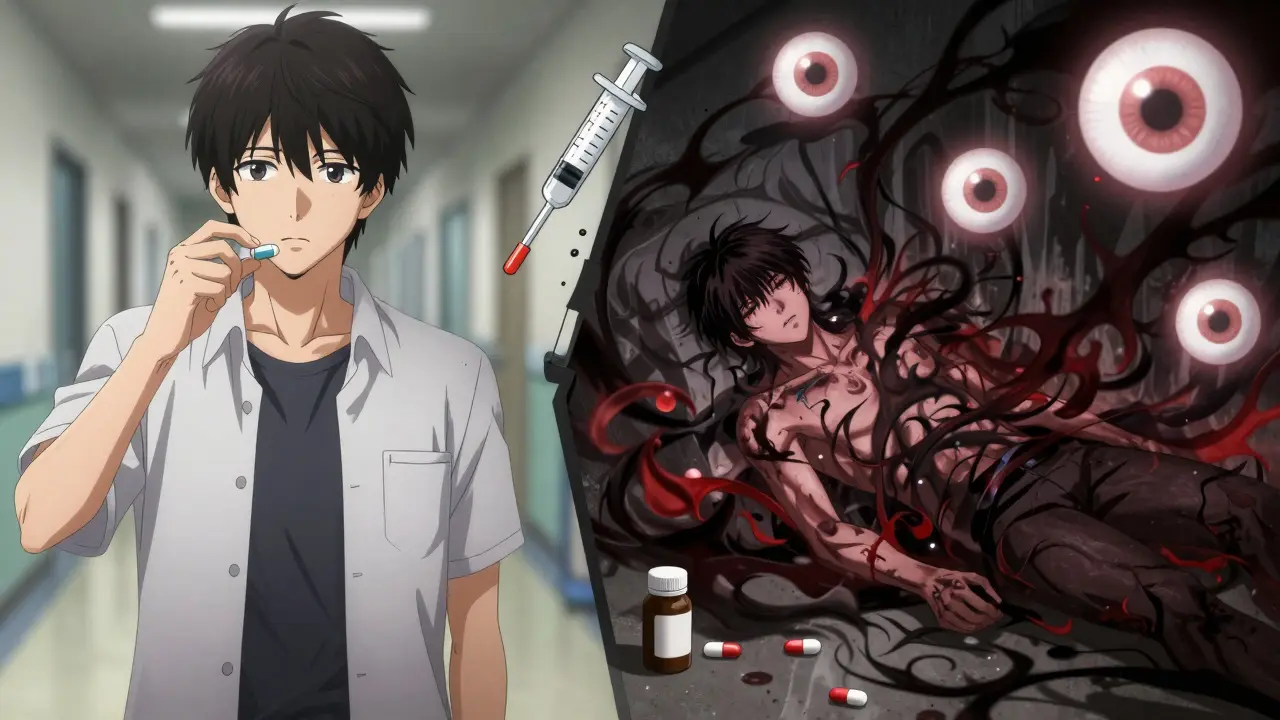
Why Supervision Matters
Trying to restart on your own is like rebuilding a car engine without a manual. You might get lucky. Or you might blow it up.
Evoke Wellness reports that patients who restart under medical supervision have an 87% success rate. Those who do it alone? Only 42%. That’s not a small gap. That’s life or death.
Medical supervision means:
- Having your doctor review your history and current health
- Getting a written restart plan with exact doses and timelines
- Being monitored for side effects (like low blood pressure or slow breathing)
- Having naloxone prescribed and explained
It’s not about trust. It’s about biology. Your body doesn’t care how strong you think you are. It only responds to chemistry.
Red Flags You’re Overdosing
Don’t wait for a crisis. Know the signs early:
- Slowed or shallow breathing (less than 12 breaths per minute)
- Unresponsiveness or extreme drowsiness
- Pinpoint pupils (very small, like pinpricks)
- Cold, clammy skin
- Blue lips or fingernails
- Loss of consciousness
If you see any of these-especially with opioids or benzodiazepines-use naloxone immediately if available. Call emergency services. Don’t wait. Don’t hope it passes. Overdose doesn’t care if you "just meant to take a little."
What About Naloxone?
If you’re restarting opioids, naloxone isn’t optional. It’s essential. Like a seatbelt for your brain.
Washington State guidelines say: "This resource should be shared with a friend or family member." Why? Because if you’re unconscious, you can’t call for help. Someone else has to act.
Naloxone reverses opioid overdose. It’s safe. It’s easy. It’s available over the counter in most places. If you’re restarting opioids-even if you’ve never overdosed before-get it. Keep it. Teach someone how to use it.
What’s New in 2026?
The field is evolving. In February 2024, the American Society of Addiction Medicine released a new 10-point scoring system to calculate safe restart doses based on:
- How long you were off the drug
- Your previous daily dose
- Your age, weight, liver function, and other medications
And in April 2023, Johns Hopkins published a study in JAMA Internal Medicine showing that giving extended-release naltrexone before restarting opioids cuts overdose risk by 73% in the first 30 days. It’s not widely available yet-but it’s coming.
Wearable devices that detect slow breathing and auto-administer naloxone are in Phase 3 trials. This isn’t science fiction. It’s the next step in saving lives.
What to Do Right Now
If you’re planning to restart a medication after a break:
- Call your doctor. Don’t wait. Don’t self-restart.
- Don’t assume your old dose is safe. It’s not.
- Start at 25-50% of your previous dose. For opioids, benzodiazepines, or antipsychotics.
- Get naloxone. Even if you think you don’t need it.
- Have someone with you for the first 24-72 hours. Someone who knows what to look for.
- Track your symptoms. Write down how you feel each day. Changes in energy, breathing, mood, or coordination matter.
This isn’t about being careful. It’s about surviving. Your body doesn’t remember how to handle the dose you used to take. It’s not weak. It’s not broken. It’s just biology. Respect it.
Can I restart my medication if I only took a few days off?
Yes-but not at your old dose. Even after 2-3 days off, your tolerance drops significantly. For opioids, methadone, or benzodiazepines, start at 25-50% of your previous amount. Wait 24-48 hours before increasing. Never assume "a few days" means your body still tolerates the same amount.
Is it safe to restart antidepressants after stopping them?
It depends. For SSRIs like paroxetine or SNRIs like venlafaxine, restarting at your old dose can cause dizziness, nausea, or serotonin issues. Start at 25% of your previous dose. Wait 3-7 days before increasing. If you were on an MAOI (like phenelzine), you must wait 2-5 weeks before starting any other antidepressant to avoid serotonin syndrome-a life-threatening reaction.
Why is restarting after jail or hospital so dangerous?
Tolerance drops fast during incarceration or hospitalization. You’re not taking your meds, your body resets, and you’re often discharged without a restart plan. Washington State data shows 62% of fatal opioid overdoses happen within 72 hours of release from jail or treatment centers. That’s why medical supervision and naloxone distribution are now standard in many states.
Can I use naloxone if I’m not sure it’s an overdose?
Yes. Naloxone is safe for people who don’t have opioids in their system. It won’t harm someone who hasn’t taken opioids. If someone is unresponsive, breathing slowly, or has blue lips, give naloxone. Then call 999. It’s better to give it and be wrong than to wait and lose someone.
What if I don’t have a doctor to help me restart?
Contact a local harm reduction clinic or pharmacy. Many offer free naloxone and restart guidance-even without insurance. In the UK, NHS pharmacies can provide naloxone kits and advice. The Alcohol and Drug Foundation and Opioid Response Network also have online resources. Don’t try to do this alone. Your life is worth more than pride or fear.
Final Thought
You didn’t fail because you stopped. You didn’t fail because you want to restart. You just need to restart safely. Your body isn’t your enemy. It’s trying to protect you. Listen to it. Start low. Go slow. Get help. And if you’re ever unsure-wait. Wait another day. Wait until you’re sure. It’s not weakness. It’s wisdom.
Gloria Ricky
February 12, 2026 AT 11:46Just wanted to say this post saved my life. I stopped my benzo for 5 days thinking I could just jump back in at my old dose. Got dizzy, nauseous, and felt like my brain was melting. Started at 25% like you said and took it slow. Still here. Thank you.
Jonathan Noe
February 13, 2026 AT 08:32Look I get it, but come on-this is just fearmongering dressed up as medical advice. I’ve been off oxycodone for two weeks and took my usual dose. Felt a little funny, sure, but I didn’t die. People need to chill. Tolerance isn’t magic, it’s biology. You don’t need to start at 25% unless you’re a toddler.
Luke Trouten
February 15, 2026 AT 03:37There’s a quiet tragedy in how we treat addiction-as if willpower alone can override physiology. The body doesn’t hold grudges, but it remembers chemistry. That’s not weakness. It’s evolution. We punish people for adapting, then wonder why they relapse. Maybe the real problem isn’t the dose-it’s the system that leaves people to restart alone.
Kristin Jarecki
February 16, 2026 AT 09:12As a clinical pharmacist with over 15 years in addiction medicine, I cannot overstate the importance of this guidance. The data is unequivocal: restarting at previous doses post-abstinence carries a 300% higher risk of fatal respiratory depression. The 25-50% restart protocol is not anecdotal-it is evidence-based, peer-reviewed, and endorsed by the American Society of Addiction Medicine. Please, do not gamble with your life.
Vamsi Krishna
February 16, 2026 AT 13:55You think this is about tolerance? Nah. This is Big Pharma’s way of keeping you dependent. They don’t want you to get better-they want you to keep buying. That ‘naloxone’ they push? It’s not a lifesaver-it’s a leash. And that ‘restart plan’? It’s a trap. Your body doesn’t forget. They just made you forget how to trust yourself. Wake up.
Neha Motiwala
February 17, 2026 AT 01:14After reading this I cried. Not because I’m weak, but because I’ve lost three friends this way. One was 22. He got out of rehab, took his old dose, and his mom found him on the bathroom floor. No one told him. No one warned him. We just assumed he knew. We were wrong. This isn’t a post. It’s a funeral notice.
Jim Johnson
February 18, 2026 AT 10:17My sister restarted her quetiapine after a 10-day break. Started at 50%. Waited 72 hours. No dizziness. No crashes. Just calm. She’s been stable for 8 months now. This isn’t just theory. It works. And honestly? The fact that we even have to talk about this like it’s a secret says something about how broken our system is.
Brad Ralph
February 19, 2026 AT 01:57My body remembers. My brain remembers. My liver remembers. But my ego? Nah. That’s what gets you killed. 😅
christian jon
February 20, 2026 AT 11:11Let’s be real: if you’re restarting meds after a break and you didn’t consult a doctor, you’re not just being reckless-you’re being selfish. You think you’re just risking yourself? No. You’re risking your family. Your friends. Your community. And if you die, you leave behind a trail of guilt, grief, and unanswered questions. This isn’t a ‘personal choice.’ It’s a public health crisis-and you’re part of it.