Drug Interaction Checker
Check Medication Interactions
Enter the medications you're taking. This tool uses data from FDA-approved sources like DailyMed and DrugBank to identify potential interactions.
Interaction Results
Enter your medications and click "Check Interactions" to see results
Important: This tool is for informational purposes only. Do not make any changes to your medication regimen based on this information. Always consult your doctor or pharmacist for medical advice.
Knowing what’s in your medicine shouldn’t feel like solving a puzzle. Yet millions of patients struggle to understand their prescriptions - dosage, side effects, interactions - often turning to Google and landing on sites filled with ads or outdated info. The truth? There are free, trustworthy, government-backed drug databases built just for you. No sales pitches. No hidden agendas. Just clear, accurate, up-to-date information straight from the FDA and top medical researchers.
Why Most Patient Drug Sites Fail
You’ve probably used WebMD, Drugs.com, or a pharmacy app to check your meds. They’re easy to find, fast, and look professional. But here’s what they don’t tell you: many of these sites are funded by pharmaceutical companies. That means their content can be influenced - drug interactions might be downplayed, side effects buried, or alternatives pushed for profit. A 2021 JAMA Internal Medicine study rated WebMD’s accuracy at just 62 out of 100. Compare that to DailyMed, which pulls its data directly from the FDA’s official drug labels. No middleman. No edits. Just the raw, legally required information that drugmakers must submit to the government. The problem? That raw info is often written for doctors, not patients. Long paragraphs. Medical jargon. Sections labeled “SPL” or “Warnings and Precautions” that sound like legal warnings, not health advice. That’s why so many people walk away confused - even after reading the “answer.”DailyMed: The Official FDA Drug Label Source
If you want to know exactly what your medication says in the eyes of the law, DailyMed is your starting point. Run by the U.S. National Library of Medicine, it’s the only website that hosts the full, unedited FDA-approved labels for every prescription and over-the-counter drug sold in the U.S. As of October 2023, DailyMed had over 142,000 drug entries. That includes everything from common pills like metformin and lisinopril to rare cancer drugs. Each label includes:- Proper dosage instructions
- Full list of side effects
- Drug interactions with other meds, food, and alcohol
- Warnings for pregnancy, kidney disease, or liver problems
- How the drug works in your body
- “Take with food to avoid stomach upset”
- “Do not drink alcohol while taking this medicine”
- “Call your doctor if you feel dizzy or have trouble breathing”
LactMed: The Only Trusted Resource for Breastfeeding Moms
If you’re breastfeeding and taking any kind of medication - even a simple painkiller - you need to know if it’s safe for your baby. Most websites give vague advice like “consult your doctor.” But LactMed gives you the science. LactMed, part of the National Library of Medicine’s Toxicology Data Network, is the only free, evidence-based database that tells you exactly what happens when a drug passes into breast milk. It covers over 4,200 substances, including antidepressants, antibiotics, migraine meds, and even herbal supplements. Each entry includes:- How much of the drug enters breast milk
- What levels show up in the baby’s blood
- Potential effects on the infant
- Alternatives if the drug isn’t recommended
- Timing tips - like “take the dose right after nursing”
DrugBank: For the Curious, the Complex, and the Connected
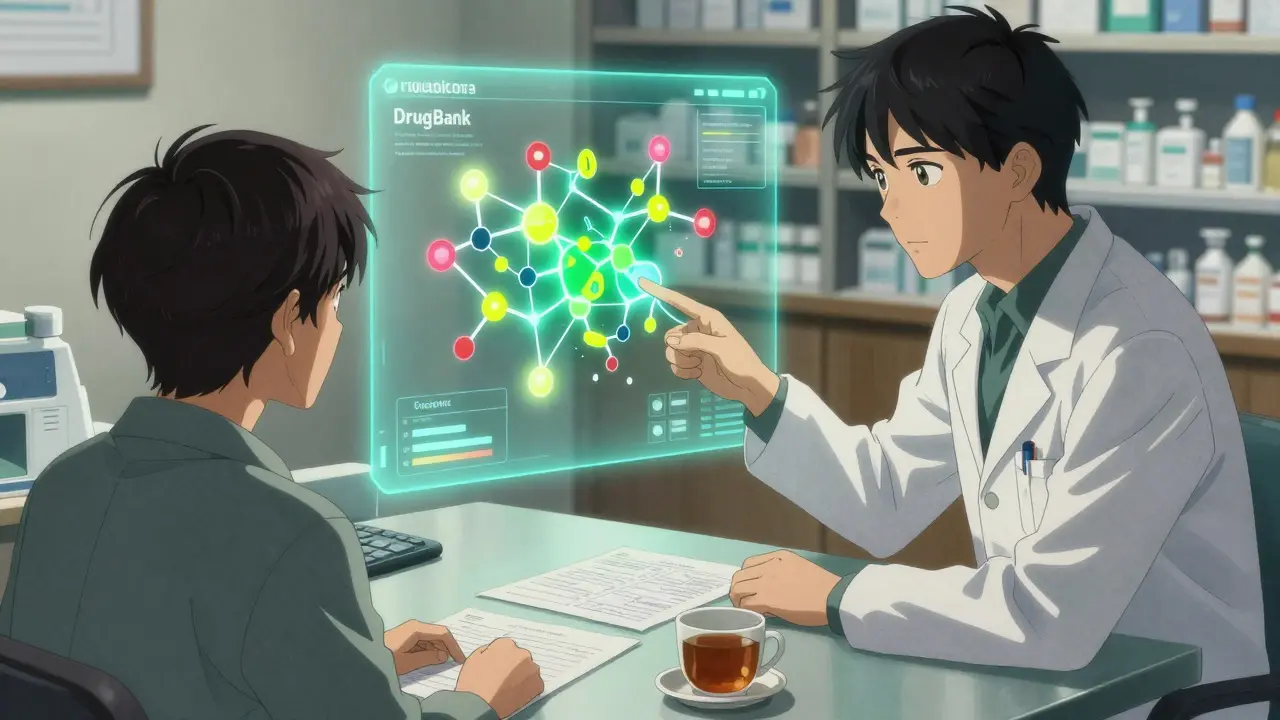
If you’re the kind of person who reads the fine print, digs into how drugs work at the molecular level, or has a rare condition that’s hard to research - DrugBank is your secret weapon. Created by the University of Alberta and launched in 2006, DrugBank started as a tool for pharmacologists. But its public-facing version (free to use) gives patients access to data you won’t find anywhere else:- Exactly how a drug binds to receptors in your body
- Which genes affect how you metabolize it
- Over 1.2 million drug-drug interaction pairs
- Chemical structures you can zoom in on
- Patent info and manufacturing details
What These Sites Don’t Do - And What You Need to Pair Them With
None of these three sites will tell you:- How much your drug costs at your local pharmacy
- If your insurance will cover it
- Where to get it cheaper
- How to refill it
- What to do if you feel sick after taking it
How to Use These Tools Without Getting Overwhelmed
Here’s a simple step-by-step plan:- Start with DailyMed to confirm your exact dosage and warnings.
- If you’re breastfeeding, check LactMed - even for OTC meds like ibuprofen.
- If you’re on multiple drugs and worried about interactions, use DrugBank’s Patient View to see risks clearly.
- Use GoodRx to find the lowest price.
- If something still doesn’t make sense, call your pharmacist. They’re trained to explain this stuff - and they’re paid to help you.
What’s Coming Next
By late 2025, DailyMed will start feeding its data directly into Apple Health Records. That means if your doctor prescribes a new drug, it could auto-populate in your phone with safety info already pulled from the FDA. The National Library of Medicine is also testing AI tools that can turn a 12-page drug label into a 30-second voice summary. Imagine asking your phone: “Is it safe to take this with wine?” and getting a clear answer. But here’s the bottom line: these tools are only as good as the people using them. The FDA says DailyMed and LactMed are “non-negotiable pillars of medication safety.” That’s not marketing. That’s policy. They’re funded by your tax dollars so you don’t have to pay for misinformation. The real danger isn’t the websites. It’s believing the ones that sound nice but aren’t backed by science.Final Tip: Always Talk to Your Doctor or Pharmacist
No database replaces a human. If DailyMed says “do not use during pregnancy,” but your doctor says it’s safe for you - ask why. They might have new data, a different risk profile, or a special reason. The best patients aren’t the ones who Google the most. They’re the ones who use these tools to ask better questions.Are DailyMed and LactMed really free?
Yes, completely free. Both are funded by the U.S. government through the National Library of Medicine. No sign-up, no ads, no hidden fees. You don’t even need to create an account.
Can I trust DrugBank if it’s from a university?
Yes. DrugBank is maintained by the University of Alberta with strict oversight. It cross-references data with the FDA, European Medicines Agency, and Health Canada. Its public data is updated quarterly and verified by independent pharmacologists. While it’s more technical, its accuracy is among the highest available.
Why isn’t there a mobile app for DailyMed or LactMed?
The National Library of Medicine focuses on web-based access to ensure universal compatibility - no app store approvals, no platform restrictions. All three sites work perfectly on phones and tablets. You can save them to your home screen like an app. Many patients do exactly that.
What if I can’t understand the language on DailyMed?
Use MedlinePlus, another NLM site, to find plain-language summaries in over 40 languages. You can search by drug name and get simplified explanations. You can also use your browser’s translation tool - Chrome and Edge do this automatically.
Is it safe to stop a medication based on what I read online?
Never. Even if DailyMed says “do not use,” your doctor may have approved it for your specific case. Stopping meds like blood pressure pills, antidepressants, or insulin without medical advice can be dangerous. Use these sites to prepare questions - not to make decisions alone.
Do these sites work outside the U.S.?
Yes. DailyMed and LactMed are accessible worldwide. But the drug labels only reflect U.S. FDA approvals. If you’re outside the U.S., check your country’s health agency (like the UK’s MHRA or Canada’s Health Canada) for local guidelines. DrugBank includes international data, so it’s more globally useful.
Annie Choi
January 15, 2026 AT 14:22Finally someone says it loud and clear - DailyMed is the real deal. No ads, no pharma BS, just raw FDA data. I’ve been using it for my mom’s heart meds and it’s saved us from two bad interactions. The Patient-Friendly Highlights? Game changer. I print them out and stick them on the fridge.
Also LactMed saved my breastfeeding journey. I was terrified of my antidepressant but the data showed it was basically harmless. My baby’s fine. My sanity? Also fine.
Mike Berrange
January 15, 2026 AT 15:51You’re all missing the point. These sites are government-controlled. DailyMed, LactMed, DrugBank - all funded by the NIH, which is part of the same bureaucracy that pushed mask mandates and lied about ivermectin. Why should we trust data from the same people who told us vaccines didn’t prevent transmission?
Dan Mack
January 16, 2026 AT 01:20Oh wow so now we’re supposed to trust a government site that doesn’t even have a decent mobile app? That’s like trusting the DMV to run your Netflix account. And DrugBank? That’s a university project - funded by who? The same people who own the FDA. It’s all one big loop. They want you to think you’re empowered but you’re just being led by the nose with sterile, soulless data. Meanwhile, your pharmacist is the one who actually knows what’s going on - and they’re paid to lie to you too. I’ve seen it.
Also, Apple Health Records integrating this? That’s just the next step before they auto-refill your meds and track your compliance. Welcome to Big Pharma 2.0.
Amy Vickberg
January 17, 2026 AT 12:37Thank you for this. I’ve been telling my friends for years to skip WebMD and go straight to DailyMed. The Patient-Friendly Highlights are such a simple fix but so powerful. I showed my sister how to use them for her diabetes meds - she cried because she finally understood what she was taking. No jargon, no fear, just facts. This is what public health should look like.
And LactMed? If you’re a mom, bookmark it. Even if you think you don’t need it. Ibuprofen? Check it. Melatonin? Check it. You’ll be glad you did.
Nishant Garg
January 18, 2026 AT 06:15As someone from India, I’ve used these tools while living abroad and now back home. DailyMed and LactMed are global gold standards - even if the labels are U.S.-focused, the science doesn’t lie. I showed my cousin’s wife in Delhi how to use LactMed for her postpartum anxiety meds - she was shocked no one told her about it before. The real tragedy isn’t the lack of info - it’s the silence around it. We need to spread this like wildfire. In my village, people still swallow pills based on neighbor advice. This isn’t just helpful - it’s revolutionary.
Also, DrugBank’s Patient View? Genius. My uncle’s cholesterol med was interacting with his turmeric supplement. He thought it was ‘natural’ so it was safe. Turns out it spiked his liver enzymes. We caught it because of DrugBank. No hype. Just data. That’s power.
Nicholas Urmaza
January 20, 2026 AT 05:41These resources are not just useful - they are essential. The fact that the U.S. government provides this information for free, without ads or corporate influence, is a national asset. We should be proud. Many countries don’t have this. If you’re not using DailyMed and LactMed, you’re not being responsible with your health. This isn’t opinion - it’s public health policy. And GoodRx? That’s the cherry on top. Use them together. It’s not complicated. It’s common sense.
Stop trusting influencers. Stop Googling. Go to the source.
Diane Hendriks
January 21, 2026 AT 00:08Let’s be real - this whole thing is a distraction. The FDA is a puppet of Big Pharma. DailyMed? It’s just the sanitized version of what the drug companies feed them. You think they’d publish the real side effects? Like the 37% of people who get suicidal ideation on SSRIs? Nah. That’s buried in the fine print. And LactMed? It only lists what’s ‘approved’ - not what’s actually happening in real life. My friend’s baby had seizures after she took Zoloft. LactMed said ‘low risk.’ Turns out the study was funded by Pfizer. Coincidence? I think not.
Real safety? You don’t trust databases. You trust your gut. And your gut says: don’t take anything unless you absolutely have to.
Sohan Jindal
January 21, 2026 AT 21:24They’re lying to you. All of it. DailyMed? It’s a trap. The FDA doesn’t want you to know how many drugs are recalled after they hit the market. They don’t want you to know that 80% of side effects are never reported. LactMed? They only include what’s ‘safe enough’ - not what’s truly safe. And DrugBank? That’s just a front for the pharmaceutical cartel. They want you to think you’re in control but you’re just being fed a diet of sanitized lies. The real solution? Don’t take any pills. Eat clean. Sleep. Pray. That’s real medicine. Not some government website with a 2005 design.
Frank Geurts
January 23, 2026 AT 18:50While I appreciate the comprehensive nature of the resources outlined, I must respectfully underscore the importance of institutional integrity and transparency in public health infrastructure. The National Library of Medicine, under the auspices of the National Institutes of Health, operates under rigorous peer-review protocols and federal accountability mandates. The absence of commercial advertising on DailyMed and LactMed is not a design flaw - it is a feature of ethical public service. Furthermore, the integration of these datasets into consumer health platforms such as Apple Health Records represents a paradigm shift toward patient-centered, data-driven care - a development that ought to be celebrated, not cynically dismissed. The onus remains on the individual to engage critically, but the tools themselves are not merely reliable - they are indispensable.
Sarah Mailloux
January 24, 2026 AT 23:10Just used DailyMed for the first time. Took me 30 seconds. Found the exact warning I was scared of - and it was way less scary than I thought. I told my sister to check it too. She was on the phone with her doctor right after. We’re all just trying to not die. These sites help. No drama. No hype. Just facts. Bookmark them. Share them. Your future self will thank you.