More than 95% of people told they’re allergic to penicillin aren’t actually allergic. Yet, millions of patients across the UK and the US still avoid this safe, effective antibiotic-simply because they were labeled allergic years ago, often after a harmless rash as a child. This isn’t just a minor inconvenience. It’s a hidden public health crisis that pushes doctors toward stronger, more expensive, and riskier antibiotics-antibiotics that fuel resistance, increase side effects, and cost the healthcare system billions every year.
Why Your Penicillin Allergy Label Might Be Wrong
If you were told you’re allergic to penicillin after breaking out in a rash as a kid, you’re not alone. Most people get that label after a mild, non-allergic reaction-like a viral rash that happened to appear while taking the drug. True IgE-mediated penicillin allergy, the kind that causes anaphylaxis, affects less than 2% of the population. But in hospitals, 10-15% of patients carry the label. That’s a huge mismatch. The problem? Once you’re labeled allergic, it sticks. Doctors assume it’s accurate. You assume it’s accurate. No one questions it. But here’s the thing: your body doesn’t remember a rash from 20 years ago the way you think it does. Allergies can fade. Immune systems change. And without proper testing, you’re living with a label that’s likely false.What Happens When You Avoid Penicillin
If you’re labeled allergic to penicillin, you’re far more likely to be prescribed something like vancomycin, clindamycin, or a fluoroquinolone-even for simple infections like strep throat or a urinary tract infection. These drugs are broader-spectrum. They hit more bacteria, good and bad. That’s the problem. They increase your risk of Clostridioides difficile (C. diff), a severe gut infection that can land you back in hospital. In the US alone, false penicillin labels contribute to over 50,000 extra C. diff cases every year. They also drive up antibiotic resistance. Patients with penicillin labels are 69% more likely to get clindamycin and 28% more likely to get fluoroquinolones-drugs linked to rising MRSA and ESBL-resistant E. coli. And the cost? On average, a false penicillin label adds about $1,000 to your annual healthcare bill. That’s because those alternative antibiotics are pricier, longer courses are needed, and hospital stays are longer. One 68-year-old patient in Massachusetts saved $28,500 in two years after getting de-labeled-no more repeated UTI hospitalizations, no more broad-spectrum drugs.How Testing Works: Skin Tests, Challenges, and Safety
Testing isn’t scary. It’s structured, safe, and backed by decades of research. The process usually starts with a detailed history. Did you have hives? Swelling? Trouble breathing? Or just a rash? Tools like PEN-FAST help doctors quickly assess your risk. For low-risk patients-those with no history of severe reactions-the safest, fastest path is a direct oral challenge. You take a single dose of amoxicillin under observation. Wait 60 minutes. If nothing happens, you’re de-labeled. Done. No needles. No skin tests. Just a pill and a watchful nurse. For moderate-risk patients, skin testing comes in. A tiny drop of penicillin is placed on your skin, then lightly pricked. If there’s no reaction, a small amount is injected just under the skin. Neither hurts much. If both tests are negative, you’re given a full therapeutic dose of amoxicillin. Over 94% of people who go through this process tolerate penicillin without issue. Adverse reactions? Less than 2% of patients have any reaction at all-and most are mild: a little itching or redness. Severe reactions are extremely rare when tests are done properly.Who Can Do the Testing? You Don’t Need an Allergist
You might think you need to see an allergy specialist. You don’t. In the UK, many GP surgeries and hospital pharmacists are now trained to do low-risk de-labeling. In the US, over 120 hospitals have trained primary care doctors to run these programs with less than 1% adverse event rates. The key is using the right tools. The PEN-FAST score (Penicillin Allergy Fast Assessment) is simple: five questions about your reaction history. Score of 3 or less? You’re low-risk. You can safely skip skin testing and go straight to the oral challenge. Hospitals in Bristol, Manchester, and London are already rolling out these programs. Some use EHR alerts to flag patients with penicillin labels and automatically suggest a de-labeling pathway. Epic’s system alone has helped remove nearly 200,000 false labels in the US since 2021.
What to Expect During Your Test
If you’re scheduled for testing, here’s what happens:- You’ll fill out a short form about your reaction: when it happened, what symptoms you had, how long it lasted.
- A nurse or doctor will review your history using PEN-FAST or a similar tool.
- If you’re low-risk: you’ll be given a single 250mg dose of amoxicillin. You’ll sit for an hour. No food, no running around. Just relax.
- If you’re moderate-risk: you’ll get skin testing first. If that’s negative, you’ll get the same oral challenge.
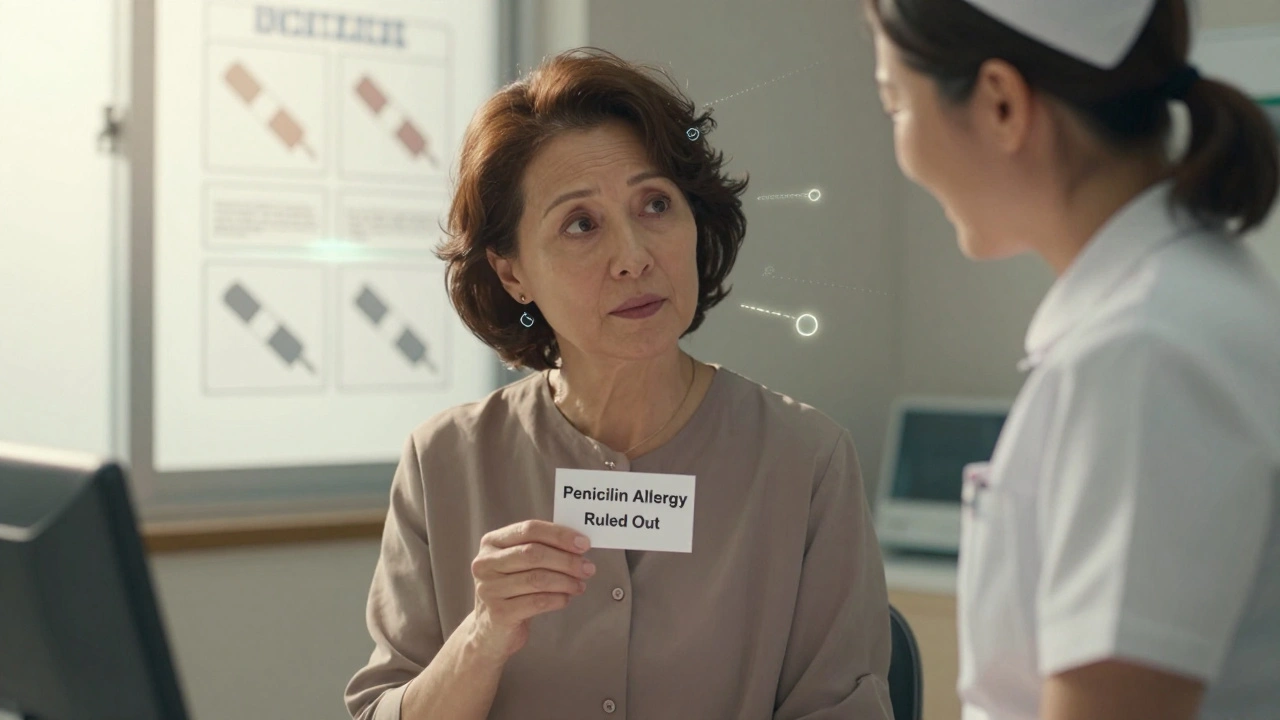
- If you tolerate the dose: you’re officially de-labeled. Your record is updated. You get a card or letter to carry with you.
Real Stories: What People Say After Testing
One woman from Leeds, 42, was told she was allergic after a rash at age 6. She avoided penicillin for 36 years. When she got a severe sinus infection, she was given azithromycin-every time. It gave her nausea and bloating. After testing, she found out she wasn’t allergic. She now takes amoxicillin without issue. “It’s like I finally got my body back,” she said. Another man in Birmingham had a mild rash after penicillin at 18. He was labeled allergic. When he developed a kidney infection, he was given ciprofloxacin. He got tendon pain so bad he couldn’t walk. After testing, he was de-labeled. He now takes amoxicillin. “I didn’t know I was paying for a mistake I made as a teenager,” he told his doctor. On Reddit, a user wrote: “I thought I was allergic. Turns out I just had a virus. Now I can take the right antibiotic without stomach issues. Best decision I ever made.”Why So Few People Get Tested
Despite the evidence, fewer than 40% of eligible patients ever get tested. Why? - Doctors don’t ask. Many assume the label is correct. - Patients are scared. They think testing might trigger a deadly reaction. - Wait times are long. In some areas, it takes 14 weeks to get an appointment. - Systems don’t support it. Some EHRs won’t let you remove a label without an allergist’s note. But change is coming. The NHS is piloting community-based de-labeling clinics. The CDC now tracks de-labeling rates as a quality metric. In 2025, UK hospitals will be expected to offer testing to all patients with a penicillin label.
What You Can Do Right Now
If you’ve been told you’re allergic to penicillin:- Ask your GP: “Was this based on a test, or just a past rash?”
- Ask: “Can I be assessed for de-labeling?”
- Ask: “Do you use PEN-FAST or a similar tool?”
- If they say no-ask for a referral to a pharmacist-led allergy service or hospital antimicrobial team.
What Happens After You’re De-labeled
Once you’re cleared: - Your allergy record is updated to “penicillin allergy ruled out” or “no penicillin allergy.” - You get a printed summary to carry with you. - Future prescriptions can include penicillin-based antibiotics like amoxicillin, ampicillin, or flucloxacillin. - You’ll likely get better results, fewer side effects, and lower costs. And here’s the biggest win: you’re helping fight antibiotic resistance. Every time you take the right antibiotic, you reduce the pressure on stronger drugs that we need to save for serious infections.FAQ
Can I outgrow a penicillin allergy?
Yes. Most people who think they’re allergic to penicillin never had a true allergy to begin with. Even if you did have a real reaction years ago, your immune system can forget it. Studies show that 80% of people who had a true penicillin allergy 10 years ago will tolerate it today. Testing is the only way to know for sure.
Is penicillin allergy testing safe?
Extremely safe when done correctly. Skin testing has a near-zero risk of serious reaction. Oral challenges are even safer for low-risk patients. Less than 2% of people have any reaction at all-and most are mild, like a small rash or itching. Severe reactions are rare and happen almost exclusively when testing is skipped and a full dose is given without monitoring.
Do I need to see an allergist for testing?
Not necessarily. Many GP surgeries, hospital pharmacists, and antimicrobial stewardship teams are trained to do low-risk de-labeling. You only need an allergist if you had a severe reaction like anaphylaxis, swelling of the throat, or low blood pressure. For most people-especially those with a childhood rash-a simple oral challenge under supervision is enough.
What if I have a reaction during testing?
If you do react, the team will stop the test and treat you immediately. They’ll have epinephrine, antihistamines, and oxygen ready. Most reactions are mild and easily managed. Even if you have a reaction, you’ll get a correct label-so you’ll know exactly what to avoid in the future. That’s better than living with a wrong one.
Will my insurance cover this?
In the UK, NHS services cover allergy testing and de-labeling at no cost. In the US, Medicare and most private insurers cover it because it reduces long-term costs. Even if you’re paying out of pocket, the cost of testing ($100-$200) is far less than the cost of multiple courses of expensive antibiotics or a C. diff infection.
Can I be allergic to one penicillin but not another?
Yes. Penicillin is a class of drugs. Amoxicillin, ampicillin, and penicillin G are closely related. But if you reacted to one, you might still tolerate another. That’s why testing is done with the specific drug you need-not just “penicillin.” Your label should reflect the exact drug you’re allergic to, if any. Most people who think they’re allergic to all penicillins aren’t.
Shayne Smith
December 7, 2025 AT 04:01So I just got my penicillin label removed last month. No skin prick, no needles-just took a pill, sat for an hour, and boom. No reaction. Now my UTIs are cheaper and my stomach doesn’t hate me. Why isn’t this common knowledge?
Karen Mitchell
December 9, 2025 AT 02:42It's deeply concerning that medical institutions continue to perpetuate outdated diagnostic paradigms without rigorous re-evaluation. The persistence of unverified allergy labels represents a systemic failure in clinical documentation integrity, and it is morally indefensible to subject patients to suboptimal therapeutic regimens based on anecdotal childhood events.
Andrew Frazier
December 10, 2025 AT 03:21Y’all in the UK and US are still doing this? We got better shit in China. They just test you once, update the record, and move on. Here you got people scared to take a pill because some kid got a rash in 1998. Pathetic.
Ibrahim Yakubu
December 11, 2025 AT 12:23Let me tell you something-back in Lagos, we don’t even have penicillin in most clinics. People die from simple infections because the pharmacy gives them paracetamol and hope. You’re complaining about being denied the right antibiotic? That’s a luxury problem. Meanwhile, my cousin’s daughter got sepsis from a cut because the only antibiotic available was something that made her vomit for three days.
pallavi khushwani
December 12, 2025 AT 03:54It’s funny how we’re so quick to label things-people, allergies, even emotions-and then never question them again. I used to think my body was broken because I couldn’t take amoxicillin. Turns out, I just had a virus. Now I feel like I’ve been given back my health. Maybe we need to apply this same curiosity to everything else we accept without proof.
Nava Jothy
December 12, 2025 AT 04:09OMG I JUST REALIZED I’M ONE OF THOSE PEOPLE 😭 I got a rash at 5 and now I’m 38 and have had 3 hospital stays because of "alternative" antibiotics that made me feel like a zombie. I’m booking a test tomorrow. I feel like I’ve been living a lie for 33 years. 💔🩹
Akash Takyar
December 12, 2025 AT 12:10This is a profoundly important topic, and I commend the author for bringing it to light with such clarity and precision. The data presented is compelling, and the procedural guidelines are both practical and evidence-based. I would strongly encourage healthcare providers to integrate PEN-FAST into routine clinical workflows, as this represents a significant opportunity to reduce antimicrobial resistance and optimize patient outcomes.
Katie O'Connell
December 13, 2025 AT 19:08While the premise is well-intentioned, one must consider the liability implications for clinicians who de-label patients without formal allergist oversight. The legal ramifications of a single anaphylactic event, even if statistically improbable, could result in catastrophic malpractice claims. The current standard of care exists for a reason.
olive ashley
December 14, 2025 AT 00:44They’re hiding the real reason. Big Pharma doesn’t want you taking cheap penicillin. Vancomycin? Fluoroquinolones? Those are the money makers. This ‘testing’ is just a PR stunt to make people feel good while they keep selling you expensive drugs. Wake up.
Mansi Bansal
December 15, 2025 AT 23:39How dare we trivialize the sanctity of medical history by reducing a potentially life-threatening immune response to a mere childhood rash? This is not merely a diagnostic error-it is a metaphysical betrayal of bodily autonomy. To dismiss a reaction from youth as ‘not real’ is to deny the lived experience of trauma encoded in our very physiology. Who are we to say what our bodies remember?
Jackie Petersen
December 16, 2025 AT 14:16So now we’re supposed to trust a pill test over decades of medical records? Next they’ll say your blood type is wrong because you sneezed once in 2003. This is why I don’t trust the CDC. They change their mind every five years. I’ll stick with my label. Better safe than sorry.
Geraldine Trainer-Cooper
December 17, 2025 AT 17:19My mom got de-labeled last year. She took the pill, sat down, and 60 minutes later she just shrugged and said ‘well that was easy.’ Now she takes amoxicillin like it’s candy. I wish I’d known this before I spent $12k on antibiotics that made me hallucinate. Honestly? This whole thing feels like a scam we all bought into because no one ever bothered to check.