When you pick up a prescription, you might not notice it-but there’s a small paper insert in the bag meant just for you. It’s called a Medication Guide, and it’s not optional. The FDA requires these guides for certain drugs that carry serious risks, and you have the right to get one every time you fill a prescription-even if the pharmacist doesn’t hand it to you.
What Are FDA Medication Guides?
Medication Guides are official, FDA-approved documents that explain the most important safety information about specific prescription drugs. They’re not the same as the general leaflets that come with over-the-counter meds. These guides are required only for drugs where the risks are high enough that patients need to understand them clearly to use the medicine safely.Think of them as a safety net. They cover things like: what serious side effects to watch for, when to call your doctor, how to take the drug correctly, and what to avoid while using it. For example, some guides warn about life-threatening reactions to blood thinners, or the risk of suicidal thoughts with certain antidepressants. Others explain why you can’t skip doses of a drug that controls seizures or prevents organ rejection after a transplant.
As of 2011, the FDA required these guides for over 300 drugs-and that number keeps growing. Each guide is written by the drug manufacturer but must be approved by the FDA before it can be distributed. The rules are strict: the language must be simple, in plain English, and avoid medical jargon. Still, many patients don’t realize these guides exist, or they don’t know they can ask for them.
When Are Medication Guides Required?
The FDA only requires a Medication Guide if the drug meets one or more of these three criteria:- The drug has serious side effects that could affect your decision to take it
- Your ability to follow the dosing instructions is critical to the drug working
- Providing clear instructions could prevent serious harm
That’s why you’ll see these guides with drugs like warfarin, lithium, isotretinoin (Accutane), or certain cancer treatments. They’re not given out with antibiotics or blood pressure pills unless there’s a specific, high-risk issue tied to that drug.
These guides are required every time you get a new prescription or refill-unless you’re in a hospital and the nurse is giving you the pill right there. In outpatient settings-like your local pharmacy, a dialysis center, or an infusion clinic-you’re entitled to the guide each time you pick up the medication.
How to Get a Medication Guide
The easiest way is to ask your pharmacist. When you drop off your prescription, say, “Can I get the Medication Guide for this drug?” Even if they don’t hand it to you automatically, they’re legally required to give it to you.You don’t have to wait for them to offer it. If you’re picking up a refill and don’t see the guide, ask. Some pharmacists assume you already have one, but if you lost it, or if this is your first time taking the drug, you’re still entitled to a new copy.
And you’re not stuck with paper. The FDA lets you choose. You can ask for an electronic version instead. Many pharmacies now offer email or text delivery of the guide. If your pharmacy doesn’t offer it, ask if they can print a copy or direct you to the FDA’s website where you can download it yourself.
Where to Find Medication Guides Online
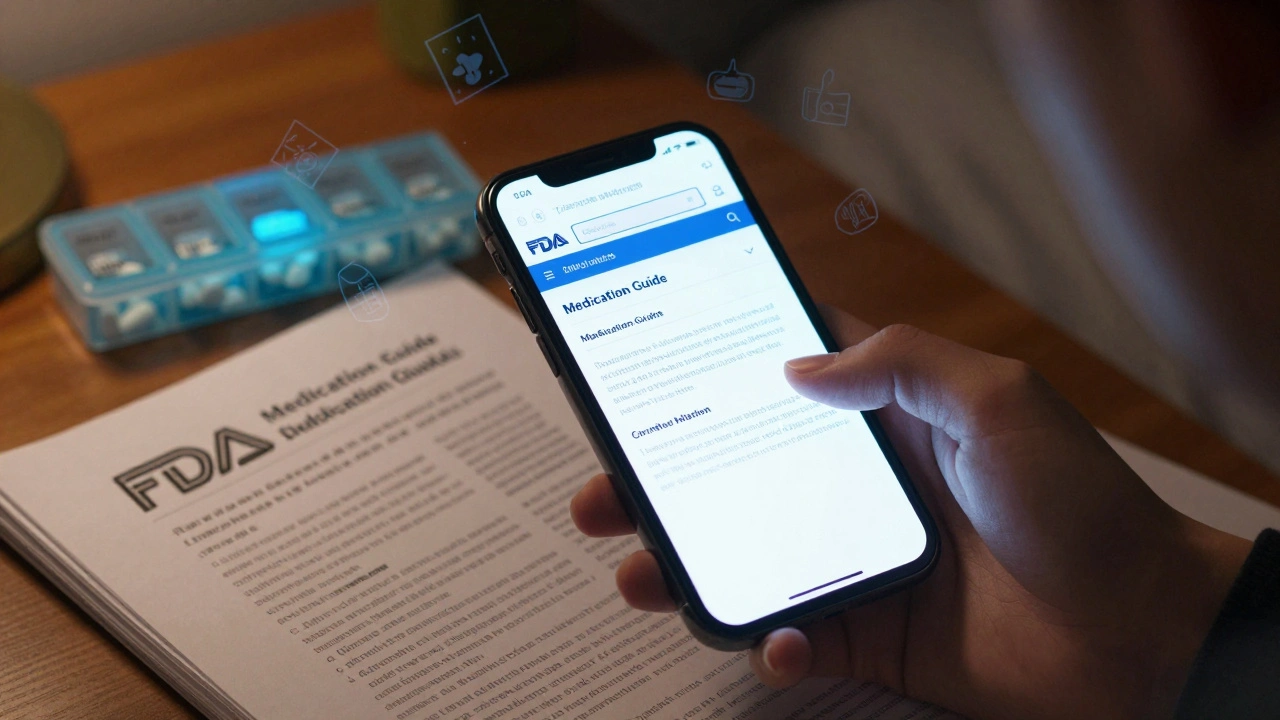
You don’t need to wait until you’re at the pharmacy. The FDA keeps a public, searchable database of all approved Medication Guides. Go to the FDA’s website and search for “Medication Guides” under the “Drugs” section. You can type in the brand name or generic name of your drug, and you’ll get the official, up-to-date version.This is especially helpful if you’re comparing drugs, if you’re traveling and want to review the guide ahead of time, or if you’re helping a family member understand their medication. You can print it, save it on your phone, or email it to your doctor.
Some drug manufacturers also post the guides on their own websites, but the FDA version is the only one that’s guaranteed to be current and approved. Always double-check that you’re looking at the FDA’s official copy.
What If Your Doctor Says You Don’t Need It?
Sometimes, your doctor might say, “You don’t need this guide,” or “I’ll explain it to you.” That’s fine-but it doesn’t override your rights. The FDA says patients have the right to receive the Medication Guide no matter what their doctor says. If you want it, you get it.This is especially true if your drug is part of a Risk Evaluation and Mitigation Strategy (REMS). REMS programs are extra safety steps the FDA puts in place for the riskiest drugs. For these, you often have to sign a form acknowledging you’ve received and reviewed the guide. Even if your doctor thinks you’re “fine,” the law still requires the guide to be given to you.
If your pharmacist refuses to give you the guide, ask to speak to the pharmacy manager. If they still say no, you can report it to the FDA through their MedWatch program. Patients who ask for their guides help keep the system accountable.
Why the System Is Changing
Right now, Medication Guides vary wildly in length, layout, and clarity. Some are two pages. Others are 15. Some use large fonts. Others are printed in tiny text. A 2012 study found that most of these guides didn’t meet basic readability standards-even though they were meant to help patients understand serious risks.The FDA is working on a fix called Patient Medication Information (PMI). The goal is to replace all current guides with one standardized, one-page document. It will have the same headings for every drug: what the drug is for, key safety info, side effects, how to take it, and what to avoid. All PMIs will be stored in a free, public FDA website, updated automatically, and accessible on any device.
This change won’t happen overnight. Drugs approved before 2013 have up to five years to switch. But eventually, every patient will get the same clear, consistent format-no more hunting through confusing booklets.
What You Can Do Today
You don’t need to wait for the system to improve. Here’s what you can do right now:- Always ask for the Medication Guide when you pick up a new prescription.
- If you’re unsure whether your drug requires one, search the FDA’s database.
- Ask for an electronic copy-you can keep it on your phone and share it with caregivers.
- Keep all guides in one place. Use a folder, a note app, or a pill organizer with a built-in reminder system.
- If you don’t understand something in the guide, write down your questions and bring them to your next appointment.
These guides aren’t just paperwork. They’re your right. And they’re designed to keep you safe when you’re taking a drug that could seriously harm you if used incorrectly. Don’t let confusion or silence stop you from getting the information you need.
James Kerr
December 2, 2025 AT 00:52Just asked for my guide today for my new blood thinner-pharmacist looked at me like I asked for a unicorn. Gave it to me after I said, ‘FDA says I’m entitled.’ Best 10 seconds of my week.
🙏
Gene Linetsky
December 3, 2025 AT 03:24Of course the FDA wants you to read the guide. Meanwhile, the drug companies are busy burying the real risks in 12-point font while they price-gouge you for the damn thing. This is all theater. They want you to think you’re ‘informed’ so you don’t sue them when your liver gives out.
They don’t care if you understand it-they just need you to sign the waiver.
Read the guide? Sure. But don’t trust it. Trust your gut. And your lawyer.
Archie singh
December 3, 2025 AT 15:18The FDA’s Medication Guides are a joke. Half of them are written by marketing interns who think ‘avoid alcohol’ counts as plain English. The language isn’t simple-it’s condescending. And the fact that you have to ASK for it? That’s not patient empowerment. That’s systemic negligence dressed up as compliance.
Meanwhile, I’ve read three guides this month. All of them contradict each other on dosage thresholds. Who’s the real authority here? The FDA? Or the pharma lawyers who edited the final draft?
Gavin Boyne
December 5, 2025 AT 10:20Let’s be real-these guides exist because someone died. Again. And again. And again. The FDA didn’t wake up one day and say, ‘Hey, let’s make patients smarter.’ No. Someone’s mom died from a drug interaction because no one told her not to drink grapefruit juice with her statin.
So now we have a 14-page booklet with bolded warnings and a tiny footnote about liver enzymes. It’s not about clarity-it’s about liability.
But hey, at least we’re not all dead yet. Progress?
Still, I keep mine in my wallet. Next to my insurance card and the receipt for my last ER visit.
Rashi Taliyan
December 5, 2025 AT 21:17I come from a family where doctors are gods and questions are rude. When I asked for my guide for my antidepressant, my aunt said, ‘Why would you read that? It will scare you.’ I cried in the parking lot. But I printed it anyway. Now I show it to my cousins who are on the same meds. Knowledge is not fear. It is power. And I will not be silent anymore.
Thank you for writing this. I needed to hear it.
Kara Bysterbusch
December 7, 2025 AT 05:08As someone who has navigated chronic illness for over a decade, I can say with absolute certainty that the Medication Guide is the single most underutilized patient advocacy tool in modern healthcare. The fact that it is not automatically included with every prescription-especially for high-risk medications-is not an oversight. It is a structural failure.
Moreover, the proposed PMI initiative, while promising, must be accompanied by mandatory patient education sessions in pharmacies-not just a printed sheet. Without context, even the clearest guide is just paper.
I have archived every guide I’ve ever received in a digital folder labeled ‘My Survival Toolkit.’ I recommend it to every patient I know.
Rashmin Patel
December 7, 2025 AT 21:29OMG I JUST REALIZED I’VE BEEN GETTING MY LITHIUM GUIDE FOR 6 YEARS BUT NEVER READ IT BECAUSE I THOUGHT IT WAS JUST LEGAL JARGON 😭
Went back to the pharmacy today and asked for it again-they were like ‘Oh you still take that?’ and I was like ‘YEAH AND I’M STILL ALIVE BECAUSE I’M LEARNING’
Now I’ve got it saved on my phone with a sticky note that says ‘DO NOT SKIP DOSE OR YOU WILL TURN INTO A HUMAN PAPERWEIGHT’
Also I printed it in BIG FONT and taped it to my fridge next to my cat’s vaccination card. We’re all learning here 🙌💊
sagar bhute
December 9, 2025 AT 04:16Pathetic. The FDA doesn’t protect patients. They protect the system. These guides are designed to make you feel safe so you don’t sue. The real dangers? Not listed. The real side effects? Buried in the appendix. The real cost? Your dignity. You think reading a pamphlet makes you empowered? You’re a pawn. The system wins either way-whether you take the drug or not.
And if you think your pharmacist cares? They’re paid by the hour. They don’t want to waste time on you.
Stop pretending this is healthcare. It’s insurance fraud with a side of paperwork.
Cindy Lopez
December 9, 2025 AT 23:53Grammar nitpick: ‘You have the right to get one every time you fill a prescription-even if the pharmacist doesn’t hand it to you.’ That em dash needs spaces.
Also, ‘FDA-required’ should be hyphenated in the title.
Otherwise, solid piece. I got my guide yesterday. Didn’t read it. Still won’t.
bobby chandra
December 10, 2025 AT 20:29Let me tell you something-I used to be the guy who tossed these guides in the trash. Thought I knew my body. Thought I knew my meds.
Then I had a seizure because I skipped a dose of my anti-epileptic and didn’t realize how fragile the balance was.
Now? I read every guide like it’s my last chance to live. I highlight, I annotate, I screenshot the warnings and send them to my sister.
These aren’t just papers. They’re lifelines written in plain English by people who’ve seen what happens when you don’t listen.
Don’t be the guy who throws it away. Be the guy who saves it.
Charles Moore
December 11, 2025 AT 12:50I’ve worked in community pharmacies in Ireland for 18 years. I can tell you-this isn’t just an American issue. Patients everywhere are too polite to ask. Too tired to read. Too scared to question.
I always hand out the guide with a smile and say, ‘This one’s for you. No rush. But when you’re ready, it’s here.’
Some take it. Some don’t. But I never stop offering.
Because sometimes, that little paper is the only thing standing between someone and a hospital bed.
Ignacio Pacheco
December 13, 2025 AT 10:23So let me get this straight-the FDA mandates a guide so you don’t die, but you have to ASK for it? And if you don’t know it exists, you’re just supposed to guess? That’s not a safety net. That’s a trapdoor with a sign that says ‘Ask nicely.’
Meanwhile, the drug companies are out here selling these meds like they’re candy. ‘Take one daily!’ No mention of the 12% chance your heart stops.
It’s not ignorance. It’s design.
Kidar Saleh
December 15, 2025 AT 06:09My mother was on warfarin for 11 years. She never asked for the guide. She trusted the doctor. She trusted the pharmacist. She died from a brain bleed because her INR spiked and no one told her to avoid cranberry juice.
I found the guide in her drawer two weeks later. Printed. Unopened.
I now print every guide I get. I read them aloud to my partner. I keep them in a binder labeled ‘Things That Almost Killed Us.’
Don’t wait until it’s too late to care.
vinoth kumar
December 16, 2025 AT 16:47Just got my guide for my new RA med. Took me 3 days to read it because I kept pausing to cry. Not because it scared me-because it made me feel seen. For once, someone wrote it like I’m a human, not a code in a database.
Went back to the pharmacy and asked if they had a digital version for my phone. They did. Sent it to my mom too.
Thank you for reminding me that I’m allowed to care about my own body.
That’s not weakness. That’s wisdom.
Gavin Boyne
December 16, 2025 AT 19:54And now that you’ve read the guide… what are you going to do with it?
Will you show it to your doctor when they prescribe a new drug? Will you hand it to your sister when she starts the same med? Will you post it on your fridge? Or will you file it under ‘Things I’ll Read Later’-right next to your gym membership and that book you bought in 2019?
Knowledge without action is just noise.
Be the person who acts. Not the one who just reads.