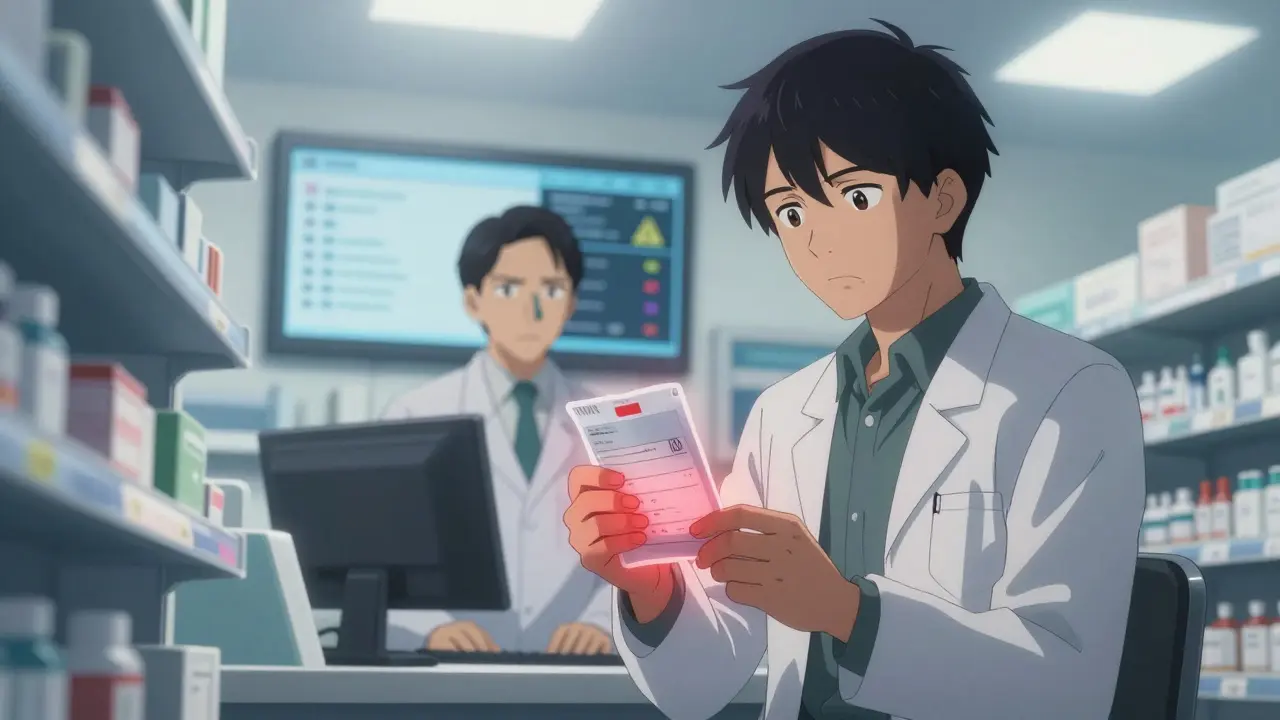
Imagine standing in line at your local pharmacy. You hand over your prescription, wait for the bag to be filled, and then reach for it. It feels routine, almost automatic. But what if that new medication clashes with an old one you’ve been taking for years? Or worse, what if it triggers a severe reaction to an allergy you forgot to mention-or perhaps one that was recorded incorrectly years ago?
This isn't just a hypothetical scare tactic. Adverse Drug Events (ADEs) are harmful reactions or side effects resulting from medical intervention. According to a 2022 study in JAMA Internal Medicine, these events account for approximately 6.7% of all hospital admissions. That is nearly one in fifteen people ending up in the hospital because of a medication issue that could have been caught right there at the counter.
The good news? The pharmacy pickup window is your final, most critical safety checkpoint. Pharmacists are trained to catch these errors, but they need your help. This guide explains how to actively participate in confirming allergies and interactions, ensuring you leave with medication that is safe for you.
Why the "Allergy List" Is Often Wrong
You might think your medical record is perfect. After all, it’s computerized, right? Unfortunately, digital health records often carry baggage from decades past. A significant problem in healthcare today is "allergy bloat." Patients are labeled as allergic to drugs like penicillin based on mild rashes or stomach upset from twenty years ago, not true life-threatening reactions.
Dr. Carla Davis, Director of Pediatric Allergy at Baylor College of Medicine, noted in a 2023 commentary that only 10-20% of patients labeled as penicillin-allergic actually have a true IgE-mediated allergy. The rest were mislabeled. Why does this matter at pickup? Because those false labels prevent doctors from prescribing the best, cheapest, and most effective antibiotics. Instead, you get second-line options that might be less effective or have different side effects.
Electronic Health Records (EHRs) are digital versions of patient charts that store medical history, diagnoses, medications, and allergies. While EHRs have reduced medication-related adverse events by 17.3% since 2010, they rely on accurate data entry. If the input is wrong, the output is dangerous. When you pick up your meds, don’t assume the system knows everything. Ask the pharmacist: "Is my allergy list up to date?"
The Hidden Dangers: Inactive Ingredients
Most people know to check for active ingredients-the part of the drug that cures the illness. But did you know you can be allergic to the inactive ingredients? These are the fillers, dyes, and binders that hold the pill together.
Pharmacy systems use different methods to check for conflicts. Some use National Drug Code (NDC) concept matching, which checks every ingredient including inactive ones. However, this method has a flaw: it generates a 12.7% false alert rate due to cross-reactivity with harmless inactive components like aspartame or certain food dyes. Other systems use drug name concept screening, which is more clinically relevant but can generate excessive alerts for common substances.
If you have sensitive skin or a history of hives, ask your pharmacist about the specific formulation. For example, if you are allergic to sulfites, some liquid suspensions contain them as preservatives, while tablets do not. Knowing the difference between an allergy to the *drug* and an allergy to the *delivery mechanism* can save you from unnecessary complications.
Understanding Drug-Drug Interactions
An interaction doesn't always mean two drugs will explode in your stomach. Sometimes, it means one drug makes the other too strong, or renders it useless.
Consider Warfarin, a common blood thinner. If you take it alongside certain antibiotics or even large amounts of green leafy vegetables, your INR levels (a measure of how long it takes your blood to clot) can swing wildly. At pickup, pharmacists run your new prescription against your existing medication list using databases like Lexicomp or Micromedex.
However, technology isn't perfect. A 2024 BMJ Quality & Safety study found that pharmacists override 68.4% of allergy alerts, sometimes missing potentially dangerous overrides due to "alert fatigue." They see so many warnings that important ones can get lost in the noise. This is where you come in. You are the expert on your own body. If you notice a new symptom after starting a combination of meds, speak up immediately.
Step-by-Step: What to Do at the Counter
To maximize safety during your next visit, follow these simple steps. Think of this as your personal quality control checklist.
- Bring Your Current Meds: Even if you think the pharmacy has your list, bring the actual bottles. Over-the-counter supplements, vitamins, and herbal remedies are often missed in electronic records but can cause serious interactions.
- Verify the Allergy Label: Look at the label on your bag. Does it say "Allergy Alert: Penicillin"? If you aren't sure why that’s there, ask. Don't be afraid to say, "I’m not sure if I’m truly allergic; can we double-check?"
- Ask About Inactive Ingredients: If you have sensitivities to dyes (like Red Dye #40) or gluten, explicitly state this. Ask, "Does this capsule contain any gluten-based fillers?"
- Confirm Timing: Interactions often depend on timing. Ask, "Should I take this with food, or away from my morning coffee?" Some drugs require an empty stomach to work, while others need fat to be absorbed.
- Request a "Teach-Back": Ask the pharmacist to explain what the drug does and what major side effects to watch for. If you can repeat it back correctly, you’re safer.
When Technology Fails: The Human Element
While systems like Epic and Cerner power 89.2% of U.S. hospitals, they struggle with nuance. For instance, current systems detect only 62.3% of monoclonal antibody cross-reactivities, according to a 2024 JAMA Dermatology study. Biologics are complex proteins, and their interaction profiles are still being mapped out.
If you are on specialty medications-such as immunosuppressants, chemotherapy agents, or biologic injections for autoimmune conditions-you need extra vigilance. Standard pharmacy software may not flag subtle interactions. In these cases, ask for a consultation with a specialist pharmacist. Many larger pharmacies have pharmacists who specialize in oncology, HIV/AIDS, or rare diseases. They have deeper knowledge than the generalist at the drive-thru window.
| Method | Pros | Cons | Best For |
|---|---|---|---|
| EHR Automated Check | Fast, covers major interactions | High false alert rate, misses OTC meds | Routine prescriptions |
| Pharmacist Interview | Catches nuances, updates outdated allergies | Takes time, relies on memory | New patients, complex histories |
| Patient Self-Disclosure | Includes supplements, lifestyle factors | May forget details, lacks clinical context | All visits |
Red Flags to Watch For
After you take your medication home, stay alert. Certain signs indicate an interaction or allergic reaction that requires immediate attention:
- Sudden Rash or Hives: Especially if accompanied by itching or swelling of the lips/tongue.
- Dizziness or Fainting: Could indicate a drop in blood pressure due to an interaction.
- Unexplained Bleeding: Bruising easily or bleeding gums can signal a blood thinner interaction.
- Gastrointestinal Distress: Severe nausea, vomiting, or diarrhea that starts shortly after beginning a new med.
If you experience any of these, call your pharmacist first. They can often triage whether you need to stop the med immediately or go to the ER. They are your closest medical resource.
The Future of Safety: AI and Better Data
We are moving toward a smarter future. Google Health’s 2024 pilot program used AI to analyze clinical notes for undocumented allergies, reducing missed allergies by 31.7%. By October 2024, new CMS rules will penalize facilities with high allergy alert override rates, forcing better system optimization.
But until AI reads your mind, you remain the primary safeguard. The FDA’s 2024 Drug Allergy Communication Initiative aims to standardize how allergies are documented, but implementation takes time. Until then, your voice at the pickup counter is the most powerful tool in preventing dispensing errors.
What should I do if I think my allergy list is wrong?
Do not ignore it. Inform your pharmacist at pickup and request that they note your concern in the system. Ideally, schedule an appointment with an allergist for skin testing. Mislabeling yourself as allergic to penicillin, for example, limits your treatment options unnecessarily. Only 10-20% of people labeled as penicillin-allergic truly have a life-threatening allergy.
Can over-the-counter supplements cause drug interactions?
Yes, absolutely. Supplements like St. John’s Wort, Vitamin K, and garlic can significantly interact with prescription drugs such as blood thinners, antidepressants, and birth control. Always disclose every supplement you take to your pharmacist, even if you bought it at a grocery store.
Why do pharmacists sometimes ignore allergy alerts?
This is known as "alert fatigue." Systems generate thousands of low-risk warnings (e.g., minor dye sensitivities), causing pharmacists to override 68.4% of alerts. While this speeds up workflow, it carries a risk. That’s why human verification and clear communication from the patient are essential to cut through the noise.
How can I tell if I’m having a drug interaction?
Signs include sudden changes in how your regular meds work (e.g., blood pressure spikes), new symptoms like rash, dizziness, or gastrointestinal issues, or unexpected side effects. If you feel different after starting a new medication, contact your pharmacist immediately.
Is it safe to switch pharmacies frequently?
It can complicate safety. Different pharmacies may not share real-time data instantly, leading to gaps in your medication history. Try to consolidate your prescriptions at one pharmacy so the pharmacist has a complete view of your regimen, enabling better interaction checking.
Jeremiah Cassandra
May 15, 2026 AT 20:29Oh, look at that. Another guide telling us to actually read the label and talk to the person handing us our poison 💊. Groundbreaking stuff. I mean, who knew that pharmacists might not have your entire medical history memorized down to the last vitamin gummy you ate in 1998? 🙄 But seriously, this is solid advice wrapped in a lot of 'duh' moments. The part about 'allergy bloat' is spot on though. I had a rash from penicillin once because I was sick and sweating, not because my immune system went full Godzilla on me. Now I’m stuck on these weird antibiotics that make me feel like I’m vibrating. Thanks, healthcare system. 🤷♂️
Warren Brewer
May 17, 2026 AT 10:22I really liked how simple this explanation was. It makes sense to just bring your bottles with you. Sometimes we forget that the computer does not know everything. We should always ask questions if we are unsure. It helps keep us safe. Thank you for sharing this easy to read guide.
charles robert
May 19, 2026 AT 02:03The illusion of safety is a fragile construct built upon the shifting sands of digital error and human fallibility. We trust the machine, yet the machine is blind to the nuances of our biological existence. It is a tragedy of modernity that we outsource our survival to algorithms that suffer from alert fatigue. 😔 The pharmacist is merely a gatekeeper in a system designed to fail us through omission. We are all just waiting for the other shoe to drop, or rather, for the wrong pill to be dispensed. 🌑
Mollie Louise
May 20, 2026 AT 07:54This is such an incredibly important topic that we often overlook in our busy lives! 🌟 I cannot stress enough how vital it is to take that extra minute at the counter to verify everything. I remember when I started a new medication for my anxiety, and I didn't mention that I was taking a herbal supplement for sleep. The interaction caused me to feel terrible for weeks, and I had no idea why! 😱 It is so empowering to know that we have a voice in our own healthcare journey. Please, everyone, do not be shy about asking those questions! Your health is worth it! 💪✨
Mark Ronson
May 21, 2026 AT 05:13As someone who works in pharmacy support, i can confirm this is very true. We try our best but sometimes the systems are confusing. It helps when patients bring their old bottles. It reduces errors. I hope more people read this. Safety is key. 👍
Mikey Mann
May 21, 2026 AT 10:57There is a profound wisdom in the act of verification. It is not just about checking boxes; it is about asserting agency over one's own well-being. When we engage with the pharmacist, we create a dialogue that transcends the transactional nature of the pickup window. It is a moment of shared responsibility. We must embrace this opportunity to connect and ensure clarity. Life is too short for preventable errors. Let us be the guardians of our own health. 🌿
Christina Moran
May 22, 2026 AT 22:26i never thought about inactive ingredients before. that sounds scary. i am allergic to some dyes so i will definitely ask next time. thanks for the info!
mardy duffy
May 24, 2026 AT 04:50Boring.