
Trying to refill your prescription while abroad isn’t as simple as walking into a local pharmacy. If you’re traveling from the U.S. to Europe, Canada, or even China, you might hit a wall-no matter how clear your doctor’s note is. The truth? Prescription transfer between countries doesn’t work like swapping pharmacies down the street. Each country has its own rules, and most don’t recognize foreign prescriptions at all. But that doesn’t mean you’re stuck. With the right prep, you can keep your meds flowing without legal trouble or health risk.
Why You Can’t Just Transfer a Prescription Like in the U.S.
In the United States, your pharmacy can electronically transfer a prescription to another U.S. pharmacy under DEA rules that took effect in August 2023. But those rules only apply within the country. International transfers? Not allowed. The DEA doesn’t regulate foreign pharmacies. The FDA bans importing prescription drugs for personal use-except in rare cases. And Canadian, UK, or Australian pharmacists won’t fill a U.S. prescription unless it’s been reviewed and re-issued by a local doctor.This isn’t about bureaucracy for bureaucracy’s sake. Countries have different drug safety standards, brand names, and controlled substance laws. A pill called Adderall in the U.S. might be called Dexamphetamine in Australia. A medication approved in the EU might be banned in Japan. Pharmacists aren’t allowed to guess what’s safe-they need local authorization.
How It Works in the European Union (The Exception)
If you’re traveling within the EU, you’re in the only region with a real cross-border prescription system. A prescription written in Germany can be filled in Italy, Spain, or Poland-*if* the medication is available under its common (generic) name. You’ll need the original paper or electronic prescription with:- The generic drug name (not brand like "Lipitor"-use "atorvastatin")
- Dosage, quantity, and instructions
- Doctor’s signature and contact info
Pharmacies across the EU are trained to recognize these. But don’t assume it’s foolproof. Some countries stock fewer versions of a drug. If your U.S. doctor prescribed a brand-name inhaler not sold in France, you’ll need an alternative. Always call ahead or use the EU e-Prescription Portal to check availability before you go.
Transferring to Canada: The Cosigning Process
Canada doesn’t accept U.S. prescriptions. Not even close. But there’s a workaround: cosigning. Here’s how it works:- Get a copy of your original U.S. prescription and a signed letter from your doctor explaining your condition and why you need the medication.
- Contact a Canadian pharmacy that works with PharmacyChecker or similar services. They’ll review your file.
- The pharmacy sends your records to a Canadian physician who reviews your history and writes a new Canadian prescription.
- You pay for the new prescription (typically $50-$100) and the medication.
This isn’t a transfer-it’s a reissue. But it’s the only legal way. U.S. pharmacies won’t send your prescription directly to Canada. In fact, most refuse even if you explain the process. One Reddit user reported being told by a Walgreens pharmacist: "We don’t do that. It’s against policy." Don’t waste time arguing. Go straight to a Canadian pharmacy that handles this.
What About the U.S.? Can You Bring Medication Back?
U.S. law (21 U.S. Code § 384) technically bans importing prescription drugs. But the FDA doesn’t stop every traveler. They use enforcement discretion. Here’s what’s allowed:- Up to a 90-day supply of medication for personal use
- Medication must be for a condition you already have
- Must be in original packaging with your name on it
- Must be accompanied by a valid prescription or doctor’s note
CBP officers have discretion. If you’re flying in with a 3-month supply of blood pressure pills in the original bottle, you’re fine. If you’re shipping 6 months of antidepressants from Mexico, you might get flagged. The key is to look like a traveler, not a supplier.
Challenges in the Middle East, Asia, and Beyond
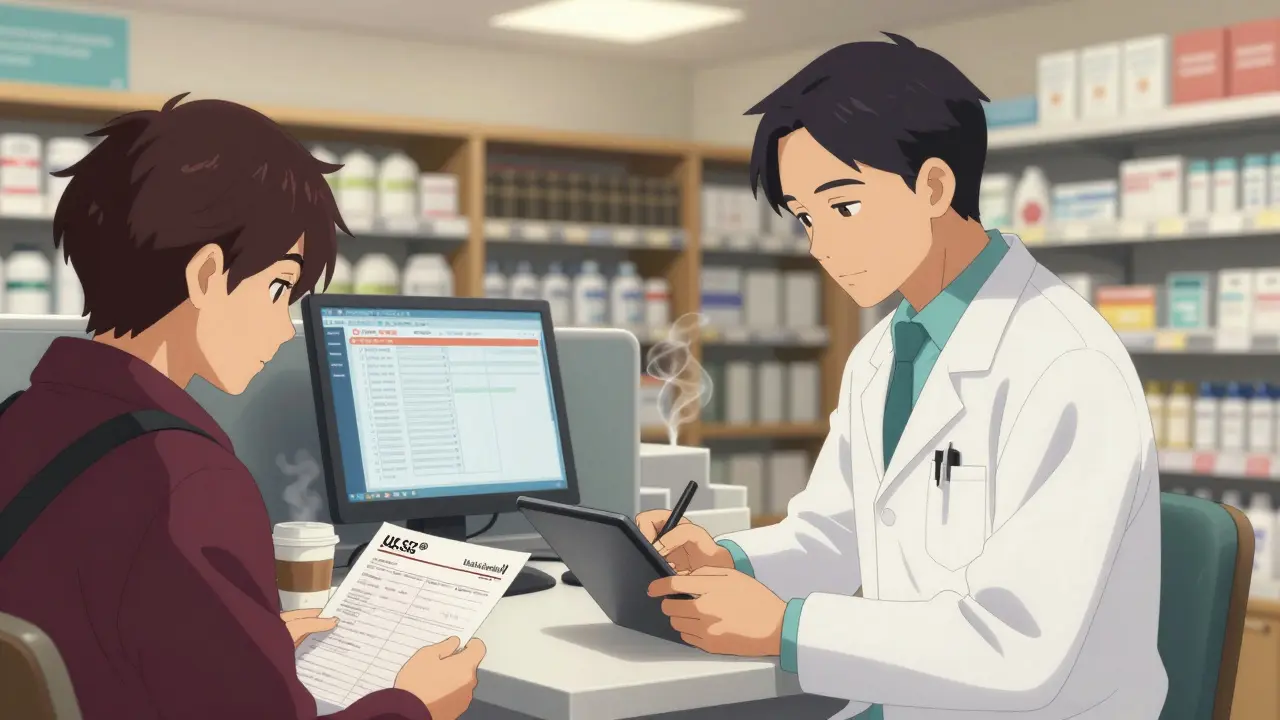
Countries like China, Saudi Arabia, and the UAE have stricter rules. Some require:- A letter from your doctor on official letterhead, translated into the local language
- Explicit diagnosis statement (e.g., "Type 2 Diabetes")
- Proof the medication is not banned locally
For example, melatonin is a dietary supplement in the U.S. but a controlled drug in the UAE. ADHD medications like Adderall are illegal in many Asian countries without special permits. Always check your destination’s list of banned or restricted drugs before you pack. The MedAire database tracks this for travelers and is updated quarterly.
What to Pack: The Traveler’s Prescription Checklist
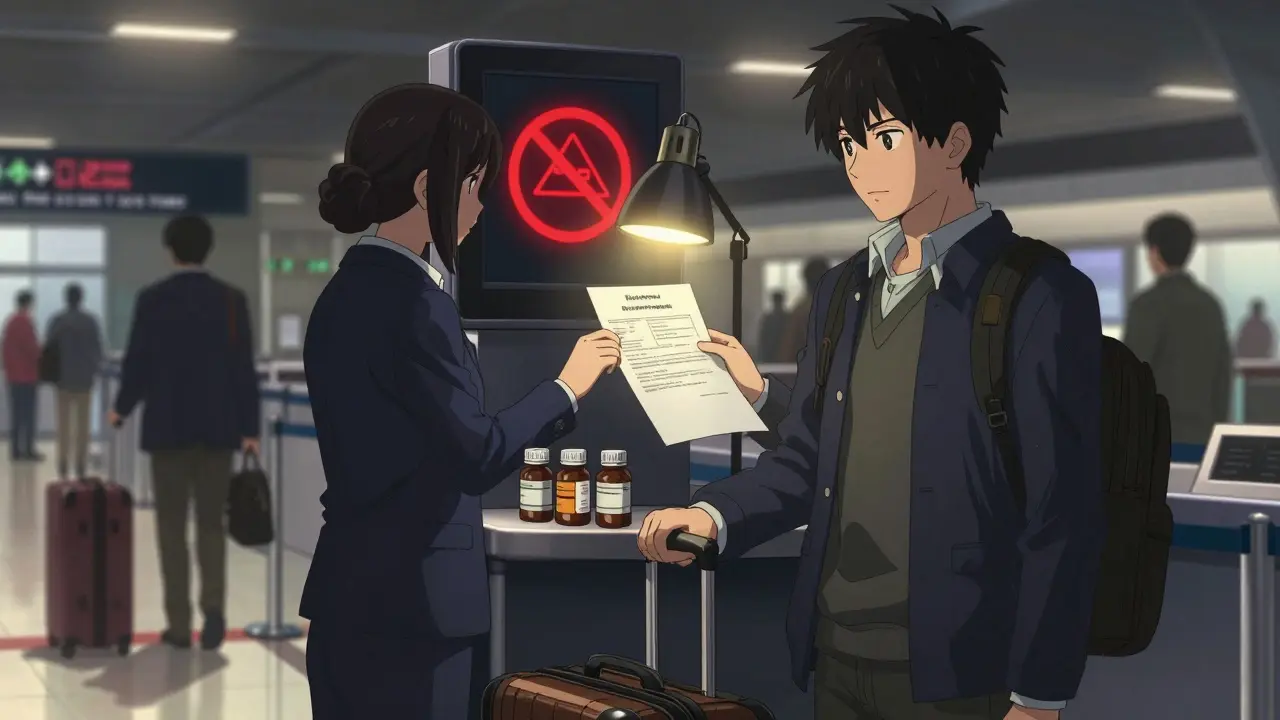
Don’t rely on memory. Before you leave, prepare this packet:- Original prescription(s) with doctor’s signature
- Letter from your doctor: state your diagnosis, medication name (generic), dosage, and reason for travel
- Copy of your medical history (list of conditions and allergies)
- Pharmacy contact info from home (in case they need to verify)
- Medication in original bottles with labels intact
- Extra supply (at least 2 weeks beyond your trip-just in case)
Keep this in your carry-on. Never check it. If your bag gets lost, you still have access to your meds and documentation.
What to Do If You Run Out
If you lose your meds or they’re stolen abroad:- Go to a local hospital or clinic. Show your documentation.
- Ask for an emergency prescription using the generic drug name.
- Call your home pharmacy-they may be able to fax or email your prescription to a local provider (rare, but sometimes works in the EU).
- Use services like PharmacyChecker to find verified international pharmacies that can help.
Don’t try to buy medication off the street. Counterfeit drugs are a real danger-especially in countries with weak regulation. The WHO estimates 1 in 10 medical products in low-income countries are substandard or fake.
How Far in Advance Should You Plan?
For EU travel: 1-2 weeks to confirm availability. For Canada: 3-4 weeks to complete cosigning. For Asia, Middle East, or restricted countries: 4-6 weeks. You may need to apply for import permits or get translations certified.Don’t wait until you’re at the airport. One traveler told a reporter she flew back to Canada twice because her U.S. pharmacy refused to transfer her insulin prescription. That’s avoidable.
Who Can Help?
You’re not alone. A few organizations specialize in this:- PharmacyChecker: Connects U.S. patients with Canadian pharmacies for cosigning. Charges a fee, but saves hours of frustration.
- MedAire: Offers travel medication consultations ($150) and a database of country-specific drug rules.
- U.S. Embassy/Consulate: Can help locate local doctors or pharmacies if you’re in distress abroad.
Most U.S. pharmacies won’t help you. Don’t waste your time asking. Go straight to the solution.
What’s Changing? What’s Not
The DEA’s 2023 rule made domestic electronic transfers easier-but explicitly excluded international transfers. The FDA still bans personal importation, even though they rarely enforce it. The EU is improving cross-border access within its bloc, but won’t extend it outside. No global system is coming soon.Experts agree: the system is broken for frequent travelers, military families, and expats. But until countries align their drug laws, the burden falls on you. Plan ahead. Document everything. Know the rules.
Can I transfer my U.S. prescription to a pharmacy in another country?
No, U.S. pharmacies cannot legally transfer prescriptions to foreign pharmacies. The DEA’s 2023 rule only applies within the United States. For countries like Canada, you must go through a "cosigning" process where a local doctor issues a new prescription based on your U.S. records. In the EU, you can use your original prescription if it includes the generic drug name, but it’s not a transfer-it’s direct dispensing under mutual recognition rules.
Is it legal to bring prescription meds from another country into the U.S.?
It’s technically illegal under U.S. federal law, but the FDA allows enforcement discretion for a 90-day personal supply if it’s for a condition you already have, in original packaging, and accompanied by a prescription. You won’t be stopped for a 3-month supply of blood pressure pills-but you could be flagged if you’re shipping large quantities or bringing controlled substances like opioids without proper documentation.
What if my medication has a different name abroad?
Always use the generic (common) name, not the brand name. For example, "Lipitor" is "atorvastatin," and "Adderall" is "dextroamphetamine/amphetamine." Pharmacists abroad may not recognize brand names. Your doctor’s letter should include both the brand and generic name to avoid confusion.
Can I get my prescription filled in the UK if I’m from the U.S.?
The UK does not accept U.S. prescriptions. You’ll need to see a local GP (general practitioner) and get a new prescription. Bring your original prescription, doctor’s letter, and medical records to speed up the process. The NHS may charge you a fee for the consultation and prescription unless you’re a resident.
Are there any countries where I can easily refill my prescription?
Yes-within the European Union, you can usually refill your prescription if you have the original and the generic drug name is listed. Some countries like Mexico and Thailand have lower-cost medications and may fill U.S. prescriptions informally, but this carries legal and safety risks. Always check local laws and avoid unlicensed pharmacies.
Courtney Carra
January 19, 2026 AT 19:05I’ve had to do this twice now-once in Germany, once in Thailand. The key? Always carry the generic name, not the brand. Lipitor? Say atorvastatin. Adderall? Dextroamphetamine. If you don’t, you’re just wasting time staring at confused pharmacists. 🙃
thomas wall
January 21, 2026 AT 15:50This article is dangerously simplistic. The notion that one can casually import pharmaceuticals under 'enforcement discretion' is not only legally misleading-it is ethically irresponsible. Medications are not souvenirs. The FDA’s tolerance does not equate to permission, and to suggest otherwise is to endanger public health. There are systems in place for a reason.
Shane McGriff
January 22, 2026 AT 03:36Really appreciate this breakdown. I’ve been in your shoes-stuck in Lisbon with no insulin, no local docs who understood my script. What saved me? Calling my U.S. pharmacy first. They faxed my prescription to a local clinic. Didn’t work everywhere, but it worked there. Also, always carry a printed copy of your med list. Not just the script-everything. I keep mine in a plastic sleeve in my wallet. Lifesaver.
And yeah, the EU thing? It’s real. But only if you spell the generic right. I once got handed metformin instead of glimepiride because I said 'Diabeta' instead of the generic. Rookie mistake. Learned the hard way.
Don’t wait till you’re in the airport. Plan like your life depends on it-because it does.
Jacob Cathro
January 23, 2026 AT 19:17LMAO this whole guide is just ‘do your research’ but phrased like a corporate whitepaper. Nobody cares about the EU e-Prescription Portal. The real answer? Just bring extra. Always. I flew to Japan with 6 months of my ADHD med. Didn’t tell anyone. Didn’t get questioned. Got through customs like a boss. If they ask? Say it’s for ‘migraines.’ Works every time. 😎
Also, ‘cosigning’? That’s just a fancy word for ‘pay $80 to some random Canadian doctor you’ve never met.’ Don’t fall for the hustle.
Paul Barnes
January 25, 2026 AT 01:28There is a factual error in the section regarding U.S. importation limits. 21 U.S.C. § 384 does not govern personal importation; that authority resides under 21 C.F.R. § 1307.11 and FDA’s Compliance Policy Guide Sec. 400.400. The 90-day supply guideline is discretionary, not statutory. Misrepresenting regulatory frameworks as law undermines credibility. Correction is warranted.
Manoj Kumar Billigunta
January 26, 2026 AT 20:05This is so helpful. I’m from India and I travel often for work. Last year, I needed my blood pressure pills in Dubai. I called my doctor, got the letter, printed it in English and Hindi. Took the original bottle. Walked into a pharmacy, showed everything. They filled it without hassle. No drama. Just clarity. If you treat it like a routine, they treat it like a routine. Simple.
And please-don’t buy meds off the street. I saw a guy in Bangkok trying to buy insulin from a guy on the sidewalk. He ended up in the hospital. Don’t be that guy.
kumar kc
January 27, 2026 AT 03:37Don’t trust the EU. They’ll still deny you if your drug is not on their formulary. I tried in Spain. Got rejected. No exceptions.
Thomas Varner
January 28, 2026 AT 06:36Okay, so… I just brought my 90-day supply of Lexapro from the U.S. to Portugal last month. No issues. Zero questions. No one even looked at the bottle. I put it in my carry-on, next to my toothpaste. The whole thing felt… weirdly easy? Like, why is everyone making this so complicated? Maybe it’s just luck? Or maybe the system’s broken? Either way, I’m not complaining.
Art Gar
January 28, 2026 AT 22:30The normalization of pharmaceutical arbitrage under the guise of ‘personal use’ is a regulatory failure of monumental proportions. The erosion of national pharmacopeias in favor of consumer convenience constitutes a systemic degradation of public health infrastructure. This article, while practically oriented, implicitly encourages the commodification of medicine, which is antithetical to the principle of equitable access. The real solution lies in harmonization-not circumvention.
Nadia Watson
January 29, 2026 AT 13:12I’m a nurse who travels to Japan every year for work. I’ve had to get my asthma inhaler refilled there twice. The trick? Get your doctor to write the generic name in Japanese. Not just translate it-have it professionally written. The pharmacist at Tokyo Medical Center recognized it immediately. They even gave me a pamphlet in English about local alternatives. So much better than the stress I expected.
Also, always bring your insurance card. Sometimes they’ll ask for it-even if you’re paying out of pocket. Weird, but true.
Andy Thompson
January 30, 2026 AT 22:50THEY’RE LYING TO YOU. The FDA doesn’t ‘allow’ 90-day supplies-you’re just lucky they don’t care. The real reason you’re not stopped? Because they’re overwhelmed. They don’t have time to chase every tourist with Zoloft. But if you’re a veteran? Or a diabetic? Or a person of color? Suddenly you’re ‘suspicious.’ Don’t be naive. This system is rigged. They let some people through and stop others. It’s not about rules-it’s about who they think you are.
Also, if you’re bringing Adderall? You’re playing Russian roulette. I know a guy who got deported from Singapore for it. He had a script. Didn’t matter. They don’t care. 🚨
Edith Brederode
February 1, 2026 AT 09:03This is so helpful-I’ve been nervous about traveling with my thyroid med. I’m going to Italy next month and just printed out the generic name, my doctor’s letter, and the EU e-Prescription link. I’m keeping it all in a little folder with my passport. Feels way less scary now. Thank you for writing this.
Emily Leigh
February 1, 2026 AT 19:26Okay, but… what if you’re just lazy? Like, what if you don’t want to call your doctor, pay $100 to some Canadian guy, or learn the EU system? What if you just… fly to Mexico and buy your pills for $5? I did it. It worked. No one asked. The pharmacy in Tijuana gave me a lollipop. I’m alive. So… is this article just for people who enjoy bureaucracy? 🤷♀️