
Why Your Medication Routine Falls Apart During Big Life Changes
It’s not weakness. It’s not laziness. It’s biology, psychology, and chaos all hitting at once. When you move cities, start a new job, go through a breakup, or lose a loved one, your brain doesn’t have room for pill schedules. The same routine that worked fine last month suddenly feels impossible. And that’s when you skip a dose. Or two. Or a whole week.
Research shows that during major life transitions, medication adherence drops by an average of 32%. In some cases, it plummets 40% within the first two weeks. That’s not rare. That’s normal. The problem isn’t you - it’s that most health systems treat adherence like a static task, not a dynamic one. They give you a pill organizer and assume you’ll keep using it, even when your life is being rewired.
The good news? You don’t need to be perfect. You just need to adapt.
Stop Fighting Your Routine - Build a Flexible One
Rigid schedules fail during transitions. If your medication used to be tied to breakfast, and now you’re working night shifts or eating takeout in a hotel room, that schedule is dead. Don’t mourn it. Replace it.
Find your three to five daily anchors - small, non-negotiable habits that stay the same no matter what. For most people, these are: waking up, brushing teeth, going to bed, drinking your first glass of water, or checking your phone in the morning. Tie your medication to one of those. Not “at 8 a.m.” but “after I brush my teeth.” Not “before dinner” but “when I sit down to watch my favorite show.”
A 2022 study from the Greater Boston Behavioral Health Institute found that people who used flexible anchors - not fixed times - improved adherence by 31.4% during transitions. Why? Because your brain remembers actions, not clocks. Anchor your health to something you already do, and your body learns the new pattern without extra effort.
Control What You Can - Ignore the Rest
During transitions, stress spikes because you feel out of control. You can’t control your boss’s schedule, your landlord’s repair timeline, or your ex’s text messages. But you can control how you respond to them - especially when it comes to your health.
Write down three lists:
- Things you can control directly: When you take your pill, where you store it, who you tell about your regimen, whether you refill early.
- Things you can influence: Asking your doctor for a longer prescription, setting up automatic refills, choosing a pharmacy near your new apartment.
- Things outside your control: Traffic delays, power outages, your partner forgetting to remind you, your insurance changing coverage.
Now, here’s the key: spend zero energy on the third list. That’s where your willpower goes to die. Redirect that energy to the first two. A 2023 analysis from Supportive Care found that people who did this improved medication adherence by 22.7%. It’s not magic. It’s focus.
Use Technology - But Only the Right Kind
Most medication apps are useless during transitions. They beep at you at 9 a.m. - but what if you’re on a plane? What if you’re sleeping in a different time zone? The app doesn’t adapt. It just keeps nagging.
Look for tools designed for change. Apps like TransitionAdhere and LifeShiftRx let you map your medication to life events, not times. You can say: “Take this pill when I land,” or “Take this after my first meeting at the new office.” They use location, calendar triggers, and behavior-based prompts - not just alarms.
And here’s the data: during stable periods, reminder apps improve adherence by 22.8%. During transitions? That drops to 8.3%. But transition-specific apps? They still hit 20%+ gains. Why? Because they respect chaos. They don’t demand perfection - they adjust to it.

Get Support - Don’t Wait to Be Asked
Most people don’t tell their doctors about upcoming transitions. They assume it’s not relevant. It is. A 2023 statement from the American College of Physicians says doctors should be asking: “Are you going through any big changes in the next 60 days?”
But if your doctor doesn’t ask - ask them. Say: “I’m moving next month. I’m worried I’ll mess up my meds. Can we make a plan?”
And don’t stop there. Tell one trusted person - a friend, sibling, coworker - what your meds are and when you take them. Give them a simple script: “If I don’t check in by Thursday, send me a text.”
Studies show that people with even one supportive person see a 34.2% boost in adherence during stressful times. Why? Because social pressure is a powerful motivator. And loneliness? It’s the silent killer of health routines.
Therapy Isn’t Just for Mental Health - It’s for Medication Survival
Acceptance and Commitment Therapy (ACT) isn’t just for anxiety or depression. It’s a survival tool for medication adherence during chaos.
ACT teaches you to accept that your routine will change - and still stick to your values. Instead of saying, “I failed because I missed my pill,” you say, “I’m still someone who takes care of my health, even if today looks different.”
A 2022 JAMA Internal Medicine trial found that ACT improved adherence by 48.6% compared to standard care during life transitions. That’s nearly double the improvement of reminder apps. The reason? ACT doesn’t fight the disruption. It teaches you to carry your health with you, no matter where you are.
You don’t need a therapist to start. Try this: When you miss a dose, write down three things: What happened? How did you feel? What’s one small step you can take now? No judgment. Just observation. That’s ACT in action.
Break It Down - Tiny Steps Beat Big Goals
Trying to “get back on track” feels overwhelming. So you don’t try. That’s why breaking your regimen into micro-steps works.
Instead of “take my blood pressure meds,” try:
- Open the pill bottle.
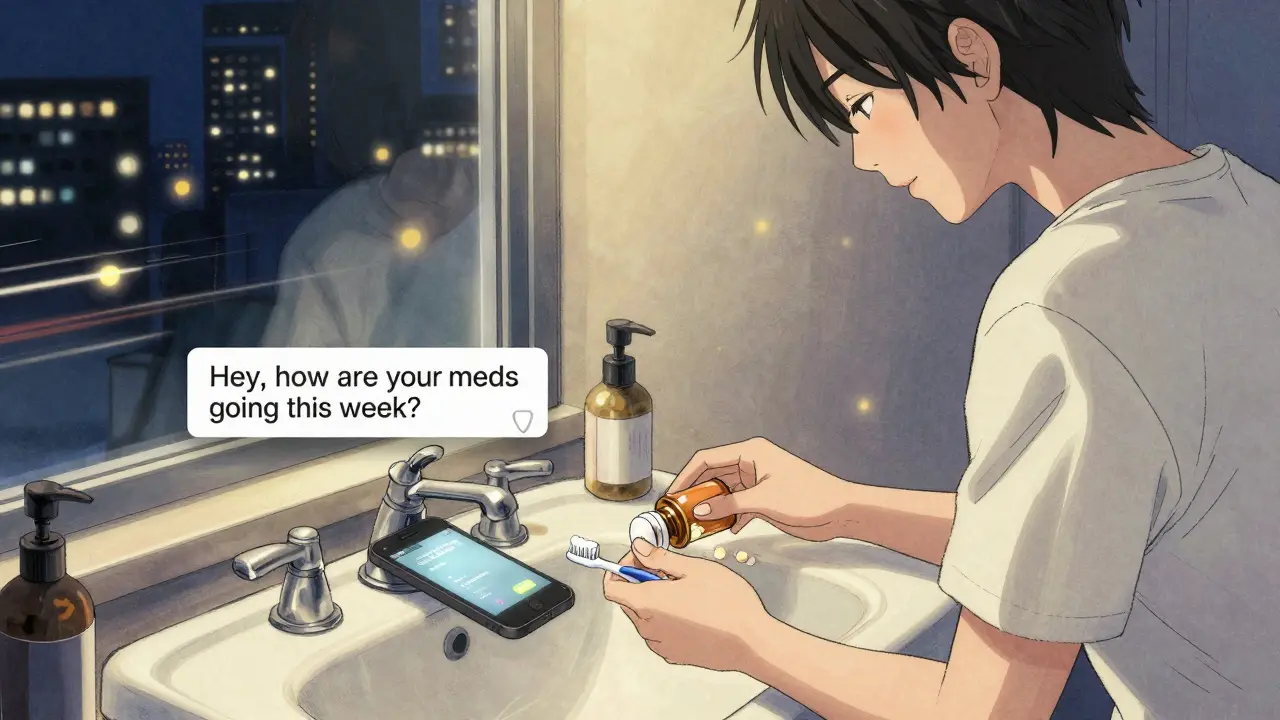
- Place it next to my toothbrush.
- Take it after I brush.
Each step is so small it feels impossible to fail. And when you do it, your brain registers success - not failure. This is how habits stick during chaos.
One user on Reddit, u/MedAdherenceWarrior, shared how they improved adherence from 62% to 94% after their job changed. Their secret? They didn’t fix their whole routine. They just moved their pill bottle from the kitchen to the bathroom. One tiny shift. One big win.
Learn to Say No - Protect Your Health Like a Boundary
During transitions, people pile on demands. New job? You’re expected to work late. Moving? Everyone wants you to help pack. Divorce? Friends want to talk for hours.
But your health isn’t optional. If taking your meds requires 10 minutes of quiet time before bed - protect that. Say no to extra commitments. Say no to guilt. Say no to “just this once.”
Research shows people who successfully maintain adherence during transitions are 3.2 times more likely to say “no” to non-essential things. That’s not selfish. That’s survival. Your body needs consistency. Your mind needs safety. Protect both.
What to Do Right Now - Your 3-Step Action Plan
You don’t need to overhaul your life. Start small. Today.
- Identify one anchor: What’s one thing you do every day, no matter what? Tie your medication to it.
- Choose one tool: Download a transition-friendly app like LifeShiftRx, or just write your new plan on a sticky note and put it on your mirror.
- Tell one person: Text someone: “Hey, I’m going through a big change. My meds are important. Can you check in with me next week?”
That’s it. No grand promises. No perfection. Just three small steps that build momentum.
It’s Not About Willpower - It’s About Design
Medication adherence during transitions isn’t about being strong. It’s about being smart. It’s about designing a system that works with your life, not against it.
When you stop trying to control everything and start adapting to change, you stop fighting yourself. And that’s when your health finally gets a chance to heal - not just survive.
Why do I keep forgetting my meds during big life changes?
It’s not laziness - it’s cognitive overload. During transitions, your brain is busy processing new environments, emotions, and routines. Medication adherence requires executive function, which gets drained under stress. Your brain prioritizes survival over schedules. That’s why flexible, anchor-based systems work better than alarms or pill organizers.
Should I talk to my doctor before a big change?
Yes - and don’t wait for them to ask. Say: “I’m moving/starting a new job/getting divorced next month. I’m worried about keeping up with my meds. Can we make a plan?” Many doctors now screen for transitions. If yours doesn’t, you’re not being difficult - you’re being proactive. This can prevent hospital readmissions and keep your treatment on track.
Are medication apps helpful during transitions?
Standard reminder apps? Not really. They work when life is stable, but fail when it’s chaotic. Transition-specific apps like LifeShiftRx or TransitionAdhere are different. They let you link doses to events - “take after landing,” “take after first meeting” - not times. These apps see 20%+ adherence gains during transitions, while regular apps drop to under 10%.
What if I miss a dose? Should I just double up next time?
Never double up unless your doctor says so. Instead, write down what happened, how you felt, and what one small step you can take now. Did you forget because you were traveling? Next time, keep a travel pack ready. Did you feel overwhelmed? Tell someone. Missing a dose isn’t failure - it’s data. Use it to improve your system, not punish yourself.
How long does it take to build a new adherence routine during a transition?
It takes 2-3 weeks to form a new habit, even during change. But you don’t need to be perfect from day one. Focus on consistency, not perfection. One successful dose a day builds momentum. After 10 days, you’ll notice you’re doing it automatically. The goal isn’t to get back to your old routine - it’s to build a new one that fits your new life.

Mark Alan
January 28, 2026 AT 09:55Phil Davis
January 30, 2026 AT 04:30Bryan Fracchia
January 30, 2026 AT 10:08fiona vaz
January 30, 2026 AT 22:42Colin Pierce
January 31, 2026 AT 00:09Ambrose Curtis
February 1, 2026 AT 07:10jonathan soba
February 1, 2026 AT 09:55matthew martin
February 2, 2026 AT 18:29Irebami Soyinka
February 2, 2026 AT 21:50doug b
February 3, 2026 AT 11:08Mel MJPS
February 5, 2026 AT 07:19Katie Mccreary
February 6, 2026 AT 03:52SRI GUNTORO
February 7, 2026 AT 08:15Kathy Scaman
February 8, 2026 AT 13:48Mark Alan
February 8, 2026 AT 21:29