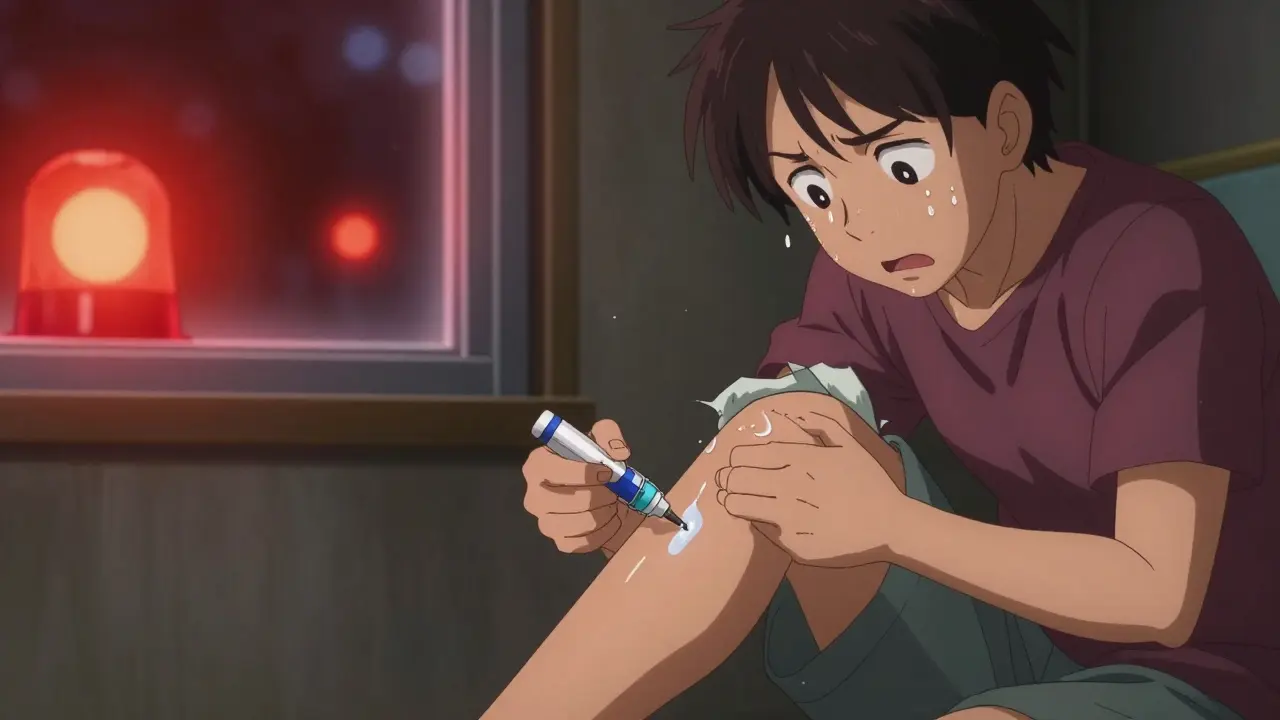
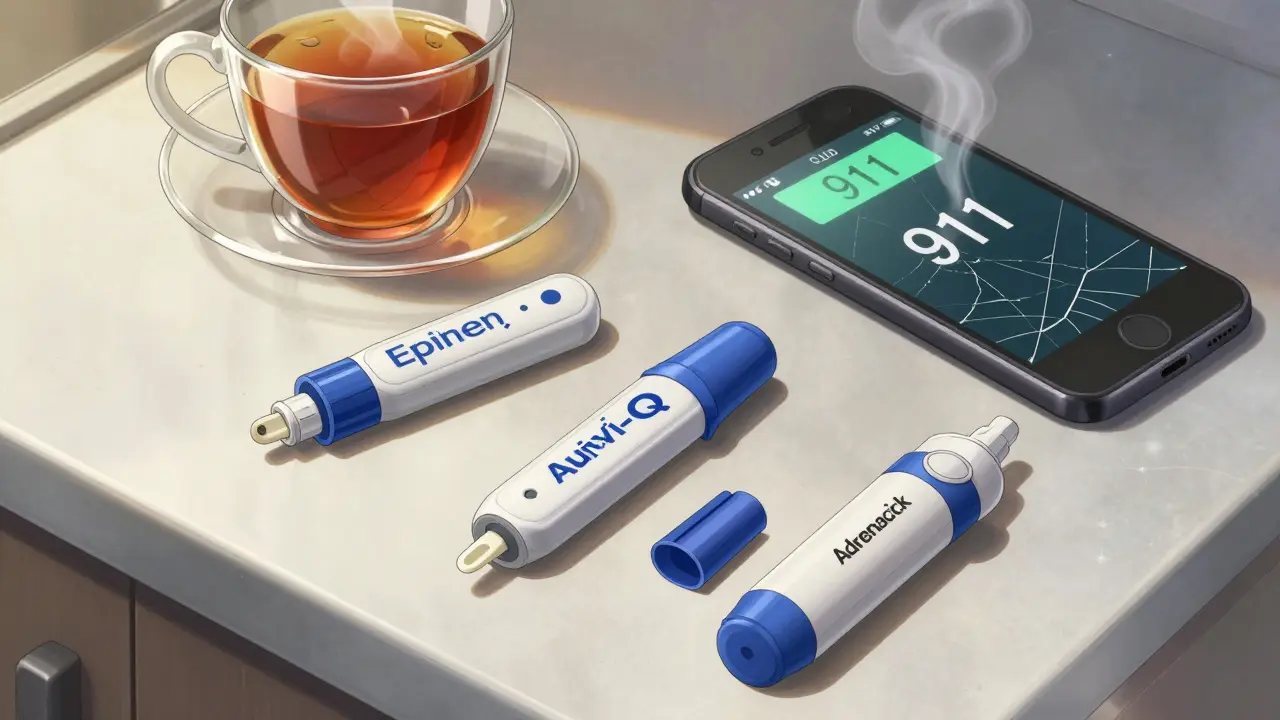
When someone is having a severe allergic reaction, every second counts. Anaphylaxis can turn a mild itch into a life-threatening emergency in under five minutes. The only thing that can stop it? Epinephrine. And if you’re carrying an auto-injector - whether it’s an EpiPen, Auvi-Q, or Adrenaclick - you need to know exactly how to use it. Not just how to hold it. Not just how to press it. But how to use it right, under panic, with shaking hands, in a crowded room, or while your child is turning blue.
What Happens During Anaphylaxis?
Anaphylaxis isn’t just a bad rash or a stuffy nose. It’s your body going into full survival mode - and it’s losing the battle. Your airways swell shut. Your blood pressure crashes. Your heart races, then falters. Without epinephrine, you’re at risk of death within minutes.
Epinephrine works fast. It tightens blood vessels to raise your blood pressure, opens your airways so you can breathe, and stops the cascade of chemicals that make you swell, break out in hives, or go into shock. It’s not a cure. But it’s the only thing that buys you time until you get to the hospital.
Studies show that if epinephrine is given within 5 to 15 minutes of the first symptoms, the chance of dying drops by 75%. Delay it even by 10 minutes, and your risk of a second, deadlier wave of symptoms - called a biphasic reaction - jumps by 300%.
Which Auto-Injector Do You Have?
You can’t use it right if you don’t know what you’re holding. There are four main types in the U.S. as of 2025:
- EpiPen - The most common. Comes in 0.15mg (for kids 33-66 lbs) and 0.3mg (for anyone over 66 lbs). Has a bright orange tip that pops out when fired.
- Auvi-Q - Smaller, square-shaped. Gives voice instructions: “Pull off gray safety cap,” “Press firmly against thigh,” “Hold for 2 seconds.”
- Adrenaclick - Cheaper, but requires two steps: remove both caps, then press down hard to activate the needle.
- Neffy - The newest. A nasal spray, no needle. Approved in 2023. Works for most people, but needs proper nasal placement.
Most people have EpiPen. But if you have another, practice with the trainer device - the one that doesn’t have a needle. Don’t wait until you’re in a panic to figure out how yours works.
Step-by-Step: How to Use an Epinephrine Auto-Injector
Here’s what to do - no matter which brand you have. These steps are backed by the American Academy of Allergy, Asthma & Immunology and the CDC.
- Recognize the signs. Anaphylaxis isn’t just hives. Look for: trouble breathing, swelling of lips/tongue/throat, wheezing, dizziness, rapid pulse, nausea, vomiting, or feeling like you’re going to pass out. If you’re unsure - use it anyway. Better safe than dead.
- Call 911. Right away. Even if you feel better after the shot, you still need emergency care. Symptoms can come back.
- Remove the safety cap. For EpiPen and Auvi-Q, pull off the blue cap. For Adrenaclick, remove both the gray and black caps. Don’t hesitate. Don’t overthink it. Just pull.
- Place it on the outer thigh. You can inject through clothing. Jeans, leggings, even a skirt - it doesn’t matter. The outer thigh is the best spot because it’s thick muscle, easy to reach, and far from major nerves or arteries. Never inject into the buttocks, fingers, hands, or feet.
- Press hard and hold. Push the injector firmly against the thigh until you hear or feel a click. Hold it there for 3 seconds. For Auvi-Q, the voice will tell you when to stop. For EpiPen and Adrenaclick, count slowly: “One-Mississippi, Two-Mississippi, Three-Mississippi.” Don’t let go early. If you don’t hold it long enough, you won’t get the full dose.
- Remove and massage the area. Take the injector away. Rub the injection site for 10 seconds. This helps the medicine absorb faster.
- Stay lying down. Sit or lie flat with legs extended. Don’t stand up. Don’t walk. Standing can make your blood pressure drop even more, and you could faint or fall.
- Use a second dose if needed. If symptoms don’t improve after 5-10 minutes - or if they get worse - use a second injector. Keep both with you at all times. One is not enough.
Common Mistakes (And How to Avoid Them)
Real people make real mistakes. And those mistakes cost lives.
- Waiting too long. People wait for antihistamines like Benadryl. That’s a deadly delay. Antihistamines help with itching. They don’t stop anaphylaxis. Epinephrine is the only thing that does.
- Not holding long enough. A 2022 study found 61% of users didn’t hold the injector for the full 3 seconds. That means they got less than half the dose. Count it out.
- Injecting in the wrong spot. Injecting into the arm, belly, or buttocks slows absorption and reduces effectiveness. The outer thigh is the only recommended spot.
- Forgetting to call 911. Epinephrine is a bridge - not a finish line. You still need an ambulance. Hospital staff will monitor you for 4-6 hours because reactions can rebound.
- Not practicing. 72% of school nurses report students and staff messing up during drills. The most common error? Forgetting to remove the blue safety cap. Practice every few months. Use the trainer.
Storage and Replacement
Epinephrine breaks down over time - especially if it’s too hot or too cold.
- Keep it between 59°F and 86°F. Don’t leave it in your car in summer. Don’t freeze it in winter.
- Check the expiration date. Replace it before it expires. Even if it looks fine, the medicine weakens.
- Keep it in its original case. That protects it from light and bumps.
- Replace every 18 months - or sooner if the liquid turns brown or cloudy.
Most insurance covers one or two per year. If you can’t afford it, ask about patient assistance programs. Auvi-Q and EpiPen both offer free or low-cost options for those who qualify.
What About Neffy - the Nasal Spray?
Neffy is new. It’s needle-free. That’s great for people terrified of needles. But it’s not perfect.
In clinical trials, it worked in 81% of cases. But in real-life simulations, 32% of people didn’t use it correctly - they didn’t press the nozzle deep enough into the nose, or they breathed in too hard and blew the medicine out.
It’s not a replacement for the auto-injector for everyone. It’s an option. If you choose Neffy, you still need to carry a backup injector. And you still need to practice - because getting the spray right is harder than it looks.
Training Matters - A Lot
Knowing how to use it isn’t enough. You need to be able to use it when your heart is pounding, your hands are shaking, and your child is screaming.
Studies show you need at least three practice sessions with a trainer device to get it right. That’s not one time. Three. And you need to do it with someone else watching - a spouse, a teacher, a friend.
Teachers, coaches, babysitters - anyone who spends time with someone at risk should know how to use an injector. Schools in 47 states are required to have epinephrine on hand. But only 28 states require staff to be trained. Don’t assume they know. Teach them yourself.
Final Thought: Don’t Wait to Act
Epinephrine is the difference between life and death. Not the difference between a little better and a lot better. It’s the only thing that stops anaphylaxis from killing you.
If you think you’re having a reaction - use it. Even if you’re not sure. Even if you’re scared. Even if you’ve never used it before.
There’s no shame in using it. There’s no shame in needing it. There’s only shame in waiting.
Keep it with you. Know how to use it. Teach the people around you. And never, ever let fear stop you from acting.
Bradly Draper
December 27, 2025 AT 18:45I used to be scared to touch the thing. Then my kid had a reaction at the park last summer. I fumbled with the cap, dropped it, panicked. But I got it in. He’s fine now. Just practice with the trainer. Don’t wait until it’s real.
Gran Badshah
December 28, 2025 AT 10:13in india we dont have epipen. my cousin died because no one knew what to do. we used antihistamine. it was too late. why dont pharma companies make cheap versions here? people are dying because of price. this is not science. this is profit.
Ellen-Cathryn Nash
December 29, 2025 AT 02:18It’s disgusting how many people treat this like a suggestion. ‘Oh I’ll wait and see if it gets worse.’ No. You don’t get to gamble with someone’s life because you’re too scared to push a plastic tube. If you own one and don’t know how to use it, you’re not just irresponsible-you’re a danger to everyone around you. And yes, I’m talking to you, the person who keeps it in the glovebox of your car where it’s 120 degrees in July.
Nicole Beasley
December 31, 2025 AT 01:02NEFFY IS A GAME CHANGER 😭 no needles!! but also… why is it so hard to spray it right?? I tried it once and blew it all out 😅 my nose felt like a broken faucet. still, i’m keeping it as backup. my kid hates needles so much he screams when he sees a bandaid 🤦♀️
sonam gupta
January 1, 2026 AT 14:44epinephrine is american privilege. in india we use home remedies. ginger tea. honey. prayer. if you die it was your karma. why do you think we need your western gadgets?
Julius Hader
January 2, 2026 AT 16:56Just want to say-this is the most important thing you’ll ever learn. Not how to do a pushup. Not how to fix a leaky faucet. This. Right here. I taught my 7-year-old how to use the trainer. She calls it her ‘superhero shot.’ She’s the one who reminds me to check the expiration date now. ❤️
Mimi Bos
January 2, 2026 AT 23:30so i just got my first epipen and i was like oh cool i guess i just press it? then i realized i had no idea which end was which. the cap was confusing. and the thing looked like a flashlight. i ended up calling my sister who’s a nurse. she said ‘just watch a youtube video’ so i did. 3 times. now i have a sticky note on my fridge that says ‘BLUE CAP OFF THEN PUSH’ lol. i feel dumb but also alive 🤷♀️
Payton Daily
January 4, 2026 AT 03:54Think about this: epinephrine isn’t medicine. It’s a biological interrupt button. Your body’s on fire, and this is the fire alarm that slams the whole system into emergency mode. We evolved to panic. But we didn’t evolve to know how to use a plastic injector. That’s why we need training. Not just knowledge. Muscle memory. Repetition. Ritual. Like a prayer. You don’t pray when you’re in crisis-you pray so you know how to pray when crisis comes. This isn’t about science. It’s about survival discipline. And if you’re not practicing, you’re not living-you’re just waiting for fate to pick you.