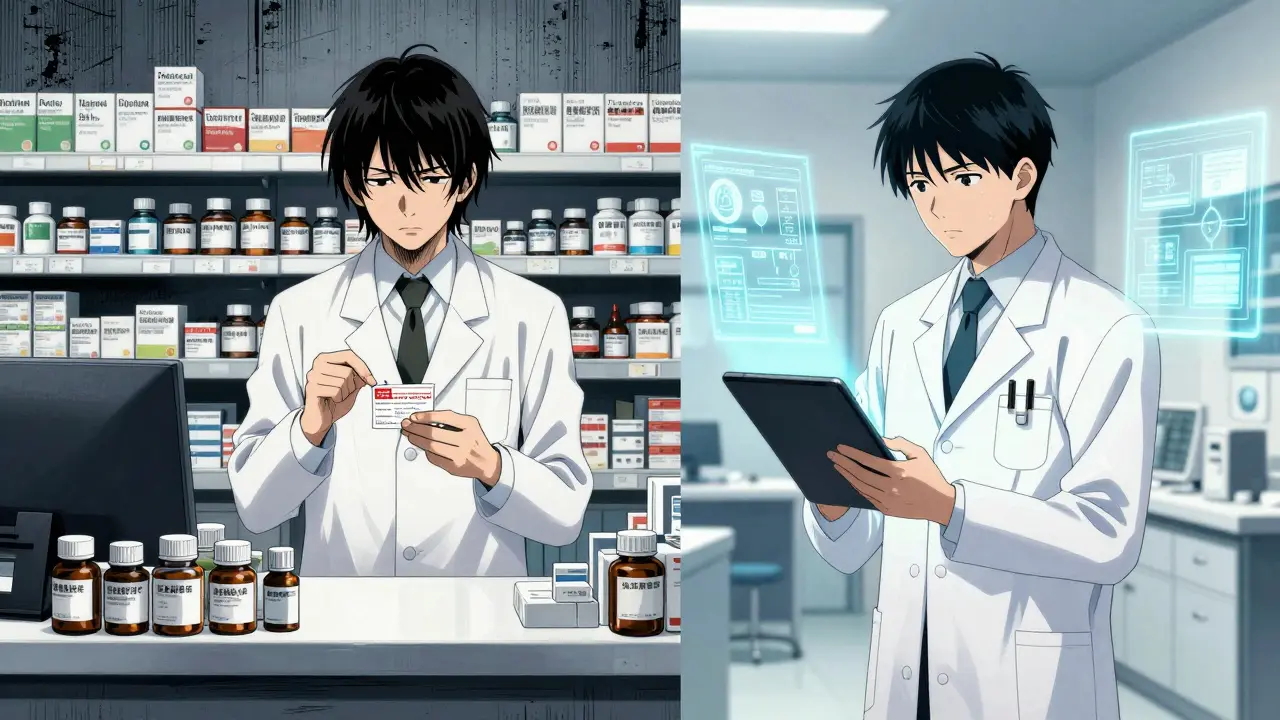
Have you ever walked out of a pharmacy with a pill bottle that looks different from the one your doctor prescribed? Maybe the color changed, or the name on the label is slightly different. That’s medication substitution in action. But here is the thing: what happens when you pick up your prescription at a local shop is completely different from what happens inside a hospital. The rules, the reasons, and the people making the decisions are not just similar-they are fundamentally distinct.
If you are a patient, this affects your safety and your wallet. If you are a healthcare professional, it affects how you manage care transitions. Understanding these differences isn't just academic; it prevents errors when patients move between home and hospital care. Let’s break down exactly how retail pharmacy and hospital pharmacy handle substitutions differently.
The Core Difference: Transaction vs. Clinical Team
At its heart, the difference lies in who makes the call and why. In a retail pharmacy setting, substitution is often a transactional event. It happens right at the counter. The pharmacist checks the insurance formulary, sees that the brand-name drug is too expensive or not covered, and swaps it for a generic equivalent. This decision is driven largely by cost containment and state laws.
In contrast, hospital pharmacy practice operates within a closed-loop clinical system. Substitutions here are rarely about simple generics. They are often therapeutic interchanges. This means swapping one active ingredient for another to treat the same condition better, safer, or more cheaply for the specific patient in front of them. These decisions aren’t made by a single pharmacist at a dispensing window. They are vetted by a multidisciplinary team, including physicians and pharmacists, through a body called the Pharmacy and Therapeutics (P&T) Committee.
Think of it this way: retail substitution is like buying a store-brand cereal because it’s cheaper than the name brand. Hospital substitution is like a chef changing an ingredient in a recipe because the diner has a specific allergy or preference, ensuring the meal still works perfectly for them.
Who Has the Authority?
Legal authority drives much of what happens behind the scenes. Retail pharmacists operate under state-specific pharmacy practice acts. In all 50 U.S. states, these laws allow pharmacists to substitute therapeutically equivalent generic drugs unless the prescriber writes "Dispense as Written" or the patient refuses. According to recent data, generic substitution rates in retail settings average over 90% for eligible medications. The pharmacist has the legal power to make this swap instantly.
Hospital pharmacists do not have this individual discretion for major changes. Their authority comes from institutional protocols approved by the P&T Committee. A 2022 survey showed that nearly 90% of acute care hospitals maintain formal therapeutic interchange protocols. If a hospital pharmacist wants to switch a patient from one antibiotic to another based on these protocols, they must notify the physician. In many cases, this notification must happen within 24 hours. The hospital pharmacist is executing a pre-approved plan, not making a spontaneous decision at the point of sale.

What Gets Swapped?
The types of medications involved tell a big story about the environment. In retail pharmacies, the vast majority of substitutions involve oral solid dosage forms-think pills and capsules. Over 97% of retail substitutions fall into this category. These are stable, easy-to-manufacture drugs where generic equivalence is well-established.
Hospitals deal with complexity. A significant portion of hospital therapeutic interchanges involves intravenous (IV) medications, biologics, and specialized compounded preparations. For example, switching a patient from a standard beta-lactam antibiotic to a different class might be done to prevent C. difficile infection or due to supply shortages. These aren't simple swaps. They require monitoring blood levels, adjusting doses, and understanding complex pharmacokinetics. Retail pharmacies rarely touch these high-acuity medication classes.
| Feature | Retail Pharmacy | Hospital Pharmacy |
|---|---|---|
| Primary Driver | Cost containment & insurance formularies | Clinical optimization & patient-specific factors |
| Decision Maker | Individual Pharmacist | P&T Committee / Multidisciplinary Team |
| Common Drug Types | Oral solids (pills/capsules) | IV meds, biologics, compounded prep |
| Notification | To Patient (verbal/written) | To Physician (within 24 hours) |
| Documentation | Pharmacy records (2 years) | Electronic Health Record (EHR) |
The Notification Gap
This is where things get tricky for patients. In retail, the law requires the pharmacist to notify the patient. In 32 states, this means a verbal heads-up. In 18 states, you need written consent for the first substitution. The focus is on consumer choice and transparency. You know you got a generic instead of the brand.
In hospitals, the notification goes to the doctor, not necessarily the patient. The rationale is that the physician manages the overall treatment plan. However, this creates a blind spot. When a patient leaves the hospital, they might not realize their medication was switched via a therapeutic interchange protocol. They go to their retail pharmacy, and the retail pharmacist sees a new drug on the discharge list. Is this intentional? Was it part of the plan? This disconnect is a major source of confusion.

Safety Risks During Transitions
The biggest risk in this entire system is the handoff. Data shows that nearly 24% of medication errors related to substitution occur during hospital-to-home transitions. Why? Because the two systems don't always talk to each other clearly.
A hospital pharmacist might switch a patient to a biosimilar or a different therapeutic agent based on hospital policy. The discharge summary lists this new drug. The retail pharmacist receives the prescription, but if the original prescriber didn't explicitly authorize the change, or if the insurance denies coverage for the hospital-preferred drug, the retail pharmacist might revert to the original brand or generic. Now the patient is back on the old drug, potentially undoing the clinical benefit intended by the hospital team.
Experts warn that poorly coordinated substitution practices account for a significant percentage of reported medication discrepancies. The Institute for Safe Medication Practices (ISMP) highlights this as a critical patient safety issue. The goal now is integration. New regulations and electronic health record (EHR) updates aim to share substitution history between settings, so everyone knows why a change was made.
Why It Matters for You
If you are a patient, ask questions. If your medication looks different at the pharmacy, ask if it’s a generic substitution or a therapeutic change. If you are discharged from the hospital, confirm with your doctor which medication you should continue taking. Don’t assume the retail pharmacy will automatically match the hospital’s discharge instructions without verification.
If you are a provider, document your intent clearly. Specify whether a substitution is mandatory or optional. Use standardized terminology in discharge summaries. As healthcare moves toward value-based models, aligning retail and hospital substitution protocols will become essential for reducing readmissions and ensuring continuity of care.
Can a retail pharmacist substitute any medication?
No. Retail pharmacists can typically only substitute therapeutically equivalent generic drugs for oral solids. They cannot perform therapeutic interchanges (switching active ingredients) unless specifically authorized by the prescriber or allowed under specific state collaborative practice agreements. Specialty drugs, biologics, and controlled substances often have stricter substitution rules.
What is therapeutic interchange?
Therapeutic interchange is the process of substituting one drug for another within the same therapeutic class to achieve better clinical outcomes, reduce side effects, or lower costs. Unlike generic substitution, it involves changing the active ingredient. This is common in hospitals and requires physician approval or adherence to P&T committee protocols.
Why do hospitals use therapeutic interchange?
Hospitals use therapeutic interchange to optimize patient care based on clinical pathways, manage antimicrobial stewardship, address drug shortages, and control costs within the institution. It allows the medical team to tailor treatment to individual patient needs rather than relying solely on the prescriber's initial choice.
Do I need to pay more if my medication is substituted?
Usually, no. Generic substitution in retail pharmacies is designed to save money. Insurance plans often require generic substitution to cover the cost. In hospitals, therapeutic interchange may also reduce costs, but the pricing structure is different. Patients should check with their insurance provider to understand copay differences for specific formulations.
How can I avoid medication errors during hospital discharge?
Review your discharge paperwork carefully. Confirm the exact name and dose of every medication with your doctor before leaving. When you fill prescriptions at your retail pharmacy, show them your discharge summary. Ask the pharmacist to verify that the dispensed medication matches the hospital's intent, especially if the drug name or appearance has changed.