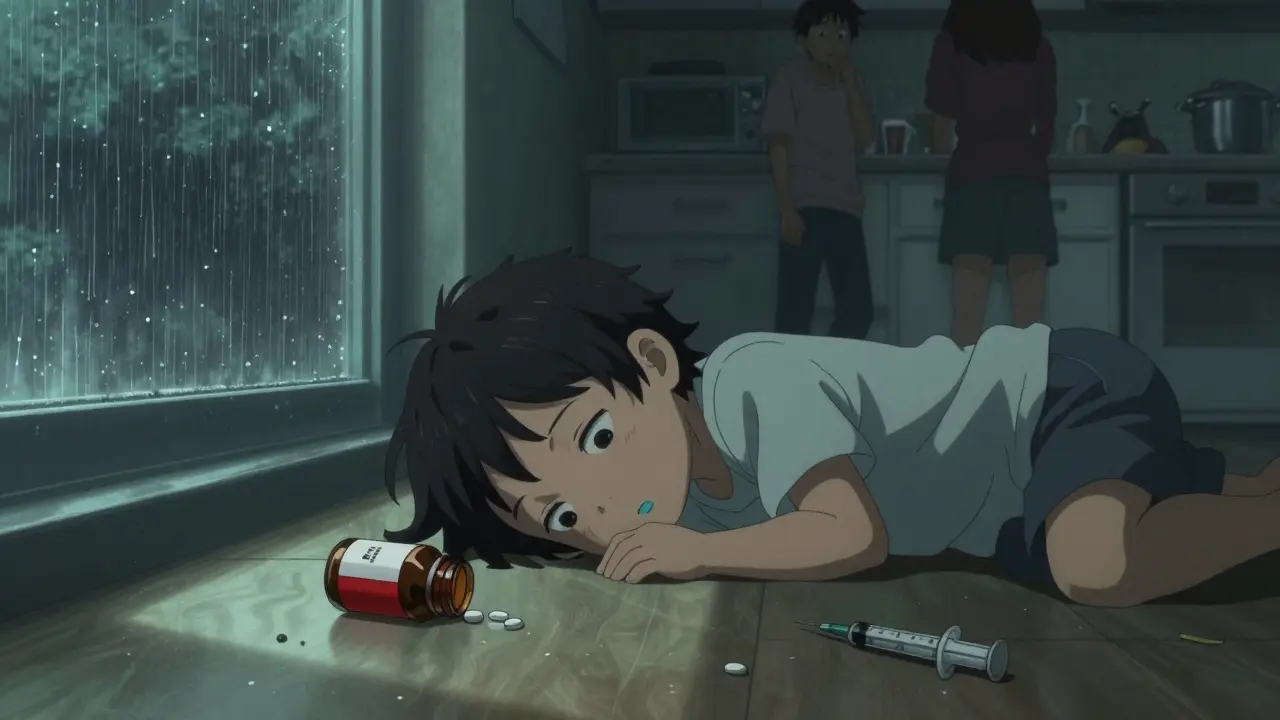
When a child swallows too much medicine-whether it’s a cough syrup, a painkiller, or even a pill meant for an adult-it can turn dangerous in minutes. Unlike adults, children’s bodies process drugs differently. Their organs are still growing, their weight is smaller, and their brains haven’t learned to avoid things that look like candy. That’s why even a single extra drop of liquid medicine can cause serious harm. You might not see symptoms right away, but damage could already be happening inside. Knowing the signs and acting fast can save a life.
What Does a Medication Overdose Look Like in a Child?
The signs of an overdose depend on what the child took. Some drugs cause drowsiness. Others make them hyperactive. Some affect breathing. Others cause seizures. Here’s what to watch for, broken down by type of medication.Opioids-like oxycodone, hydrocodone, or fentanyl-slow down the body. If a child has taken these, you might notice:
- Pupils that look like tiny pinpricks
- Unresponsiveness-even if you shake them or shout
- Slow, shallow, or stopped breathing
- Blue or gray lips and fingernails
- Cold, clammy skin
- Gurgling or choking sounds, like they’re drowning
These are life-threatening. If you see any of these, call 911 immediately. Don’t wait. Fentanyl is especially dangerous-even a tiny amount can kill a child.
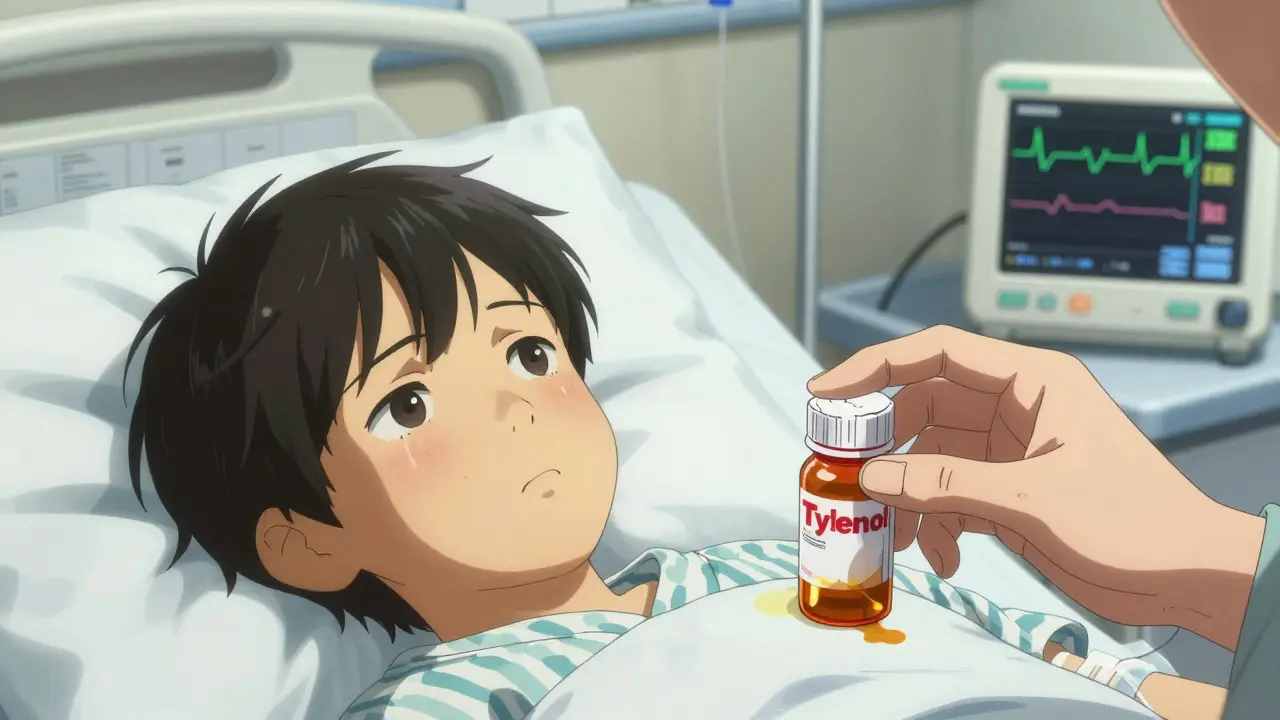
Acetaminophen (Tylenol) is the most common cause of pediatric poisoning. It’s in cold medicines, pain relievers, and fever reducers. The scary part? A child might seem fine for hours-even a full day-while their liver is quietly being damaged. Symptoms that show up later include:
- Nausea and vomiting
- Stomach pain
- Loss of appetite
- Yellowing of the skin or eyes (jaundice)
- Extreme tiredness or confusion
By the time these show up, it’s already serious. But if you catch it early-within 8 hours-there’s a treatment called N-acetylcysteine (NAC) that can prevent liver failure. After 16 hours, that treatment becomes much less effective.
Stimulants-like ADHD medications (Adderall, Ritalin)-can cause the body to go into overdrive. Watch for:
- Fast or irregular heartbeat
- High fever
- Agitation, panic, or hallucinations
- Seizures
- Difficulty breathing
- Extreme sweating or flushed skin
These can lead to stroke, heart attack, or organ failure. Even if the child seems “just hyper,” don’t assume it’s normal behavior.
Cough and cold medicines often contain antihistamines, decongestants, or cough suppressants. In kids, these can cause:
- Drowsiness or extreme agitation
- Blurred vision or hallucinations
- Fast heartbeat
- Difficulty urinating
- Seizures
Many of these medicines are sold in liquid form-and it’s easy to accidentally give too much. A common mistake? Giving both a cold medicine and a pain reliever, not realizing both contain acetaminophen. That’s how 70% of acetaminophen overdoses happen.
When to Call Poison Control vs. 911
This is the most important decision you’ll make.Call Poison Control (800-222-1222) immediately if you suspect your child swallowed any medication they weren’t supposed to-even if they seem fine. Don’t wait for symptoms. Don’t try to Google it. Don’t wait to see if they “get better.” Call now. Poison Control experts are trained to ask the right questions: What was taken? How much? When? How old is the child? They’ll tell you exactly what to do next.
They can also guide you through the webPOISONCONTROL® tool, which gives real-time advice for non-emergency cases. It’s free, available 24/7, and used by hospitals across the U.S.
Call 911 immediately if your child shows any of these signs:
- Cannot be woken up
- Is not breathing or breathing very slowly
- Is having seizures or uncontrollable shaking
- Has blue or gray skin, lips, or nails
- Is having trouble swallowing or is drooling uncontrollably
- Has swelling of the face, lips, or tongue
These are emergencies. Every second counts. While you wait for help, if you have naloxone (Narcan) and suspect an opioid overdose, give one dose in the nose or muscle. Wait 2-3 minutes. If there’s no change, give another dose. Keep giving doses every 2-3 minutes until help arrives.
Why Waiting Is Dangerous
Parents often think: “They’re sleeping, but they’re breathing. Maybe they’ll wake up.” Or: “They didn’t throw up. Maybe they didn’t swallow much.” That’s how tragedies happen.Acetaminophen doesn’t cause vomiting or pain right away. But liver cells start dying within hours. By the time the child looks sick, the damage may be irreversible.
Fentanyl-even in tiny amounts-is often mixed into other pills that look like prescription drugs. A child might think they’re taking a painkiller, but it’s actually a deadly dose of fentanyl. There’s no safe amount for a child.
Studies show that 47% of all medication exposures in kids happen under age 6. Most of those happen at home. Not in a stranger’s house. Not at school. Right where you store your meds.
How to Prevent Accidental Overdose
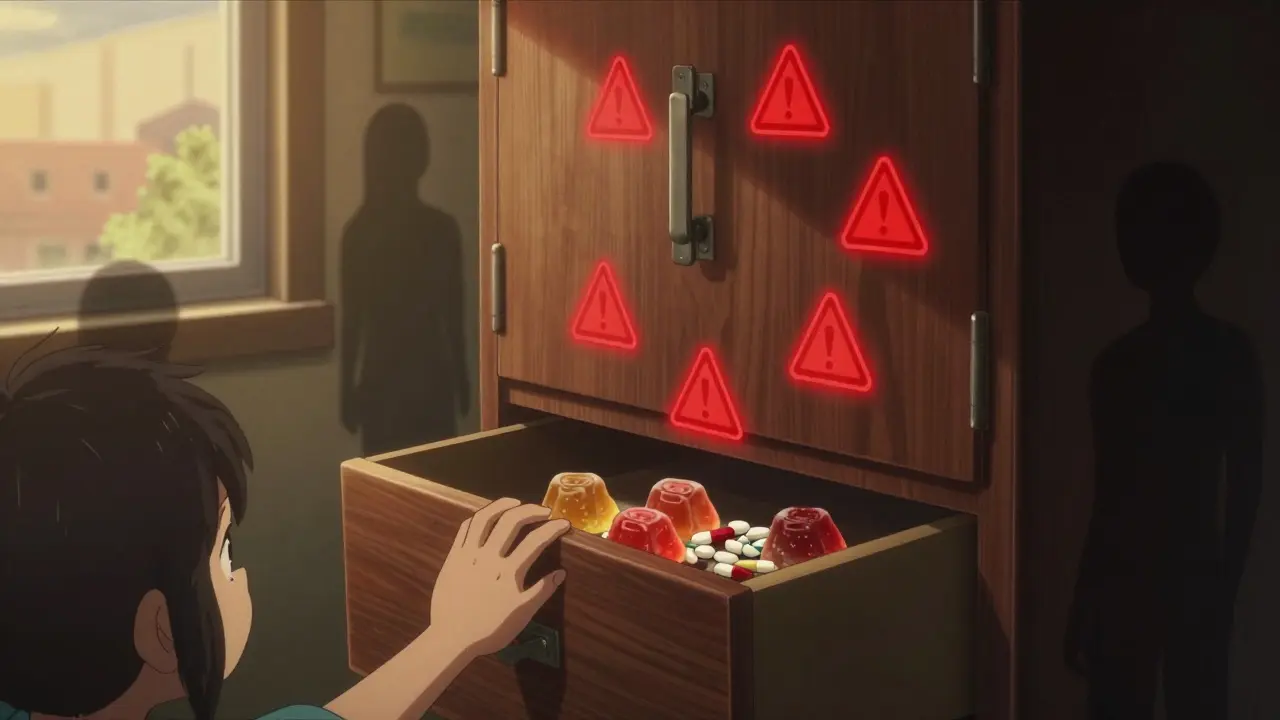
You can’t be perfect. But you can reduce the risk dramatically.- Lock it up. Store all medications-prescription, OTC, vitamins, even CBD-in a locked cabinet. Not on the counter. Not in a purse. Not in a drawer the child can reach. CDC data shows 60% of poisonings happen in the child’s own home.
- Use child-resistant caps properly. They’re not foolproof. 20% of poisonings still happen even when caps are used. Always lock the cabinet after.
- Never call medicine “candy.” Even jokingly. Kids learn fast. If you say, “Here’s your medicine, it tastes like candy,” they’ll believe it.
- Use the right measuring tool. Never use a kitchen spoon. Use the dropper, syringe, or cup that came with the medicine. Many overdoses happen because people guess the dose.
- Check labels for acetaminophen. If you’re giving a cold medicine, check if it already has acetaminophen. Don’t give Tylenol on top of it. That’s the #1 mistake.
- Dispose of old meds. Don’t keep expired or unused medicines around. Take them to a pharmacy drop-off. Don’t flush them-unless the label says to.
What Happens After You Call for Help
If you call Poison Control, they’ll ask you to describe what was taken, how much, and when. They might tell you to:- Give activated charcoal (only if directed)
- Watch for symptoms and call back in an hour
- Take the child to the ER
If you call 911, paramedics will check vital signs, give oxygen, start IV fluids, and may give antidotes like naloxone or NAC. At the hospital, they’ll run blood tests to check liver and kidney function. They’ll monitor breathing and heart rate for hours-even if the child seems fine.
Many parents feel guilty after an overdose. But this isn’t about blame. It’s about learning. The system is designed to protect us, but mistakes happen. What matters now is acting fast and getting help.
What’s Changing to Keep Kids Safer
There’s good news. Things are getting better.In 2020, the FDA required liquid acetaminophen to come in unit-dose packaging. That means each dose is pre-measured in a single-use container. Since then, accidental overdoses in kids have dropped by 19%.
By 2025, all liquid medications will need standardized labels and measuring tools. That should cut another 45,000 dosing errors a year.
But the biggest threat now? Illicit drugs. Fentanyl is showing up in pills meant for kids. Marijuana products are being ingested by children who think they’re gummies. Between 2017 and 2022, pediatric exposures to medical marijuana jumped 1,475%.
That’s why prevention isn’t just about locking up your own meds. It’s about talking to grandparents, babysitters, and other caregivers. It’s about asking: “Do you keep your pills out of reach?”
Because in the end, it’s not about being perfect. It’s about being prepared. And knowing what to do when things go wrong.
What should I do if I think my child swallowed medicine but seems fine?
Call Poison Control at 800-222-1222 immediately. Even if your child seems fine, some medications-like acetaminophen-cause damage without obvious symptoms for hours or even a full day. Poison Control experts will ask you questions about what was taken, how much, and when, and tell you exactly what to do next. Don’t wait. Don’t watch. Don’t hope. Call now.
Can I wait to see if my child vomits before calling for help?
No. Vomiting doesn’t mean the danger is over. Many drugs are absorbed quickly into the bloodstream, even before vomiting happens. Some, like fentanyl or opioids, can stop breathing without causing vomiting at all. Waiting for vomiting can cost precious minutes. If you suspect an overdose, call 911 if there are life-threatening symptoms, or Poison Control if you’re unsure. Time is critical.
Is it safe to give my child ipecac to make them throw up?
No. Ipecac is no longer recommended for routine use in poisoning cases. It can cause more harm than good, especially if the substance ingested is a corrosive chemical, petroleum product, or opioid. It can also interfere with treatments like activated charcoal or antidotes. Always follow the advice of Poison Control or emergency responders. Do not induce vomiting unless specifically told to do so.
How do I know if my child took too much acetaminophen?
You might not know until it’s too late. Acetaminophen overdose often has no symptoms for the first 24 hours, even as liver damage begins. Signs like nausea, vomiting, and stomach pain usually appear after that. The only way to be sure is to call Poison Control and get a blood test. If your child took more than the recommended dose-even if they seem fine-call immediately. Treatment with N-acetylcysteine (NAC) is most effective if given within 8 hours.
Can I use a kitchen spoon to measure liquid medicine?
Never. Kitchen spoons vary in size and are not accurate. A teaspoon might hold 3-7 milliliters, but medicine dosing is exact. Using the wrong spoon can lead to a 50% overdose or underdose. Always use the dropper, syringe, or measuring cup that came with the medicine. If you lost it, ask your pharmacist for a new one. It’s free.
What if my child took a medication meant for an adult?
Call Poison Control immediately. Adult doses can be fatal for children. Even a single pill of a blood pressure or antidepressant medication can cause seizures, coma, or heart problems in a young child. Don’t assume it’s “just one pill.” Tell the expert exactly what the medicine is, how much your child took, and their weight and age. They’ll tell you whether to go to the ER or monitor at home.
Are child-resistant caps enough to prevent overdoses?
No. While child-resistant caps help, 20% of poisonings still happen even when they’re used. Kids are clever. They can open them with tools, by rolling them on the floor, or with help from older siblings. The safest option is to store all medications in a locked cabinet, out of sight and reach. Never rely on the cap alone.
Tru Vista
January 1, 2026 AT 20:30acetaminophen overdoses are the #1 cause of pediatric poisoning but most parents don’t even know what it is in their meds. i’ve seen moms give tylenol + cold syrup + ibuprofen and think they’re being ‘proactive’. lol. no. just no. 🤦♀️
erica yabut
January 2, 2026 AT 10:25Oh sweet mercy, the sheer *arrogance* of modern parenting. You lock your meds? How quaint. The real issue is that we’ve turned children into fragile, coddled organisms who can’t be trusted near *anything* - not medicine, not peanut butter, not a damn stair. We’re raising a generation of walking liability waivers. Locking up medicine? That’s not prevention. That’s surrender. 🤷♀️
JUNE OHM
January 3, 2026 AT 22:55they’re putting fentanyl in kids’ gummies?? 🤯 i knew the government was lying about the opioid crisis. this is a bioweapon. the CDC is complicit. why are we not rioting?? 🚨 #fentanylgate #lockdownkids
Vincent Sunio
January 5, 2026 AT 02:39While the article presents a commendable framework for identifying pharmacological toxicity in pediatric populations, it fails to address the epistemological limitations of parental intuition. The reliance on symptomatology as a diagnostic proxy is fundamentally flawed - particularly in the context of acetaminophen-induced hepatotoxicity, where the latency period renders subjective observation useless. A more rigorous approach would mandate universal serum level screening post-exposure, regardless of clinical presentation. One cannot rely on anecdotal vigilance in a pharmacologically complex society.
Kerry Howarth
January 5, 2026 AT 15:37Call Poison Control. Seriously. Just call. I used to think I could handle it myself - until my nephew swallowed half a bottle of melatonin. He was fine. But if we’d waited? Who knows. You don’t need to be a doctor. You just need to be brave enough to pick up the phone.
Shanahan Crowell
January 6, 2026 AT 05:14Look - I get it. You’re tired. You’re overwhelmed. You’re juggling work, kids, laundry, and a million other things. But here’s the thing: one minute you spend locking up meds? Could save your child’s life. One minute you spend reading the label? Could prevent a hospital trip. Don’t wait for the worst-case scenario. Be the parent who *does* the thing. Even when it’s annoying. Especially then.
Angela Goree
January 7, 2026 AT 00:55And what about the grandparents?! They’re the ones leaving their pills on the coffee table! They think ‘it’s just aspirin’ - but it’s not! It’s a death trap! And don’t even get me started on the daycare centers that don’t have locked cabinets! I’ve seen it! I’ve seen it with my own eyes!!
Tiffany Channell
January 8, 2026 AT 15:10Let’s be real: 90% of these overdoses happen because parents are lazy. They don’t read labels. They don’t measure properly. They use spoons. They double-dose because ‘it didn’t work last time.’ This isn’t a public health crisis - it’s a parenting crisis. Stop blaming the system. Start parenting.
Joy F
January 9, 2026 AT 01:12It’s not just the medicine - it’s the entire epistemological collapse of modern care. We’ve replaced intuition with algorithms, presence with apps, and wisdom with CDC bulletins. Poison Control is a band-aid on a severed artery. The real poison? The belief that a 24/7 hotline can replace vigilance, love, and presence. We’ve outsourced motherhood to a phone number. And now we’re surprised when the system fails?
Haley Parizo
January 9, 2026 AT 21:34Locking up medicine is a start - but it’s not enough. We need systemic change. Child-resistant caps are a joke. The pharmaceutical industry profits from confusion. They design bottles that look like candy. They market syrup with fruit flavors. This isn’t negligence - it’s predatory design. And we’re letting them get away with it. Until we sue the manufacturers and ban flavored acetaminophen, this won’t end.
Ian Detrick
January 10, 2026 AT 15:34My daughter once got into my blood pressure pills. She was fine. But I didn’t know that until I called Poison Control. They walked me through it. No panic. No judgment. Just facts. And that’s the thing - the system works if you use it. Don’t be ashamed. Call. It’s what the experts are there for.
Angela Fisher
January 11, 2026 AT 12:58They’re putting fentanyl in EVERYTHING now. Gummies. Lollipops. Even kids’ vitamins. I saw a video on TikTok - a 3-year-old ate one and went into cardiac arrest. The hospital didn’t even have naloxone. The government knew. They’ve known for years. And they’re still selling it. This isn’t an accident. It’s genocide. 🚨💔
Neela Sharma
January 11, 2026 AT 21:00In India, we don’t lock up medicine - we teach respect. Children learn early: medicine is not candy. It is power. It is danger. It is sacred. We don’t need cabinets. We need culture. When your child knows that a pill is not a treat - they won’t touch it. The solution is not fear. It is wisdom.
Shruti Badhwar
January 13, 2026 AT 20:57While the preventive measures outlined are commendable, it is imperative to recognize that socioeconomic disparities significantly influence adherence to these guidelines. Families without access to secure storage, measuring devices, or pharmacy drop-off locations face disproportionate risk. Policy interventions must extend beyond individual responsibility to include universal provision of childproof containers, subsidized medication disposal programs, and community-based education initiatives.
Philip Leth
January 15, 2026 AT 05:09My cousin’s kid swallowed a whole bottle of Benadryl. Thought he was just sleepy. Took him to the ER. Turns out he needed a liver transplant. Now he’s fine. But the whole thing? Changed our whole family. We don’t keep meds out anymore. Not even vitamins. Lock it. Always. No excuses.