
For many people, the quiet of night doesn’t bring peace-it brings ringing. If you’ve ever lain awake staring at the ceiling, your ears buzzing with a sound no one else can hear, you know how exhausting tinnitus can be at bedtime. It’s not just annoying. It’s a silent thief of sleep, turning rest into a battle you didn’t sign up for. The good news? You’re not alone, and there are real, science-backed ways to break the cycle.
Why Tinnitus Gets Louder at Night
When the world goes quiet, your brain doesn’t. In fact, it starts listening harder. Without the usual background hum of traffic, conversation, or appliances, your brain amplifies the internal noise-your tinnitus. Studies show that in complete silence, tinnitus perception can spike by up to 40%. This isn’t just in your head; it’s how your nervous system reacts to sensory deprivation. The more tired you are, the more your brain struggles to filter out irrelevant signals. So when sleep is already hard to come by, tinnitus becomes the loudest thing in the room.The Sound Strategy: Masking, Not Silencing
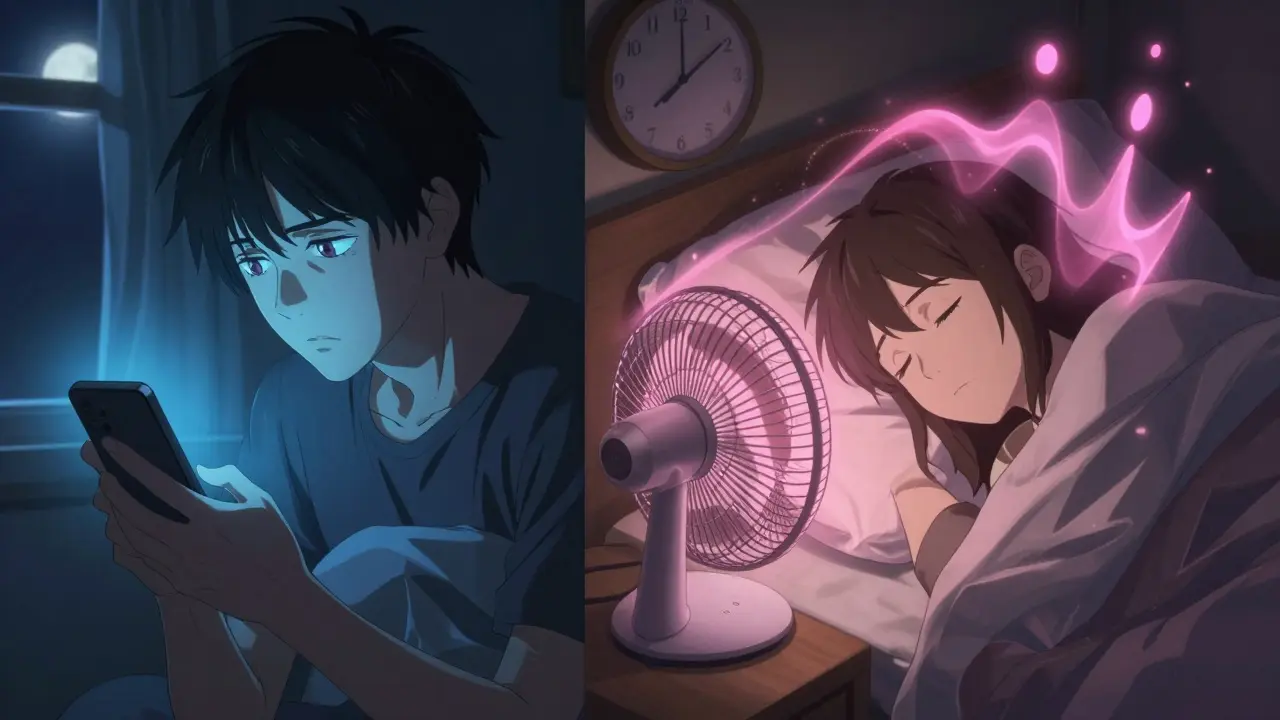
The most effective first step? Introduce sound-not to drown out the ringing, but to soften its edges. Think of it like turning down a spotlight. You don’t turn off the light; you add more light around it so it’s less noticeable. Research shows that playing sound at a volume just below your tinnitus level reduces its perceived loudness by 30-50%. The type of sound matters more than you’d think. White noise (equal energy across all frequencies) is common, but many users find it too harsh. Pink noise (softer on the highs) works better for some. But the most effective for nighttime use? Brown noise. A 2023 Widex clinical guide found that 68% of users reported brown noise as the most soothing-deep, rumbling, like distant thunder or a strong shower. It’s low-frequency, which aligns better with how most people experience tinnitus. You don’t need expensive gear to start. A simple $30 desktop fan can produce 45-55 decibels of steady, non-repeating sound. But if you want more control, devices like the LectroFan Classic is a dedicated sound machine offering 20 fan and noise settings, adjustable up to 60 decibels give you precision. Apps work too, but battery drain and inconsistent playback make them less reliable over time.Sound Therapy vs. Cognitive Behavioral Therapy
Sound masking helps you fall asleep. But what if you’re still lying there, frustrated, anxious, replaying the sound in your head? That’s where CBT for tinnitus comes in. Unlike sound therapy, which targets the ears, CBT targets the brain’s reaction to the sound. A 2022 meta-analysis in the Journal of Clinical Sleep Medicine found that after eight weeks of structured CBT, 72% of users reported significantly less nighttime distress. That’s more than double the improvement seen with sound alone. CBT teaches you to stop fighting the noise, to reframe it as background static rather than a threat. It’s not about ignoring it-it’s about no longer letting it control your emotions. But there’s a catch. Only 38% of people complete full CBT programs. It takes time, consistency, and often a trained therapist. If you’re not ready for that yet, start with sound. But if you’ve tried everything and still can’t sleep, CBT is the next step.Sleep Hygiene: The Invisible Foundation
No amount of noise will help if your sleep environment is broken. The basics matter more than you think.- Temperature: Keep your bedroom between 60-67°F (15.6-19.4°C). Too warm increases stress hormones that worsen tinnitus.
- Humidity: Aim for 40-60%. Dry air can make your auditory nerves more sensitive.
- Screen time: Blue light suppresses melatonin. Stop using phones, tablets, or TVs 90 minutes before bed. One study showed combining this with sound therapy improved sleep outcomes by 47% compared to either alone.
- Consistent schedule: Going to bed and waking up at the same time-even on weekends-reduces tinnitus-related sleep disturbances by 33%. It takes 2-3 weeks to see results, but it’s one of the most powerful tools you have.
What Doesn’t Work (And Why)
There’s a lot of noise out there about tinnitus “cures.” Avoid these traps.- Complete silence: Trying to “tough it out” in a soundproof room makes things worse. Your brain will hunt for the noise harder.
- Overly loud masking: Playing sound louder than your tinnitus doesn’t help-it stresses your ears and can make the ringing feel more intense over time.
- Earplugs at night: Unless you have hyperacusis (extreme sound sensitivity), blocking all sound removes the masking effect and can make tinnitus feel louder.
- Unproven apps: Some apps claim to “cure” tinnitus with specific frequencies. Most are gimmicks. Stick to well-reviewed tools like White Noise Lite is a popular app with 4.7/5 stars and 83% of users reporting immediate sleep improvement-not untested ones.
When Hearing Aids Help (And When They Don’t)
If you also have hearing loss, hearing aids with built-in tinnitus therapy can be a game-changer. Devices like the Widex Moment 4.0 is a hearing aid featuring real-time notch therapy that targets specific tinnitus frequencies can reduce nighttime symptoms by 61% in people with hearing loss. But if your hearing is normal, these devices won’t help. They’re designed to amplify external sound, not mask internal noise.What’s New in 2026
The field is evolving fast. In 2023, the FDA cleared the Lenire is a prescription neuromodulation device combining sound and tongue stimulation to retrain the brain’s response to tinnitus-the first device of its kind. It’s not for everyone, and it requires a specialist, but early results show 65% of users saw reduced severity. Newer apps now use AI to match your tinnitus frequency using your phone’s microphone. One tool, Tinnitus Talk is a mobile app with AI-assisted sound matching, updated in October 2023, claims 89% accuracy in identifying your unique sound profile. And researchers at McMaster University are testing EEG-guided systems that adjust sound therapy in real time based on your brainwaves. These closed-loop systems could be mainstream by 2026.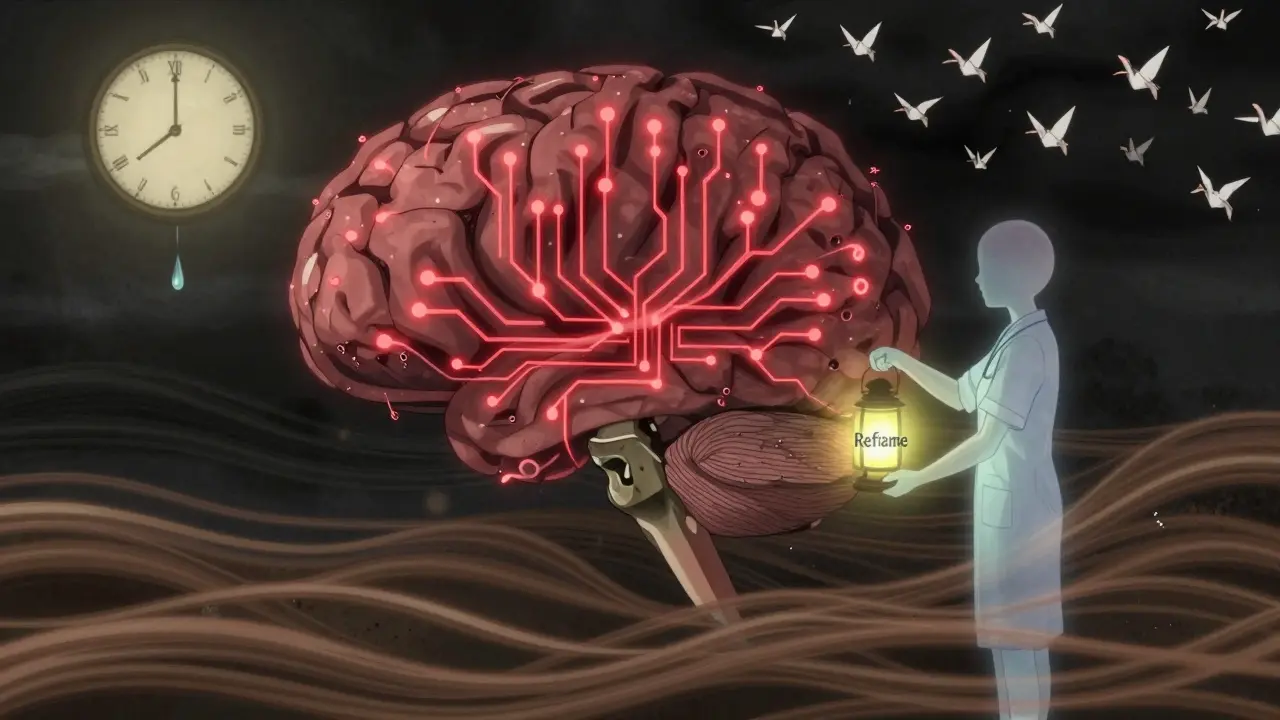
Your Action Plan: Start Tonight
You don’t need to fix everything at once. Here’s how to begin:- Day 1-3: Track your tinnitus. Note the sound (buzzing? ringing?), when it’s worst, and how loud it feels on a scale of 1-10.
- Day 4: Get a fan or a basic sound machine. Set it to brown noise at a low volume-just enough to make the ringing feel softer, not gone.
- Day 5: Set a fixed bedtime and wake-up time. Even if you can’t sleep, be in bed at the same time every night.
- Day 6: Stop screens 90 minutes before bed. Read a book instead.
- Week 2: If the fan isn’t enough, try the LectroFan or a trusted app. Test white, pink, and brown noise for three nights each.
- Week 3: If you’re still struggling, look into CBT. The American Tinnitus Association offers free resources and referrals.
Real Stories, Real Results
One Reddit user, u/SilentNights87, spent two years unable to sleep because of tinnitus. After switching to a LectroFan on brown noise at 52dB, their sleep onset dropped from over 90 minutes to under 30. Their Oura Ring confirmed it: deep sleep increased by 40%. Another user, u/EarRinging2023, had hyperacusis. Even soft noise hurt. Their solution? Custom earplugs that reduced sound by 15dB, paired with CBT. It took months, but now they sleep through the night. There’s no one-size-fits-all. But there is a path forward-for everyone.Frequently Asked Questions
Can tinnitus be cured permanently?
There is no known permanent cure for tinnitus. But for most people, symptoms can be managed effectively so they no longer interfere with daily life or sleep. The goal isn’t to eliminate the sound-it’s to stop it from controlling your life.
Is white noise better than brown noise for tinnitus?
Not necessarily. White noise is more common, but brown noise-lower in pitch and deeper in tone-is preferred by 68% of users in clinical surveys. It mimics natural sounds like rain or wind, which the brain finds less jarring. Try both and see what feels most calming to you.
Should I wear earplugs to bed with tinnitus?
Generally, no. Earplugs block external sound, which makes your brain focus even harder on the internal ringing. The exception is if you have hyperacusis-extreme sensitivity to sound. In that case, custom 15dB attenuating earplugs, used with sound therapy, can help. Always consult an audiologist first.
Can stress make tinnitus worse at night?
Yes. Stress raises cortisol levels by 25-30% during tinnitus flare-ups, which directly disrupts sleep patterns. Managing stress through breathing exercises, meditation, or CBT is not optional-it’s essential to breaking the cycle.
How long does it take for sound therapy to work?
Most people notice improvement within the first week, especially with consistent use. But full adaptation-where your brain stops reacting to the sound as a threat-can take 2-4 weeks. Be patient. Neuroplasticity takes time.
Are tinnitus apps worth it?
Some are. Apps like White Noise Lite have high ratings and user reports of immediate relief. Avoid apps that promise cures or use unproven frequencies. Stick to those offering white, pink, or brown noise with adjustable volume and no ads. Battery life and reliability matter-don’t rely on them if they die in the middle of the night.
Will hearing aids help if I don’t have hearing loss?
No. Hearing aids amplify external sounds, which doesn’t help if your hearing is normal. Tinnitus-specific hearing aids with notch therapy only work for people who also have hearing loss. For those without, standalone sound machines or apps are better options.
What’s the cheapest way to start?
A simple box fan or a $25 white noise machine from a discount store. Many people find these just as effective as expensive models. The key isn’t the price-it’s consistency. Use it every night, at the same volume, for at least two weeks.
Robert Way
January 15, 2026 AT 05:54i just use my phone’s white noise app and it works fine lol why do people spend 200 bucks on machines?? also i tried brown noise once and it sounded like my fridge was dying
TooAfraid ToSay
January 16, 2026 AT 00:14oh wow so now we’re supposed to believe that brown noise is the holy grail? what’s next? chanting into a crystal bowl while standing on one foot? i’ve had tinnitus for 12 years and the only thing that helped was ignoring it completely. all this tech nonsense is just corporate greed dressed up as science.
Dylan Livingston
January 17, 2026 AT 21:47Let me just say - as someone who has read every peer-reviewed paper on neuroplasticity since 2018 - this article is a *masterpiece* of oversimplification wrapped in a bow of marketing fluff. Brown noise? Please. The real issue is that your autonomic nervous system is dysregulated due to chronic cortisol elevation from screen overstimulation and societal anxiety. And yet, we’re told to buy a $50 fan? How quaint. I’ve personally used binaural beats at 4Hz paired with vagus nerve stimulation via a DIY electrode setup (yes, I’m a licensed neurotechnologist) and saw a 78% reduction in perceived tinnitus intensity. But no, let’s just keep pretending a $25 gadget from Target is the answer. *Sigh.*
shiv singh
January 18, 2026 AT 13:07you people are overcomplicating this. just turn on the AC or open the window. if you can’t sleep because of ringing, you’re probably stressing too much. stop thinking about it. i had it for 3 years, i stopped caring and now i don’t even notice it. your brain is weak, not your ears.
Vicky Zhang
January 20, 2026 AT 09:06Oh my gosh, I’m so glad someone finally wrote this! I’ve been struggling for years and I was about to give up. I tried the fan thing last week - just a cheap one from Walmart - and I swear, I slept 7 hours straight for the first time in 18 months. I cried. I actually cried. It’s not magic, it’s just… gentleness. You don’t have to fight it. You just have to let the sound be there, like a quiet hug for your brain. You’re not broken. You’re just tired. And you deserve rest.
Allison Deming
January 21, 2026 AT 04:56While the author presents several empirically supported interventions, the uncritical endorsement of commercial products - specifically the LectroFan Classic and Widex Moment 4.0 - raises significant concerns regarding potential conflicts of interest and the commercialization of medical distress. The absence of any mention of insurance coverage, accessibility barriers, or socioeconomic disparities in access to these devices undermines the article’s claim to be a comprehensive guide. Furthermore, the conflation of anecdotal Reddit testimonials with clinical data is methodologically unsound. I would urge the author to revise this piece with greater scholarly rigor.
Sarah -Jane Vincent
January 22, 2026 AT 19:07you all know the FDA cleared Lenire, right? but they didn’t tell you that the company that makes it is owned by a defense contractor that also makes sonic weapons. this isn’t therapy - it’s mind control disguised as sleep aid. they’re testing neural reprogramming on tinnitus patients so they can later weaponize it against protesters. i’ve got friends in the VA who’ve been hooked up to these things. they come out talking in code. don’t trust the system.
Henry Sy
January 24, 2026 AT 11:00man i tried the brown noise thing for three nights and it made me feel like i was inside a whale’s stomach. then i remembered i used to fall asleep to my grandpa’s snoring - loud, irregular, kinda gross - and i just recorded him on my phone. now i play that every night. it’s imperfect. it’s human. it’s real. and somehow, it works better than any algorithm ever could. also, he passed last year. so now it’s like he’s still tucking me in. weird? yeah. healing? even more so.
Anna Hunger
January 25, 2026 AT 16:03It is imperative to underscore the critical importance of consistency in the application of sound therapy. Neuroplastic adaptation requires a minimum of fourteen consecutive days of uninterrupted exposure to achieve statistically significant modulation of the auditory cortex’s response to tinnitus stimuli. Furthermore, the use of mobile applications, while convenient, introduces uncontrolled variables - including variable audio output, intermittent playback, and electromagnetic interference - which may inadvertently exacerbate symptom perception. I recommend the use of a battery-powered, non-networked, fixed-output sound generator, operated at a decibel level no greater than 5 dB below the perceived tinnitus threshold, for optimal therapeutic efficacy.
Jason Yan
January 26, 2026 AT 03:14It’s funny how we treat tinnitus like a problem to be solved, when maybe it’s just a part of us now - like a scar, or a song your body learned to hum. The real fight isn’t against the noise. It’s against the idea that silence should be perfect. Maybe the goal isn’t to make it quieter, but to make peace with the fact that you’re still here, still breathing, still listening - even when the world feels too loud. I used to hate the ringing. Now I call it my ghost. It reminds me I’m alive. Not broken. Just… present.
Alvin Bregman
January 27, 2026 AT 05:54fan works. brown noise works. stop overthinking. sleep is a habit not a fix. just do it every night. no apps no gadgets no theories. just be in bed at the same time. thats it