
Imagine waking up feeling like you ran a marathon, even though you just slept in your own bed. For millions of people with obstructive sleep apnea (OSA), this is reality. But here’s the twist that confuses many patients: losing weight can change how much air pressure you need from your CPAP machine, yet sometimes starting CPAP itself makes weight management trickier. If you’ve been wondering why your doctor keeps asking about your body mass index (BMI) during sleep studies, or if you’re trying to figure out if losing 10 pounds will actually help your breathing at night, you’re not alone.
The relationship between your weight and your sleep isn’t just a vague correlation; it’s a mechanical one. Fat deposits around your neck and chest physically squeeze your airway, making it harder for air to flow when your muscles relax during sleep. This article breaks down exactly how BMI dictates your CPAP settings, what happens to your pressure needs as you lose weight, and how to navigate the tricky side effects of treatment without falling into a cycle of weight gain.
The Math Behind Your Airway: Why BMI Matters
To understand why your weight affects your sleep therapy, you have to look at the anatomy. Obstructive Sleep Apnea (OSA) is a chronic condition where the upper airway collapses repeatedly during sleep, causing pauses in breathing. It’s not just about being "heavy"; it’s about where that mass sits. Adipose tissue in the neck narrows the pharynx, while fat on the abdomen pushes up against the diaphragm, reducing lung volume.
Researchers have established a clear mathematical link between these factors. A 2022 study published in the *Journal of Clinical Sleep Medicine* analyzed 434 veterans and found a direct linear relationship: for every 1-point drop in BMI, the Apnea-Hypopnea Index (AHI)-the number of breathing interruptions per hour-decreases by approximately 6.2%. In the most common patient range (BMI 25-40 kg/m²), this effect strengthens to a 7.1% reduction per BMI point. This gives us a practical rule of thumb: losing roughly 7 pounds can lead to a 7% improvement in your AHI score.
This isn't just theoretical. Excess weight doesn't just block the air; it changes the mechanics of breathing. When your BMI rises, the resistance in your airway increases, meaning you need more force to keep it open. That’s why higher BMI patients often start with higher baseline pressures. If you are in the Class III obesity category (BMI ≥40), your treatment success rate with standard CPAP drops significantly compared to normal-weight patients, often requiring specialized high-pressure systems or supplemental therapies like mandibular advancement devices.
How Weight Loss Lowers Your Required CPAP Pressure
If you’ve lost weight since your last sleep study, you might be over-treating your apnea. Current standard protocols require CPAP pressure settings ranging from 4 to 20 cm H₂O. On average, each 1-point increase in BMI necessitates about 0.5 cm H₂O higher pressure to achieve the same therapeutic effect. Conversely, as you shed pounds, that required pressure drops.
A survey of 1,200 CPAP users by the American Sleep Association found that 74% of patients who achieved a 10% weight loss were able to reduce their pressure settings by an average of 2.3 cm H₂O within six months. For some with mild OSA (AHI 5-15), this reduction was enough to discontinue CPAP entirely. One user on a popular sleep forum shared their experience: after dropping from a BMI of 38 to 31, their AHI plummeted from 32 to 9, and their pressure setting dropped from 14 to 9 cm H₂O. They now only use the device when sleeping on their back.
However, don’t adjust your machine yourself. The American Academy of Sleep Medicine recommends polysomnography retesting after a significant weight loss (typically 10%) to determine if adjustments are warranted. Clinicians usually lower pressure in 1 cm H₂O increments while monitoring residual AHI to ensure you aren’t under-treated. Getting this right matters because too much pressure causes discomfort and leaks, while too little leaves you vulnerable to apneic events.

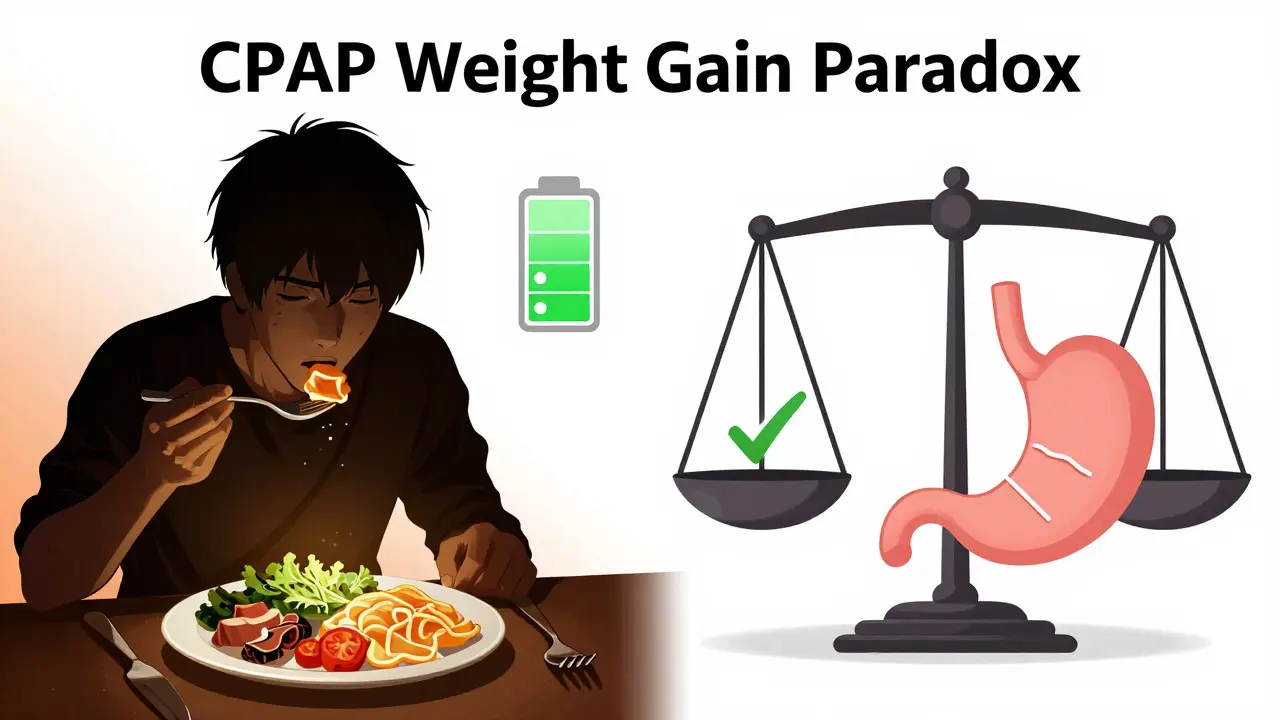
The CPAP Weight Gain Paradox
Here is where things get counterintuitive. You’d expect that treating sleep apnea would make it easier to lose weight, right? After all, better sleep means more energy. While true for many, data suggests a complex metabolic interaction. A 2015 meta-analysis of over 3,000 patients confirmed that CPAP treatment frequently causes a small amount of weight gain, averaging 1.2 kg (about 2.6 lbs) over six months.
Why does this happen? Research indicates two main drivers. First, untreated OSA disrupts hormones: ghrelin (the hunger hormone) is elevated, while leptin (the satiety hormone) is suppressed. Second, once you start CPAP, your basal metabolic rate may decrease slightly as your body no longer has to work so hard to breathe, but your appetite returns to normal levels. This mismatch can lead to increased caloric intake. One study noted a 287 kcal/day increase in self-reported consumption after CPAP initiation.
But there’s good news buried in the data. This weight gain is predominantly seen in patients who use their CPAP inconsistently (less than 5 hours a night). Those who adhere strictly to therapy see minimal weight fluctuation. Furthermore, consistent CPAP use improves insulin sensitivity by nearly 15% in prediabetic patients, which helps regulate blood sugar and reduces cravings. So, the key isn't avoiding CPAP, but pairing it with mindful nutrition and consistent usage.
Practical Steps for Managing Weight and Sleep Together
Managing both conditions requires a coordinated approach. Here is how to make it work:
- Set Realistic Weight Goals: Aim for a 5-10% weight loss initially. For a 200-pound individual, that’s 10-20 pounds. This is enough to produce clinically meaningful AHI reductions without requiring drastic lifestyle overhauls overnight.
- Monitor Your Metrics: Track your daily step count and sleep hours. Many patients report that after three months of combined efforts, their daily steps jump from around 4,200 to 7,800 due to improved energy levels.
- Address Mask Fit Issues: Higher BMI patients often struggle with mask leaks (reported by 57% of high-BMI users). Work with a respiratory therapist to find a mask size that accommodates facial structure changes as you lose weight. A loose mask leads to air leaks, which reduces effectiveness and causes dry mouth.
- Seek Multidisciplinary Care: Studies show that patients receiving care from a team including a sleep specialist, obesity medicine physician, and dietitian lose 42% more weight than those given standard advice alone.
Insurance can also be a hurdle. Medicare typically requires a documented AHI >15 (or >5 with comorbidities) for CPAP coverage. Weight loss programs vary widely, with only about 41% of commercial insurers covering FDA-approved anti-obesity medications. Always check your specific plan details before starting new treatments.
When to Consider Alternative Therapies
For some, CPAP isn't the end-all solution, especially if adherence is low or weight loss stalls. Bariatric surgery remains the most effective intervention for severe obesity-related OSA, with studies showing a 78% resolution rate of OSA one year post-surgery. This compares to a 37% resolution rate with intensive lifestyle intervention alone.
Newer technologies are also entering the market. Devices like the ResMed AirSense 11 AutoSet feature adaptive pressure algorithms calibrated specifically for patients with BMI >35. Similarly, the Philips DreamStation 3 includes integrated weight tracking that can suggest pressure adjustments based on documented changes. These tools help bridge the gap between static prescriptions and dynamic bodily changes.
If you have a BMI between 35 and 40 and find CPAP ineffective, hypoglossal nerve stimulation is another option, showing success rates of up to 71% in this demographic. However, these are generally reserved for cases where conservative measures fail.
| BMI Category | Typical CPAP Pressure Range | Treatment Success Rate (AHI < 5) | Key Challenge |
|---|---|---|---|
| Normal (18.5 - 24.9) | 4 - 8 cm H₂O | 89% | Maintenance of healthy habits |
| Overweight (25 - 29.9) | 8 - 12 cm H₂O | 75% | Mask fit adjustments |
| Obese Class I/II (30 - 39.9) | 12 - 16 cm H₂O | 63% | Air leakage and comfort |
| Obese Class III (≥ 40) | 16 - 20+ cm H₂O | 45-50% | Need for supplemental therapy |
Frequently Asked Questions
Does losing weight always eliminate the need for CPAP?
Not always. While weight loss significantly reduces AHI scores, it rarely eliminates OSA completely unless the apnea was very mild to begin with. For moderate to severe cases, CPAP is often still needed, but at lower pressure settings. About 31% of mild OSA patients can discontinue CPAP after significant weight loss, but this is less common in severe cases.
How much weight do I need to lose to see a difference in my sleep apnea?
A 5-10% reduction in total body weight is the clinical benchmark for seeing meaningful improvements in AHI. For most adults, this translates to losing 10-20 pounds. Even modest losses of 5% can preferentially reduce fat deposits in the upper airway, improving airflow without major overall weight changes.
Why did I gain weight after starting CPAP?
This is known as the CPAP weight gain paradox. It occurs because your metabolism slows slightly as your body stops working so hard to breathe, but your appetite returns to normal. Additionally, inconsistent use of the device can disrupt hormonal balance further. Ensuring you use your CPAP for at least 5 hours a night and maintaining a calorie-controlled diet can mitigate this effect.
Should I change my CPAP pressure myself after losing weight?
No. Always consult your sleep specialist. Adjusting pressure incorrectly can lead to under-treatment (residual apneas) or over-treatment (air leaks and discomfort). Your doctor will likely order a repeat sleep study to measure your current AHI before making any pressure adjustments.
Is bariatric surgery a viable option for sleep apnea?
Yes, for patients with severe obesity (BMI ≥35) and comorbidities, bariatric surgery is highly effective. It resolves OSA in about 78% of patients within one year. However, it is a major surgical procedure and is typically considered when other weight loss methods have failed or when the severity of obesity poses immediate health risks.