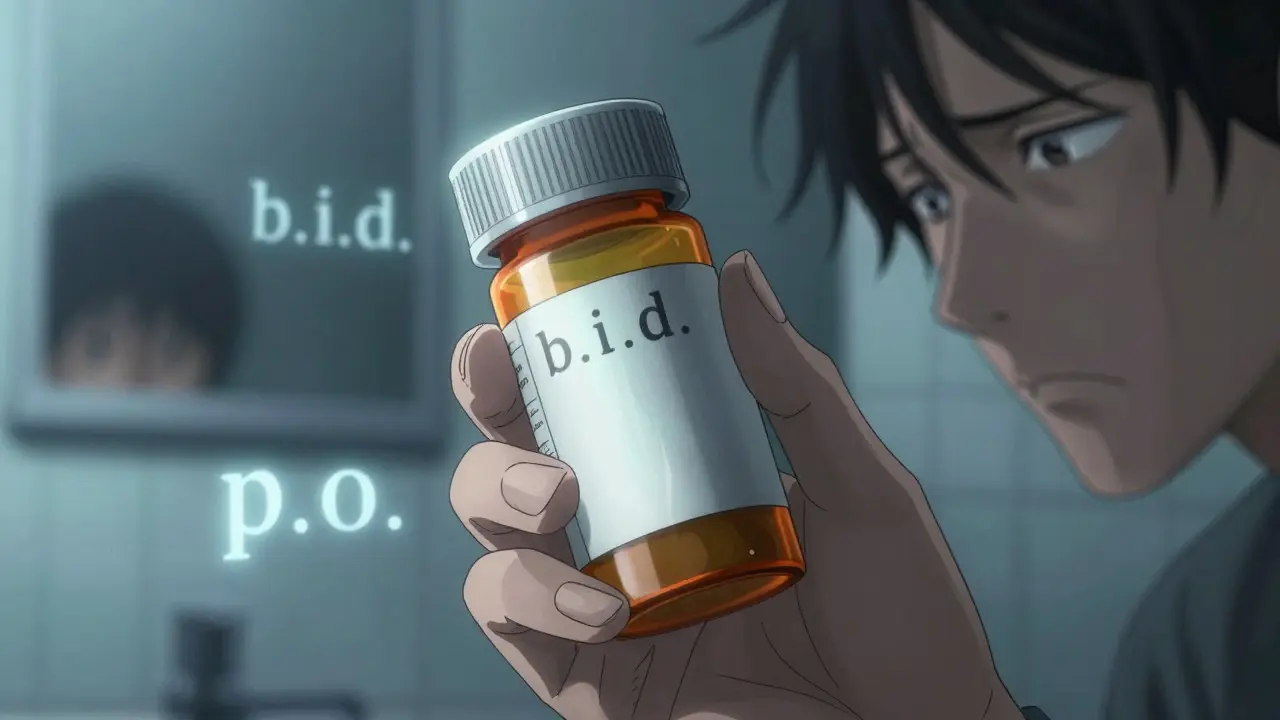
Have you ever stared at a prescription bottle, squinting at tiny letters like b.i.d., p.o., or q.d., and wondered what on earth they mean? You are not alone. These cryptic codes are the legacy of Latin medical terminology that has persisted for centuries. While they were once designed to streamline communication among doctors across Europe, today they often create confusion-and sometimes dangerous errors-for patients and even healthcare professionals.
Understanding these abbreviations is no longer just about passing a pharmacy exam; it is a critical component of personal health safety. In this guide, we will break down the most common prescription labels, explain why some are being banned, and show you how to read your medications with confidence.
The Origins of Medical Shorthand
To understand why our prescriptions look the way they do, we have to look back at history. The symbol Rx is derived from the Latin word 'recipe,' which means 'take' appears on almost every prescription. It was first documented in prescription notation in 1598. Back then, physicians wrote in Latin because it was a universal language among educated Europeans, ensuring that a doctor in France could prescribe for a patient in Germany without language barriers.
Over time, this evolved into a specialized lexicon. However, as English became the dominant language in many healthcare systems, the reliance on Latin shorthand created a gap between professional efficiency and patient understanding. Today, organizations like the World Health Organization (WHO) and the Institute for Safe Medication Practices (ISMP) are pushing to replace these old codes with plain English to reduce errors.
Common Abbreviations You Will See on Labels
Prescription labels typically use abbreviations to save space, but each one carries specific instructions. Here are the most frequent categories you will encounter:
- Frequency: How often you take the drug. For example, b.i.d. stands for 'bis in die,' meaning twice daily. Similarly, t.i.d. means 'ter in die,' or three times daily.
- Route of Administration: How the drug enters your body. p.o. comes from 'per os,' meaning by mouth. If you see SQ or SC it indicates subcutaneous injection.
- Anatomical Location: Where to apply eye or ear drops. O.D. means right eye (oculus dexter), while O.S. means left eye (oculus sinister).
- Condition Codes: Sometimes labels include the condition being treated, such as OSA for obstructive sleep apnea or PAD for peripheral arterial disease.
While knowing these helps, remember that clarity is key. If a label looks unclear, ask your pharmacist to write out the full instruction.

The "Do Not Use" List: High-Risk Abbreviations
Not all abbreviations are safe. Some are notoriously easy to misread, leading to serious medication errors. The Joint Commission maintains an official 'Do Not Use' list of high-risk abbreviations to prevent these mistakes. This list is updated regularly, with significant revisions as recently as January 2023.
Here are the most critical ones to watch out for:
| Abbreviation | Intended Meaning | Common Misinterpretation | Risk Level |
|---|---|---|---|
| U | Units | 0 or 4 | Critical |
| IU | International Units | IV or 10 | High |
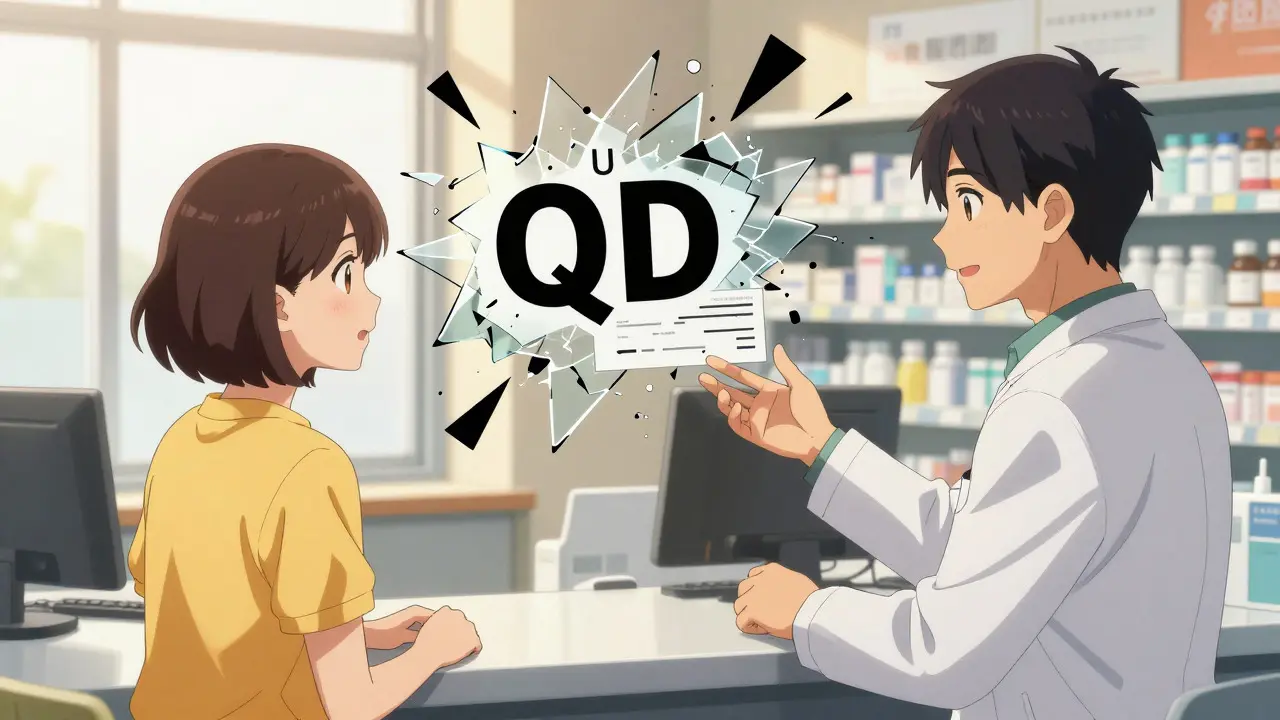
| QD / QOD | Daily / Every Other Day | QID (Four times daily) | High |
| MS | Morphine Sulfate | Magnesium Sulfate | High |
| Trailing Zero (e.g., 1.0 mg) | 1 milligram | 10 milligrams | Critical |
For instance, writing "U" for units can be mistaken for the number 4 or zero, potentially causing a ten-fold dosing error. The Joint Commission specifically prohibits trailing zeros (like 1.0 mg) and requires leading zeros (like 0.5 mg) to prevent these catastrophic mistakes. Always spell out "units" instead of using "U."
Regional Differences: UK vs. US Approaches
How strict should we be with these codes? Different countries have taken different paths. In the United States, the approach is nuanced. While electronic prescribing systems like Epic Systems help standardize orders, community pharmacies still face challenges. A 2023 survey revealed that nearly 68% of community pharmacies still encounter problematic abbreviations from prescribers using hybrid paper-electronic systems.
In contrast, the United Kingdom’s National Health Service (NHS) took a more radical step. In 2019, the NHS eliminated nearly all prescription abbreviations, mandating English-only prescriptions except for standard metric units like mg and mL. The result? A 28.7% reduction in dispensing errors, according to the British Journal of Clinical Pharmacology. This shift highlights a growing global consensus: clarity beats brevity when patient safety is on the line.
The Role of Technology in Reducing Errors
Technology is playing a huge role in cleaning up prescription labels. Electronic Health Records (EHRs) and Computerized Physician Order Entry (CPOE) systems now flag prohibited abbreviations automatically. For example, Epic’s SafeScript module checks for risky codes in real-time, boasting a 98.7% accuracy rate in validation studies.
However, technology isn’t a silver bullet. The transition period creates unique risks. As Dr. Linda Spooner of Johns Hopkins warned, mixed systems operating simultaneously can lead to a temporary increase in errors. That’s why human verification remains essential. Pharmacists and technicians undergo rigorous training-often 16 hours during residency-to master these standards and catch what software might miss.
What Patients Can Do to Stay Safe
You are the last line of defense in your own healthcare. Here is how you can decode your labels safely:
- Ask for Plain Language: Most modern pharmacies, including Walmart and CVS, now convert abbreviations to plain English on patient-facing labels. If yours doesn’t, ask them to.
- Check the Frequency: Make sure you know if "b.i.d." means morning and night, or every 12 hours. Clarify with your pharmacist.
- Verify Eye/Ear Instructions: Confusion between O.D. (right eye) and O.S. (left eye) is common. Double-check which side needs treatment.
- Look for Leading Zeros: Ensure doses under 1 mg are written as 0.5 mg, not .5 mg, to avoid decimal point errors.
If anything looks ambiguous, do not guess. Call your pharmacy. It is better to spend two minutes on the phone than to risk a medication error.
What does Rx stand for on a prescription?
Rx stands for the Latin word "recipe," which means "take." It is a traditional symbol used to indicate the start of a prescription order.
Why are abbreviations like U and QD banned?
These abbreviations are banned because they are easily misread. "U" can look like "0" or "4," and "QD" (daily) can be confused with "QID" (four times daily), leading to dangerous dosing errors.
What is the difference between O.D. and O.S.?
O.D. stands for "oculus dexter," meaning the right eye. O.S. stands for "oculus sinister," meaning the left eye. Using the wrong one can lead to untreated conditions or irritation.
Has the UK stopped using prescription abbreviations?
Yes, the UK's National Health Service largely eliminated prescription abbreviations in 2019, requiring English-only text to improve safety and reduce dispensing errors.
How can I ensure my prescription label is clear?
You can ask your pharmacist to write instructions in plain English rather than using Latin abbreviations. Many major pharmacy chains already do this as part of their safety protocols.

Garry Hedges
August 15, 2026 AT 04:55finally someone said it. these latin codes are archaic and dangerous. i had a pharmacist almost give me 4 times the dose because qd looked like qid to him. just write out the words. its not rocket science.
Jw George John Warren
August 16, 2026 AT 17:50lol imagine being so lazy you cant type 'twice daily'. 🙄 the whole medical industry is run by people who think they are smarter than everyone else but cant even spell out instructions clearly. typical gatekeeping behavior. #fail
Ankit Sinha
August 16, 2026 AT 19:47you guys are missing the point entirely. this isn't about laziness, it's about historical precedence and professional shorthand that has been standardized for centuries. the problem isn't the abbreviation, it's the illiterate prescribers who write illegibly or the pharmacists who don't know their basic latin roots. if you dont understand oculus dexter maybe you shouldnt be handling meds. stop crying about it and learn the terminology instead of demanding everything be dumbed down to kindergarten level english. it creates a false sense of security anyway.
Rachel Robinson Interiors
August 17, 2026 AT 08:56That is a very valid perspective on the history, but patient safety must come first. It is wonderful that you have such a deep understanding of Latin, but most patients do not. When I pick up my prescriptions, I always ask the pharmacist to explain exactly what each code means before I leave the counter. It feels empowering to know exactly what is going into your body rather than guessing at cryptic symbols. Communication is key in healthcare, and plain language bridges that gap effectively.
Ankit Sinha
August 18, 2026 AT 21:44empowerment? please. you are enabling dependency. if you need a translator for every pill bottle you will never take responsibility for your own health. the uk experiment failed in many areas because doctors started over-prescribing when they had to write full sentences. efficiency drops and costs rise. let the professionals handle the jargon and let patients just swallow the pills.
olatunde oluranti
August 20, 2026 AT 19:44its all a scam. the big pharma companies want you confused so you buy more supplements to fix the side effects from the wrong dosage. they ban abbreviations only when it suits their liability insurance. look at the dates. 2019 uk change? right after the last major patent cliff. coincidence? i think not. they want you dependent on the system so you never question why you are taking three different drugs for one symptom. wake up sheeple.
Jamaal Johnson
August 22, 2026 AT 18:53The transition to electronic prescribing systems has undoubtedly mitigated some of these risks, yet the reliance on legacy data entry protocols remains a significant vulnerability. One must consider the cognitive load placed upon healthcare providers during high-stress environments. While the elimination of abbreviations is a noble pursuit, the implementation strategy often lacks the necessary granularity to account for regional linguistic variations and individual practitioner habits. We require a more nuanced approach that balances standardization with practical workflow integration.
Paul Coar
August 24, 2026 AT 09:13i mean... yeah. my doctor writes like he is trying to hide evidence. i once got a script that looked like a spider died on the paper. glad we are moving to digital but still weird how we kept these old codes for so long. feels like we are using abacus math in a quantum computer world lol. good info tho.
Vivek sharma
August 26, 2026 AT 06:03This is a fascinating insight into the cultural shift in medicine! 🌟 In India, we also use a lot of English mixed with local languages, and sometimes the confusion is real. But knowing that Rx comes from 'recipe' (take) is such a cool historical fact! It shows how much our global medical community shares a common root. Let's keep learning and sharing knowledge to make healthcare safer for everyone! 💊✨
teresa baldini
August 27, 2026 AT 23:55Indeed; however, one must ponder the implications of such standardization on the autonomy of the physician. Is it not presumptuous to assume that all patients possess the cognitive capacity to decipher complex medical terminology without guidance? Furthermore, the bureaucratic overhead associated with mandating plain language prescriptions could potentially stifle innovation in clinical documentation practices. One might argue that the current system, flawed as it may appear, fosters a certain level of critical engagement between the provider and the patient.
Jesse Barlau
August 28, 2026 AT 14:13While the historical context provided in the article is certainly interesting, it is perhaps more prudent to focus on the immediate practical applications for the average consumer. The distinction between O.D. and O.S. is particularly vital for those managing ocular conditions, as applying medication to the incorrect eye can lead to unnecessary discomfort or delayed treatment outcomes. It is always advisable to maintain open lines of communication with your healthcare team, ensuring that any ambiguities in prescription labeling are addressed promptly and thoroughly before initiating a new treatment regimen.