
Giving up cigarettes is one of the hardest things you'll ever do, but it's also the single best move you can make for your health. While willpower is great, the reality is that nicotine is a powerful drug that rewires your brain, making the "cold turkey" approach a gamble with high odds of relapse. If you're tired of trying and failing, the good news is that you don't have to do this alone or without help. Using a combination of the right meds and a solid game plan can drastically tilt the odds in your favor.
The Quick Guide to Quitting Options
Before we get into the weeds, here is a snapshot of the primary tools available to help you quit. Most people find that combining a medication with a behavioral strategy-like a support group or a therapist-works better than any single pill or patch alone.
| Medication | How it Works | Pros | Cons |
|---|---|---|---|
| Varenicline | Blocks nicotine receptors in the brain | Highest success rate; reduces cravings | Can cause nausea or vivid dreams |
| Nicotine Replacement Therapy (NRT) | Provides low-dose nicotine to ease withdrawal | Available over-the-counter; flexible | Lower long-term success than prescription meds |
| Bupropion | Antidepressant that reduces nicotine urge | Helps with mood/depression; weight neutral | Can cause insomnia; not for those with seizures |
The Heavy Hitter: Understanding Varenicline
Varenicline (often known by the brand name Chantix) is a prescription medication that targets nicotinic acetylcholine receptors to reduce the pleasure you get from smoking while easing withdrawal symptoms. If you're looking for the most effective single drug, this is usually it. The American Thoracic Society points to it as the top choice because it doesn't just replace nicotine-it blocks it.
In the landmark EAGLES study, varenicline showed a 6-month abstinence rate of 21.8%, which beat out both bupropion and nicotine patches. It's particularly effective for people who haven't had luck with other methods. However, it's not a magic pill. Many users report nausea or incredibly vivid dreams. The trick is to start it 1-2 weeks before your actual quit date, allowing the drug to build up in your system so that by the time you light your last cigarette, the cravings are already muted.
The Versatile Choice: Nicotine Replacement Therapy (NRT)
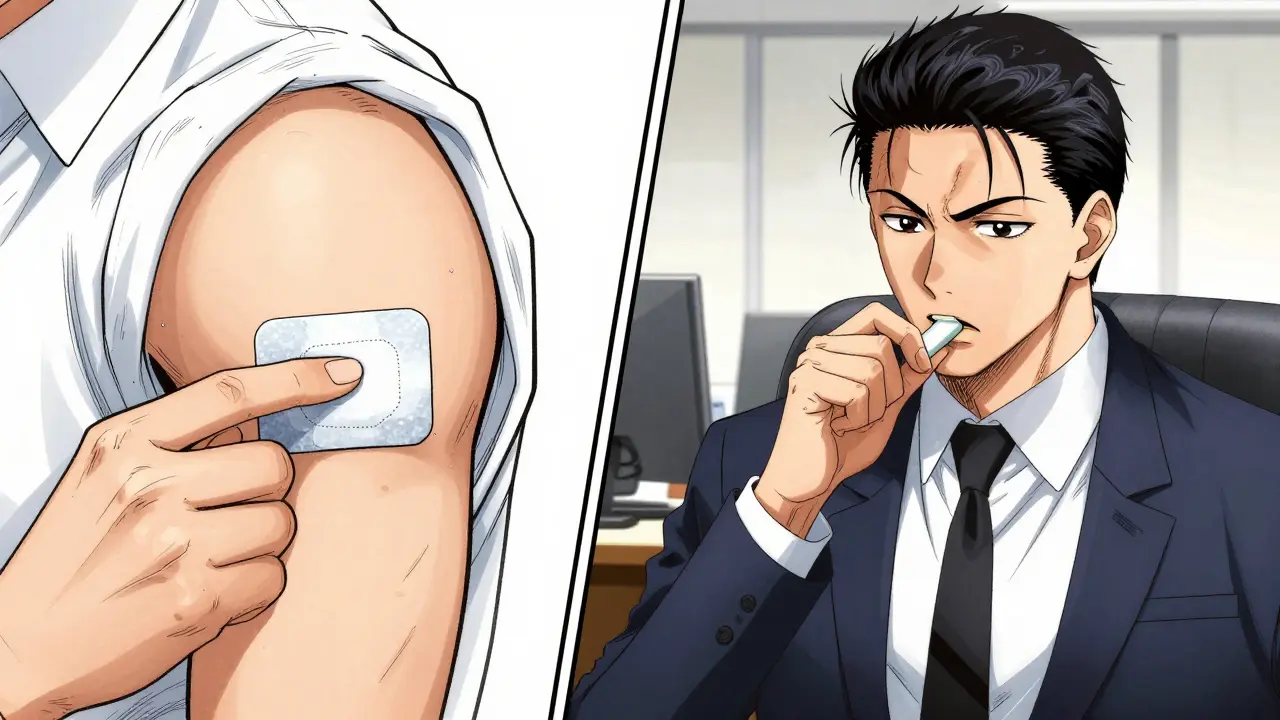
Nicotine Replacement Therapy is a method of delivering nicotine without the harmful tars and carbons found in tobacco smoke. NRT is a favorite because you can buy it at any drugstore without a prescription. It comes in several forms, and the best way to use it is often a "combination attack."
For instance, if you smoke more than 10 cigarettes a day, using a high-dose transdermal patch (21mg) provides a steady baseline of nicotine. Then, when you hit a sudden, intense craving-like during a stressful meeting-you can use a fast-acting nicotine gum or lozenge to kill the urge instantly. This dual-pronged approach is generally more effective than using a patch alone.
The Mood Booster: Bupropion
Bupropion (brand name Zyban) is an antidepressant that was discovered to help people quit smoking by reducing the reward the brain feels from nicotine. It's a great option if you struggle with depression or find that you smoke to manage your mood. Unlike some other cessation aids, it doesn't contain nicotine, so you aren't replacing one addiction with another.
The dosing usually starts at 150mg once daily, moving up to twice daily a week before you quit. While it's not as potent as varenicline in clinical trials, it's a solid alternative for those who can't tolerate NRT or those who need a bit of a mood lift during the stressful quitting process. Just be aware that it can cause insomnia for some, so it's usually best taken early in the day.
Psychological Strategies: More Than Just Pills
Medication handles the chemical side of addiction, but smoking is also a habit. You might smoke because you're bored, stressed, or because it's part of your morning routine. To succeed, you need to replace those habits. The CDC notes that even a few minutes of professional counseling can boost your success rate by 30%.
Try these concrete habit-swaps:
- The Oral Fixation: Keep cinnamon sticks, toothpicks, or crunchy vegetables like carrots nearby. The physical act of chewing or having something in your mouth tricks your brain into feeling satisfied.
- The Trigger Map: Identify when you crave a cigarette most. If it's always after dinner, immediately stand up and wash the dishes or take a 5-minute walk to break the mental link between eating and smoking.
- The 5-Minute Rule: Most intense cravings actually last only about 5 to 10 minutes. When a craving hits, tell yourself you just have to wait 5 minutes. By the time the clock is up, the peak of the urge has usually passed.

Avoiding Common Pitfalls and Relapses
Many people fail not because they lack willpower, but because they don't have a plan for "the slip." A single cigarette doesn't mean you've failed; it just means you had a lapse. The danger is when a lapse turns into a full relapse because you feel defeated.
One of the biggest mistakes is trying to "taper off" too slowly. While some prefer a gradual decrease, clinical evidence suggests that a firm quit date, supported by medication, is more effective. Also, avoid "rewarding" yourself with a cigarette during a stressful moment; this reinforces the idea that smoking is a coping mechanism, which makes the addiction stronger in the long run.
The Cost of Quitting: Budgeting for Success
Money can be a barrier. Varenicline can be expensive without insurance (sometimes around $500 for a full course), while generic bupropion is often very affordable. If you're on a tight budget, check if your insurance covers cessation programs-many do, as it's cheaper for them to pay for your meds than to pay for your future respiratory treatments.
Which medication is the most effective?
Based on the EAGLES study and guidelines from the American Thoracic Society, varenicline is generally the most effective single medication for long-term abstinence, though combining it with nicotine replacement therapy (NRT) can lead to even higher success rates.
Can I use the nicotine patch and gum at the same time?
Yes. This is often recommended for heavy smokers. The patch provides a steady, slow release of nicotine to prevent general withdrawal, while the gum or lozenge handles "breakthrough cravings" that hit suddenly.
How long should I take these medications?
Varenicline is typically taken for a 12-week course, sometimes extended to 24 weeks if necessary. NRT patches are usually tapered down over 8 to 10 weeks, reducing the dose every few weeks.
What are the side effects of varenicline?
The most common side effects include nausea and vivid or strange dreams. Nausea is often managed by taking the medication with food and a full glass of water.
Is it better to quit "cold turkey"?
For most people, no. While some succeed with cold turkey, pharmacotherapy (meds) combined with behavioral support significantly increases the chances of quitting for good by reducing the physical pain of withdrawal.
Tallulah Sandison
April 29, 2026 AT 19:53Just started my journey and the 5-min rule is a lifesaver!! Totaly worth it.
Srinivas Komakula
April 30, 2026 AT 14:35The biochemical modulation of nicotinic acetylcholine receptors is merely a facade for deeper systemic control... One must question the pharmaceutical industrial complex's motive for promoting Varenicline over holistic detox protocols!!! The neuroplasticity mentioned is a double-edged sword, likely designed to create a synthetic dependency that replaces the original organic addiction with a corporate one!!!
Allison Maier
May 1, 2026 AT 10:14meh lol just drink water. too much reading 🙄
Rebekah Korak
May 2, 2026 AT 02:04It is honestly so amusing how people believe a pill can solve a spiritual void that they've spent decades filling with tobacco smoke, because the addiction isn't actually to the nicotine but to the ritual of self-destruction, a dance with the void that we all pretend to avoid until we're staring at a hospital bill. If you haven't contemplated the metaphysical implications of your cravings, you're just treating a symptom while the soul remains malnourished and starving for a purpose that doesn't come in a cardboard pack from a gas station. Most of you are just terrified of the silence that comes when the smoke clears, and that's where the real work begins, far beyond the reach of some prescription from a doctor who spends five minutes looking at your chart. You think a patch is going to save you? Please. Until you align your consciousness with the rhythm of your own breath and realize that the cigarette is just a physical manifestation of your internal chaos, you're just swapping one set of handcuffs for another, more expensive pair. It's a cycle of dependency that feeds on the illusion of control, and frankly, most of you aren't even ready to admit that you enjoy the struggle because it gives you an identity. The 'success rate' is a statistical ghost, a number designed to make you feel like a failure when your spirit isn't aligned. True liberation requires a shedding of the ego, not just a shedding of the habit, and until you understand the symbiotic relationship between your anxiety and your inhalation, you're just playing house with your health.
Spencer Farrell
May 3, 2026 AT 16:12The premise of the aforementioned 'ritual of self-destruction' is an emotionally charged oversimplification of a complex neurobiological process. One must acknowledge that the efficacy of pharmacotherapy is grounded in empirical evidence, not spiritual alignment. The dichotomy between the 'soul' and the 'synapse' is a false one, as the physiological state directly informs the psychological experience.
Ken Baldridge
May 4, 2026 AT 18:37Hold up, let's look at the dopamine loop here! We're talking about a total rewiring of the reward circuitry. If you're hitting that 21mg baseline but still feeling those breakthrough cravings, you're basically fighting a war on two fronts. Just keep pushing through the brain fog, fam; the neuroplasticity will kick in and your baseline will reset eventually!
Robert Cowley
May 4, 2026 AT 22:37Imagine actually believing that a 'combination attack' of gum and patches works lol. It's just adding more chemicals to a chemical problem. 🤡 Absolute joke.
kelvin villa saab
May 6, 2026 AT 00:58Ummm excuse me? This is basic science! Some of u guys are just tryin to make it harder than it is. I tried the patches and they practically fell off my arm... total waste of money if u dont have a good brand!!
princess lovearies
May 7, 2026 AT 12:46It's okay to struggle with this. Be kind to yourselves if you have a slip-up; the journey isn't a straight line. Every day you try is a victory in itself.
Sarah Mifsud
May 8, 2026 AT 21:19I've seen a lot of folks have great success with the cinnamon sticks thing! I mispelled it in my last post but it realy helps with the hand-to-mouth habit.
Prudence Wesson
May 9, 2026 AT 10:04The audacity to suggest a five-minute walk is a 'strategy'... truly pathetic!!! One must have actual disipline, not just 'habit swaps' that look like toddler activities!!!
Bradley Gusick
May 10, 2026 AT 06:09Big Pharma just wants you on Varenicline for life so they can track your neural patterns! Wake up! This isn't about health, it's about behavioral compliance for the New World Order! The patriots will quit with raw willpower and nothing else!
Leah Sentz
May 10, 2026 AT 10:21OMG I can't even deal with the hate in this thread!! 😡 Just follow the guide and stop complaining!!! 🇺🇸🇺🇸🇺🇸✨
Kartik Agarwal
May 12, 2026 AT 03:56For those experiencing severe withdrawal, I suggest focusing on the titration process. The gradual reduction of NRT dosage helps mitigate the acute phase of nicotine deficiency syndrome, ensuring a more sustainable transition to abstinence.
Christina Lancey
May 13, 2026 AT 01:51You can do this. Just take it one hour at a time.