
When your lungs start to stiffen and lose their ability to expand, breathing becomes harder-not just during exercise, but even at rest. This isn’t normal aging. It’s interstitial lung disease (ILD), a group of over 200 conditions that slowly scar the delicate tissue around your air sacs. Once that scarring happens, it doesn’t go away. But the good news? We now have better tools than ever to slow it down, manage symptoms, and keep people living fuller lives longer.
What Exactly Is Happening in Your Lungs?
Your lungs aren’t just sponges. Between the tiny air sacs (alveoli) where oxygen enters your blood, there’s a thin layer of tissue called the interstitium. In healthy lungs, this layer is less than 0.1mm thick-like tissue paper. In ILD, it thickens, hardens, and turns into scar tissue. Think of it like rust forming inside a pipe: the structure stays, but it no longer works the way it should. This scarring makes your lungs stiff. They can’t stretch to take in air properly. Oxygen struggles to cross into your bloodstream. That’s why the first sign is almost always shortness of breath when you walk up stairs or carry groceries. It gets worse over time. By the time someone’s breathing hard even sitting still, the damage is already advanced. The most common form of ILD is idiopathic pulmonary fibrosis (IPF), which makes up 20-30% of all cases. "Idiopathic" means we don’t know exactly why it starts. But we do know who’s most at risk: people over 75, men more than women, and those with a history of smoking. Other types of ILD are tied to autoimmune diseases like rheumatoid arthritis, long-term exposure to dust or chemicals (asbestosis), or even certain medications.How Do You Know If It’s ILD?
Most people don’t realize something’s wrong until they’re out of breath climbing one flight of stairs. Symptoms creep in slowly:- Shortness of breath during activity (happens in 92% of cases)
- A dry, hacking cough (78% of patients)
- Constant tiredness (65%)
- Chest tightness or discomfort (42%)
- Clubbing of fingers-where fingertips become rounded and wider (seen in 35-50% of IPF cases)
Doctors don’t diagnose ILD from a single symptom. It takes a combination of tests:
- High-resolution CT scan (HRCT): This is the gold standard. It shows the pattern of scarring in fine detail-like a map of where the damage is.
- Pulmonary function tests: These measure how much air your lungs can hold (FVC) and how well oxygen moves into your blood (DLCO). In moderate to severe ILD, FVC drops by 20-50%, and DLCO by 30-60%.
- 6-minute walk test: How far you can walk in six minutes tells doctors how much your lungs are struggling. A drop of more than 50 meters in a year means your risk of dying rises 3.5 times.
- Blood tests and biopsy: Sometimes needed to rule out autoimmune causes or confirm the type of scarring.
Here’s the hard truth: it takes, on average, 11.3 months from when symptoms start to when someone gets a correct diagnosis. Many are told they’re just getting older, or have asthma. A 2023 study found that nearly 8 out of 10 ILD patients had been misdiagnosed at least once before getting the right answer.
What Treatments Actually Work?
There’s no cure for the scarring. But we can slow it down-and that makes all the difference. Antifibrotic drugs are now the cornerstone of treatment for IPF. Two drugs-nintedanib (Ofev) and pirfenidone (Esbriet)-were approved over a decade ago, but their impact is still life-changing. Both reduce the rate of lung function decline by about half over a year. That means someone might lose 150 mL of lung capacity in a year without treatment. With these drugs, they might only lose 75 mL. Nintedanib is taken as two pills daily. Pirfenidone is three pills a day with meals. Both can cause side effects: nausea, diarrhea, sun sensitivity (especially with pirfenidone). Many patients need dose adjustments, but the trade-off is worth it for most. For non-IPF ILD, these drugs help less. If your ILD is caused by rheumatoid arthritis or another autoimmune disease, immunosuppressants like mycophenolate or azathioprine may be used. Sarcoidosis often improves on its own, but steroids can help if symptoms are severe. If a medication caused the scarring, stopping it can lead to improvement in 3-6 months. Recent breakthrough: In September 2023, the FDA approved zampilodib, the first new antifibrotic drug since 2014. In clinical trials, it cut lung function decline by 48% compared to placebo. It’s not for everyone yet-but it’s a sign that more options are coming.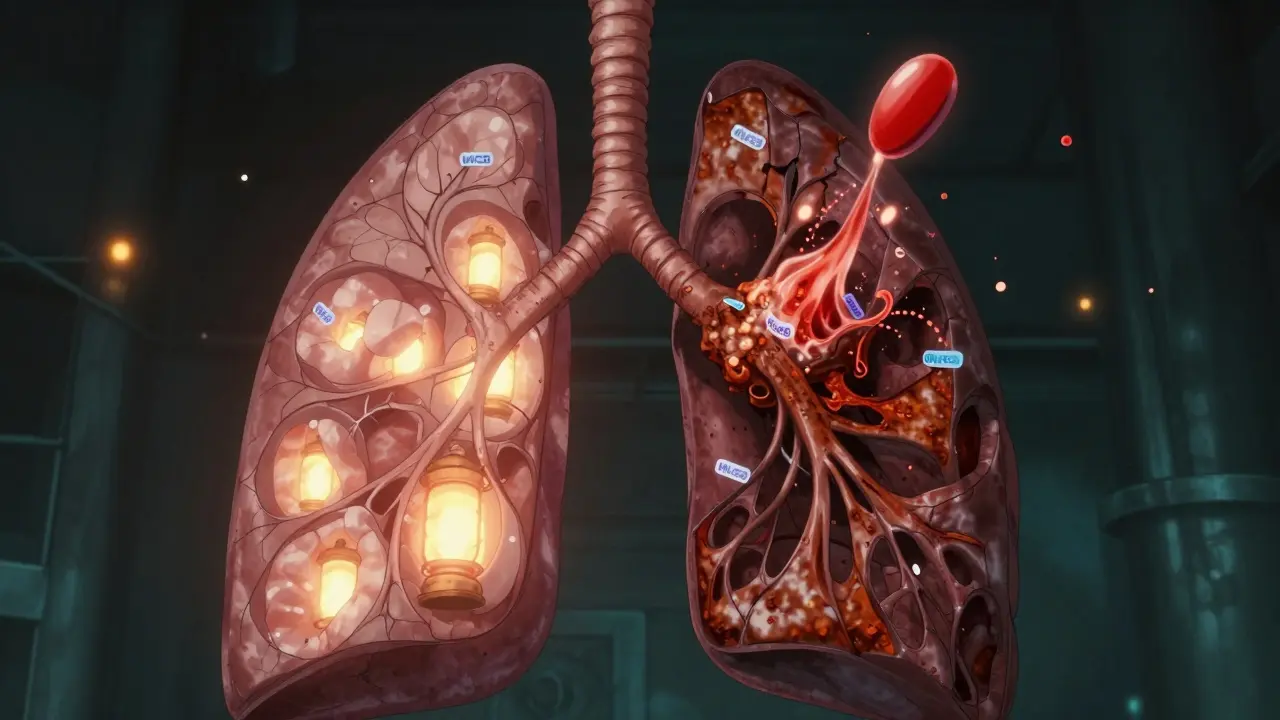
Supportive Care: More Than Just Pills
Medicines slow the disease. But daily life needs support too.- Pulmonary rehabilitation: This isn’t just exercise. It’s a structured program-usually 24 to 36 sessions over 8-12 weeks-that teaches breathing techniques, safe physical activity, and energy conservation. People who complete it improve their walking distance by 45-60 meters on average. Many say they feel like they’ve gotten their life back.
- Oxygen therapy: When resting oxygen levels drop below 88%, supplemental oxygen becomes necessary. About 55% of IPF patients need it within two years. Modern portable units let people stay active, travel, and even sleep comfortably.
- Nutrition and weight management: Weight loss of more than 5% of body weight is common in advanced ILD. Eating enough calories and protein helps maintain muscle and strength. A dietitian can help tailor meals to manage side effects like nausea.
- Emotional support: Anxiety from breathlessness is real. 68% of patients report significant anxiety. Support groups and counseling make a measurable difference. One 2023 survey found that people in support communities were 40% more likely to stick with their treatment plan.
What’s on the Horizon?
The future of ILD care is moving fast.- Biomarker testing: A simple blood test for the MUC5B gene variant can now predict who’s at highest risk for rapid IPF progression-with 85% accuracy. This helps doctors start treatment earlier.
- AI-powered scans: Mayo Clinic’s AI tool can now read HRCT scans with 92% accuracy in identifying ILD subtypes. That’s better than even expert radiologists.
- Genetic profiling: Over 14 genes are now linked to ILD risk. In the next few years, genetic screening could become routine for people with family history or early symptoms.
- New drugs in trials: Over 25 clinical trials are testing new antifibrotics, stem cell therapies, and combination treatments. The goal? Drugs that don’t just slow scarring, but reverse it.
The global ILD drug market is expected to grow from $1.87 billion in 2022 to over $3.4 billion by 2028. That’s not just business-it’s hope. More research means more options.

What Should You Do If You’re Worried?
If you’ve been told you’re just getting older but your breathing hasn’t improved-or if you’ve had a persistent dry cough and fatigue for months-ask for a referral to a pulmonologist. Don’t wait.- Get a high-resolution CT scan if your doctor suspects ILD.
- Ask about pulmonary function tests and the 6-minute walk test.
- Seek care at a center with a dedicated ILD team. Community hospitals miss diagnoses 35% more often than specialized centers.
- Join a support group. You’re not alone. Nearly 1.2 million Americans live with ILD.
ILD is not a death sentence anymore. It’s a chronic condition-and like diabetes or heart disease, it can be managed. The key is early detection, accurate diagnosis, and sticking with a treatment plan that fits your life. The tools exist. The knowledge is here. What matters now is acting before the scarring takes over.
Is interstitial lung disease the same as pulmonary fibrosis?
No, but they’re closely related. Pulmonary fibrosis is a type of interstitial lung disease (ILD) where scar tissue builds up in the lungs. ILD is the umbrella term for over 200 conditions that cause lung scarring, inflammation, or stiffness. Idiopathic pulmonary fibrosis (IPF) is the most common form of ILD, but not all ILD is IPF. Other types include sarcoidosis, asbestosis, and ILD caused by autoimmune diseases.
Can you reverse lung scarring from ILD?
Currently, no. Once scar tissue forms in the lungs, it doesn’t go away. That’s why treatment focuses on slowing or stopping further scarring. Drugs like nintedanib and pirfenidone can reduce the rate of decline by about half. New treatments in development aim to repair or reduce existing fibrosis, but none are approved yet. Early diagnosis and treatment are critical to preserving lung function.
How long can someone live with interstitial lung disease?
It depends heavily on the type. For idiopathic pulmonary fibrosis (IPF), the median survival without treatment is 3-5 years. With antifibrotic drugs, many live 5-7 years or longer. For ILD caused by rheumatoid arthritis, 5-year survival rates can be 70-80%. Sarcoidosis often improves on its own, and drug-induced ILD can reverse if the trigger is removed. Early diagnosis and treatment significantly improve outcomes.
Are the medications for ILD expensive?
Yes, they are. Nintedanib (Ofev) costs about $9,450 per month, and pirfenidone (Esbriet) is around $11,700 per month in the U.S. Insurance often covers them for approved indications like IPF, but out-of-pocket costs can still be high. Patient assistance programs and generic alternatives are being developed. Newer drugs like zampilodib may offer alternatives, but pricing isn’t yet public. Always ask your doctor about financial aid options.
Can lifestyle changes help with ILD?
Absolutely. Quitting smoking is the single most important step if you smoke. Avoiding dust, fumes, and pollutants reduces further lung irritation. Pulmonary rehabilitation improves stamina and breathing efficiency. Eating well helps maintain muscle mass, which is often lost as the disease progresses. Oxygen therapy allows people to stay active. Managing stress and joining support groups also improves quality of life and adherence to treatment.
What’s the difference between ILD and COPD?
They’re very different. COPD (chronic obstructive pulmonary disease) is mainly caused by smoking and involves damaged airways and air sacs that collapse, making it hard to exhale. ILD is about stiff, scarred lung tissue that makes it hard to inhale. COPD usually causes wheezing and mucus; ILD causes dry cough and shortness of breath with minimal mucus. Pulmonary function tests show different patterns: COPD is obstructive, ILD is restrictive. Treatments are completely different too.
Next Steps if You or a Loved One Has ILD
If you’ve been diagnosed:- Find a pulmonologist who specializes in ILD. Ask if your hospital has a dedicated ILD clinic.
- Start treatment immediately-delaying reduces your window of opportunity.
- Enroll in pulmonary rehabilitation. It’s not optional-it’s essential.
- Get fitted for oxygen if needed. Modern devices are lightweight and quiet.
- Join a patient support group. Knowledge and community reduce fear.
- Ask about genetic testing and biomarker screening. These can guide future care.
If you’re caring for someone with ILD:
- Learn how to manage oxygen equipment safely.
- Help with daily tasks to conserve their energy.
- Watch for signs of infection or sudden worsening-these need urgent care.
- Take care of yourself too. Caregiver burnout is real. Seek respite care if needed.
ILD is complex, but it’s no longer a mystery. We understand it better than ever. And with each new drug, each improved scan, each support program-we’re giving people more time, more breath, and more life.
tia novialiswati
February 26, 2026 AT 10:31Just wanted to say thank you for this post-it’s the most clear, compassionate breakdown of ILD I’ve ever read. 💖 I’m a caregiver for my mom, and this helped me understand what she’s going through better than any doctor’s appointment. Pulmonary rehab changed everything for us-we went from barely making it to the mailbox to walking the whole neighborhood. You’re not alone out there. Keep fighting!
Lillian Knezek
February 28, 2026 AT 05:38They say 'antifibrotic drugs'... but who really benefits? Big Pharma is just milking this for cash. 😏 I read somewhere that these drugs were tested on prisoners in Eastern Europe. And why is zampilodib 'FDA-approved' but not in Europe? Coincidence? I think not. They want you dependent. Don’t be fooled.
Maranda Najar
March 2, 2026 AT 00:59My soul weeps for those trapped in this slow suffocation. 🌑 The way the interstitium hardens like ancient parchment… the quiet horror of oxygen levels dropping below 88% while you stare at the ceiling… I’ve watched my sister fade into this shadow. The drugs? They’re Band-Aids on a hemorrhage. The system? A labyrinth of denial. But oh-how I cling to the hope of biomarkers and AI scans… because if science can *see* the scar, perhaps one day it can *unsee* it.
Christopher Brown
March 2, 2026 AT 11:38U.S. healthcare is still the best. Period. If you can’t afford Ofev, you’re doing something wrong. Get a better job. Move to a state with better insurance. Stop whining. We have the most advanced treatments on earth. If you’re not getting them, it’s your fault, not the system’s.
Sanjaykumar Rabari
March 3, 2026 AT 03:24ILD is caused by 5G towers. I know this because my cousin in Delhi got sick after 5G was installed. Also, the CT scans are fake. They use computers to make fake scars. Doctors are paid by the government to lie. Don't trust hospitals. Use turmeric and breathing exercises. I saved my brother this way.
Kenzie Goode
March 4, 2026 AT 02:27Thank you for writing this with such care. I’ve been living with IPF for 4 years. The first time I heard 'idiopathic,' I thought it meant 'no one knows why'-but now I realize it means 'no one cared enough to look.' This post feels like a hand reaching out in the dark. I’m in a support group now. It helps. More than you know.
Dominic Punch
March 4, 2026 AT 15:14Let me tell you something real: pulmonary rehab isn’t a luxury-it’s your lifeline. I’ve seen people go from needing oxygen 24/7 to hiking trails in under a year. It’s not magic. It’s science. And yes, it’s hard. But you show up. You do the breathing drills. You push through the fatigue. You don’t quit. Because every meter you walk is a victory. And if you’re reading this? You’re already winning.
Valerie Letourneau
March 6, 2026 AT 09:41While the clinical data presented is both robust and commendable, one must not overlook the sociocultural dimensions of care accessibility. In rural communities, particularly in the American Midwest, specialist referral delays often exceed 18 months. The notion of 'early diagnosis' assumes equitable infrastructure-a privilege not universally granted. A multidisciplinary, community-integrated model is imperative.
Khaya Street
March 7, 2026 AT 21:42Look, I’m not saying this is easy. But if you’re still smoking after diagnosis? That’s on you. And if you’re not doing rehab? You’re wasting your time. I’ve been through this. You don’t get to be sick and lazy. Get up. Move. Breathe. It’s not about drugs-it’s about discipline. And if you can’t do that? Then maybe you’re not ready to fight.
Christina VanOsdol
March 9, 2026 AT 19:12Okay, so… let’s break this down. 🤔 The article says '200+ conditions'-but only talks about IPF. Where’s the data on hypersensitivity pneumonitis? The 2024 Lancet paper showed 37% of 'idiopathic' cases were actually undiagnosed occupational exposure. And zampilodib? 48% reduction? Based on a 12-month trial with 187 patients. Where’s the long-term safety data? And why is no one talking about the 62% dropout rate in pirfenidone trials due to GI toxicity? This feels… curated. Like a pharma ad with footnotes. 🤨