
Most people think sunscreen is just about avoiding a sunburn. But if you’re not using it right, you’re missing the real point: preventing skin cancer and slowing down 90% of visible skin aging caused by UV rays. The FDA says daily sunscreen use cuts melanoma risk by half. That’s not a guess-it’s backed by data from the American Academy of Dermatology. Yet, most people still get it wrong. They pick the highest SPF they see, skip reapplication, or rub on a thin layer and call it good. Here’s what actually matters.
What SPF Really Means (And Why Higher Isn’t Always Better)
SPF stands for Sun Protection Factor. It measures how well a sunscreen blocks UVB rays-the ones that burn your skin. SPF 30 blocks 97% of UVB. SPF 50 blocks 98%. SPF 100? That’s 99%. The jump from 30 to 50 gives you barely more protection, but it can make you feel invincible. That’s dangerous. No sunscreen lasts longer just because the number is bigger. SPF 100 doesn’t mean you can stay out all day without reapplying. It still breaks down after two hours-or sooner if you sweat, swim, or towel off.
The FDA’s testing protocol uses 20 people with light skin (Fitzpatrick types I-III) under controlled lab conditions. Real life? You’re running around, sweating, touching your face, wiping your nose. That’s why even SPF 50 can drop to SPF 15 if you don’t apply enough. The rule is simple: you need 2 mg per square centimeter of skin. For your face, that’s about a quarter teaspoon. Think of it as five pea-sized dots-forehead, nose, each cheek, chin-and then spread them out. Most people use less than half that. That’s why your nose still peels.
Broad Spectrum Isn’t Just a Marketing Word
UVB burns. UVA ages. UVA rays go deeper, damage DNA, and cause wrinkles, dark spots, and skin cancer. If a sunscreen doesn’t say “broad spectrum,” it’s only protecting you from sunburn-not the silent damage that builds up over years. The FDA requires broad-spectrum sunscreens to pass a test called Critical Wavelength. The product must block UV rays up to 370 nanometers. That’s the minimum to cover the full UVA range.
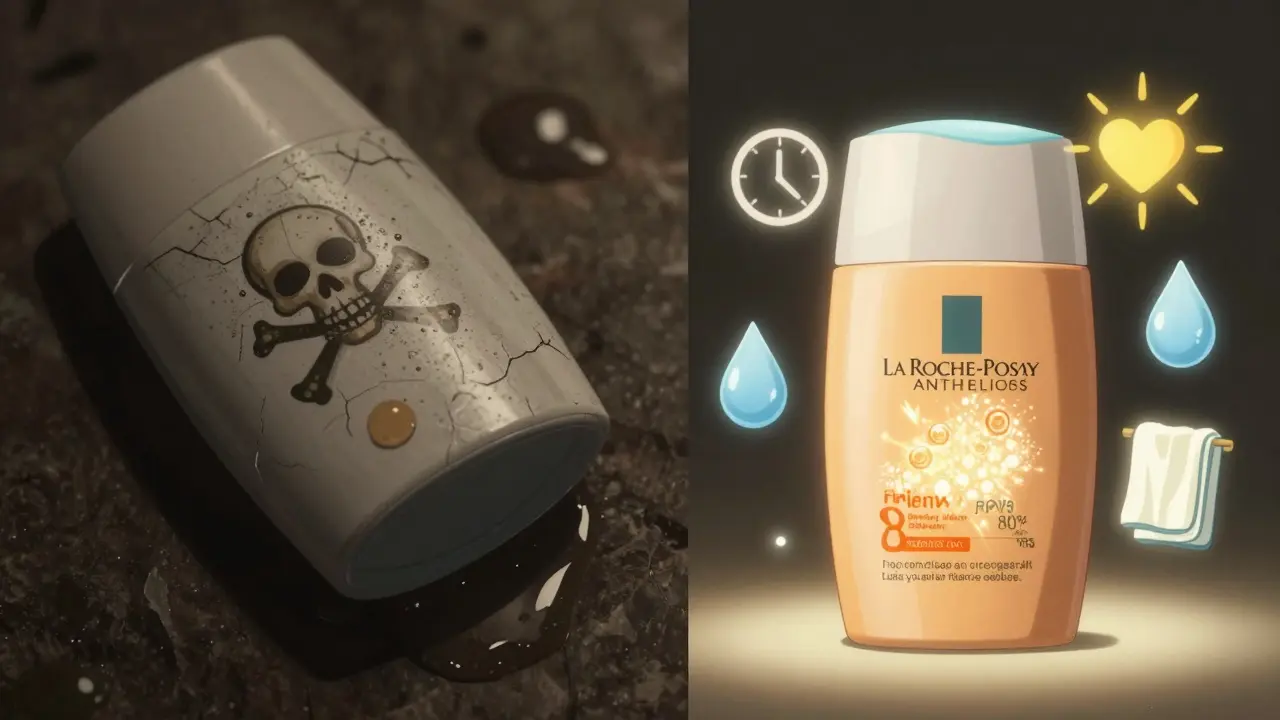
But here’s the problem: not all broad-spectrum sunscreens are equal. Consumer Reports tested over 100 products in 2025. The top performer? La Roche-Posay Anthelios Melt-in Milk SPF 60. It blocked 98% of UVA and UVB. The best mineral option? Blue Lizard Sensitive SPF 50. It scored 55 out of 100. Why? Many mineral sunscreens use too little zinc oxide or titanium dioxide. One product labeled SPF 30 only blocked UV at SPF 4 levels. That’s not a typo. That’s a real product sold in stores.
Mineral vs. Chemical: Which Should You Use?
There are two types of active ingredients: mineral (zinc oxide, titanium dioxide) and chemical (avobenzone, octinoxate, oxybenzone). Mineral sunscreens sit on top of your skin and reflect UV. Chemical ones absorb it. Mineral sunscreens work immediately. Chemical ones need about 15 minutes to activate. That’s why dermatologists recommend applying chemical sunscreens before getting dressed.
Mineral sunscreens are often better for sensitive skin, rosacea, or melasma. EltaMD UV Clear SPF 46, with 9% zinc oxide and niacinamide, is a top pick for acne-prone or reactive skin. But they often leave a white cast-especially on darker skin tones. That’s why brands like Black Girl Sunscreen and Caravee have gained popularity. But even some “tinted” mineral sunscreens oxidize. One Sephora reviewer said her Vichy tinted SPF 60 turned orange within two hours.
Chemical sunscreens? They’re usually lighter, invisible, and more effective at UVA protection. Supergoop! Unseen Sunscreen SPF 40 disappeared on NC45 skin in Amazon reviews. But they can sting your eyes. Thirty-seven percent of users on Reddit’s r/SkincareAddiction say chemical sunscreens burn their eyes. Oxybenzone is also linked to coral reef damage. Hawaii banned it in 2021. If you swim in oceans, look for “reef-safe” labels-but know that term isn’t regulated. Zinc oxide and titanium dioxide are the only truly reef-safe filters.

Reapplication: The Most Ignored Rule
You’re not supposed to reapply sunscreen because it’s “gone.” You reapply because it’s rubbed off, sweated off, or broken down by sunlight. The FDA says every two hours. The American Academy of Dermatology says immediately after swimming or sweating-even if the bottle says “80 minutes water resistant.” That’s because towel drying removes up to 80% of the product. Most people don’t know this. A 2024 study found only 14.3% of beachgoers reapply sunscreen on schedule.
And no, spray sunscreens aren’t easier. You need to spray generously and rub it in. The FDA says sprays often deliver less than half the recommended amount. If you’re using a spray, spray it twice over each area and rub it in. Don’t just mist. You’re not watering a plant.
People skip reapplication because it’s inconvenient. But here’s a trick: keep a mini bottle in your bag, car, or desk. Use a stick for touch-ups on your nose and ears. There are UV-detecting apps like Sunscreenr that show you where you missed spots. They use your phone camera to reveal unprotected skin. It’s weird, but it works.
What’s Really in Your Sunscreen?
The FDA has approved 17 active ingredients for OTC sunscreens. But only two are mineral: zinc oxide and titanium dioxide. The rest are chemical filters. Avobenzone is the most common UVA blocker, but it breaks down in sunlight unless stabilized with octocrylene or other ingredients. That’s why you see complex ingredient lists.
The FDA proposed banning 12 chemical filters in 2019 because they’re absorbed into the bloodstream and lack long-term safety data. Oxybenzone is one of them. It’s still allowed at up to 6% in the U.S., but capped at 2.2% in the EU. The final rule is expected in late 2025. Until then, if you’re worried, stick with zinc oxide or titanium dioxide.
Don’t be fooled by “natural” or “clean” labels. They mean nothing legally. A product can say “chemical-free” and still contain octinoxate. Check the ingredient list. If you see avobenzone, octinoxate, or oxybenzone, it’s chemical. If you see zinc oxide or titanium dioxide, it’s mineral.
Price Doesn’t Equal Protection
Some sunscreens cost $55 an ounce. Others are $3. The median price? $14.75 per ounce. La Roche-Posay and CeraVe dominate dermatologist recommendations. Neutrogena leads in sales. But Consumer Reports found that cheaper sunscreens often outperform expensive ones. CVS Health SPF 50 spray scored just as well as high-end brands. JLo Beauty’s SPF 30 moisturizer? It’s a fancy product, but not necessarily better protection.
What you’re paying for is texture, scent, packaging, or brand. If you like the way it feels, you’ll use it. And that’s the point. A sunscreen you hate? You won’t use it. A sunscreen you love? You’ll reapply. Find one that doesn’t pill under makeup, doesn’t sting your eyes, and doesn’t leave a white cast. Test it for a week before committing.
Who Needs What?
- Everyday use (city, office, driving): SPF 30+ broad spectrum. Mineral or chemical. Look for niacinamide or hyaluronic acid for added skin benefits.
- Outdoor activities, beach, sports: SPF 50+ water-resistant (80 minutes). Chemical filters preferred for better UVA coverage. Reapply every 2 hours.
- Sensitive skin, rosacea, melasma: Mineral sunscreen with zinc oxide 10% or higher. EltaMD UV Clear is the gold standard.
- Darker skin tones: Look for tinted mineral or invisible chemical formulas. Caravee, Black Girl Sunscreen, and Supergoop! Unseen are top-rated.
- Swimming or ocean use: Zinc oxide or titanium dioxide only. Avoid oxybenzone and octinoxate to protect reefs.
Final Checklist: Are You Doing It Right?
- Is your sunscreen labeled “broad spectrum”? If not, throw it out.
- Is the SPF 30 or higher? SPF 15 is no longer enough for daily use.
- Did you apply a quarter teaspoon to your face? Use the pea method.
- Did you reapply after swimming, sweating, or towel drying?
- Did you reapply every two hours-even if you’re not outside?
- Do you use sunscreen on cloudy days? UVA rays penetrate clouds.
- Do you check the expiration date? Sunscreen loses effectiveness after 3 years.
The truth? Sunscreen isn’t magic. It’s a tool. And like any tool, it only works if you use it correctly. You don’t need the most expensive one. You don’t need SPF 100. You just need to use it every day, use enough, and reapply like clockwork. Your skin will thank you in 10 years.
Do I need sunscreen if I have dark skin?
Yes. While darker skin has more natural melanin protection, it’s not immune to UV damage. UVA rays still cause premature aging, dark spots, and skin cancer. In fact, melanoma in darker skin tones is often diagnosed later and has higher mortality rates. Use broad-spectrum SPF 30+ daily. Look for tinted formulas to avoid white cast.
Can I use last year’s sunscreen?
Most sunscreens expire after 3 years. Check the expiration date on the bottle. If there’s no date, assume it’s good for 12 months after opening. If the texture changes-becomes grainy, separates, or smells off-pitch it. Expired sunscreen won’t protect you, even if it looks fine.
Is spray sunscreen safe and effective?
Sprays can be effective if used correctly, but most people apply too little. The FDA says you need to spray generously and rub it in. Don’t just mist. For full coverage, spray twice over each area and massage it in. Avoid using sprays in windy conditions or near open flames. They’re fine for touch-ups but not ideal as your only sunscreen.
Do I need sunscreen on cloudy days or indoors?
Yes. Up to 80% of UV rays penetrate clouds. UVA rays also pass through windows. If you sit near a window at home or in the office, you’re still exposed. Daily sunscreen is for protection, not just beach days. Dermatologists recommend it as part of your morning routine, like brushing your teeth.
Can I rely on makeup with SPF instead of sunscreen?
No. Most makeup with SPF has too little product applied to give real protection. You’d need to apply 7 times the normal amount of foundation to reach the labeled SPF. Use a dedicated sunscreen underneath. Makeup with SPF is a bonus, not a replacement.
Why does my sunscreen pill under makeup?
Pilling happens when the sunscreen doesn’t fully absorb or when it’s incompatible with your moisturizer or foundation. Wait 15 minutes after applying sunscreen before putting on makeup. Use lightweight, non-greasy formulas. Avoid layering thick creams underneath. Some sunscreens, like Supergoop! Unseen, are specifically designed to work under makeup.
Is mineral sunscreen better for the environment?
Yes. Zinc oxide and titanium dioxide are the only ingredients proven to be reef-safe. Chemical filters like oxybenzone and octinoxate have been linked to coral bleaching and DNA damage in marine life. If you swim in oceans or lakes, choose mineral sunscreens labeled “reef-safe.” Even if not regulated, it’s the safest choice for the environment.
kate jones
January 30, 2026 AT 13:23SPF 30 blocks 97% of UVB? That’s the number most people don’t realize is already sufficient. The jump to SPF 50 is negligible, but the psychological effect is massive-people think they’re invincible. And then they don’t reapply. The real issue isn’t the number on the bottle, it’s the amount applied. Most people use half the recommended dose. Two mg per cm² isn’t just a lab number-it’s what actually protects you.
Also, broad spectrum isn’t optional. UVA is the silent killer. It doesn’t burn, it just ages you into wrinkles and dark spots while you’re scrolling through your phone at the window. And yes, that’s still UV exposure. Daily use isn’t a luxury-it’s preventative medicine.
Mineral sunscreens with zinc oxide are the gold standard for sensitivity and reef safety. No debate. If you’re swimming in the ocean, avoid oxybenzone. Period. The science is settled. The FDA’s still dragging its feet, but we don’t need their final rule to do the right thing.
And spray sunscreens? Don’t fool yourself. You’re not getting full coverage unless you’re spraying twice and rubbing it in like you’re buffing a car. Most people just mist. That’s not sunscreen. That’s a fantasy.
Bottom line: Use enough. Reapply. Don’t trust the hype. Your skin doesn’t care how expensive your sunscreen is. It only cares if you used it right.
Natasha Plebani
January 31, 2026 AT 13:21There’s a deeper philosophical layer here: we treat sunscreen like a ritual rather than a responsibility. We want the ritual to be easy-high SPF, spray-on convenience, ‘natural’ branding-so we don’t have to confront the truth that protection requires discipline.
UV radiation doesn’t negotiate. It doesn’t care if you’re ‘too busy’ or ‘didn’t think it was necessary’ because it was cloudy. It doesn’t care if your sunscreen costs $55 or $3. It only responds to molecular absorption and physical blocking. The science is cold. The consequences are warm-melanoma doesn’t announce itself with a red flag. It creeps in under a mole you thought was ‘just a freckle.’
We’ve outsourced our health to marketing. ‘Reef-safe’ is unregulated. ‘Chemical-free’ is meaningless. ‘Anti-aging’ is a sales pitch. The only real metric is the active ingredient list. Zinc oxide. Titanium dioxide. Avobenzone stabilized. That’s it.
Our culture rewards convenience over consistency. But skin cancer doesn’t care about your morning routine. It only cares if you showed up. And most days, we don’t.
Kelly Weinhold
February 1, 2026 AT 11:47Okay I just want to say I started using sunscreen daily after reading this and I swear my skin has never looked better?? Like I used to get this weird redness around my nose and now it’s just… gone??
I got the CeraVe SPF 50 because it was cheap and my dermatologist said it’s solid and I put it on every morning like clockwork-even on weekends when I’m just in pajamas. And I keep a mini bottle in my purse and reapply before I leave the house for lunch. It’s not perfect but I’m trying!!
Also I bought the Black Girl Sunscreen for my sister and she cried because it didn’t leave a white cast. Like, she actually cried. I didn’t know sunscreen could be emotional.
And yes I know sprays are trash but I use them on my legs at the beach because I’m lazy. But I rub it in. I promise I rub it in. I’m not a monster.
Y’all just use sunscreen. It’s not hard. Your future self will hug you. I promise.
Kimberly Reker
February 2, 2026 AT 22:39One thing people forget: sunscreen isn’t just for the beach. It’s for your commute, your porch, your office window, your car ride home. UVA penetrates glass. That’s not a myth. That’s physics.
I used to skip it on cloudy days. Then I got a UV meter app and tested it. My porch at 10 a.m. on a gray day? Still 70% of peak UV. That’s enough to cause cumulative damage.
Also, don’t ignore your ears, neck, and hands. Those are the first places to show aging. I keep a stick in my glovebox and reapply on the drive home. It’s become part of my routine-like buckling my seatbelt.
And yes, mineral sunscreens can be thick. But the new tinted ones? Game changer. No more ghost face. Just clear skin and zero guilt.
You don’t need expensive. You need consistent. And you need enough. That’s it.
Eliana Botelho
February 4, 2026 AT 06:09Let’s be real-this whole sunscreen thing is overblown. You’re telling me I need to reapply every two hours? What am I, a lab rat? I’ve been using SPF 15 since I was 16 and I’m 42 and I’ve never had skin cancer.
And who even tested these ‘broad spectrum’ claims? Some FDA guy in a lab with 20 white people? What about people with melanin? Your ‘science’ doesn’t apply to everyone.
Also, zinc oxide leaves a white cast? So I’m supposed to pay $50 for a tinted sunscreen just so I don’t look like a ghost? That’s capitalism, not skincare.
And don’t get me started on ‘reef-safe.’ You think your sunscreen is killing coral? The real killers are plastic waste, runoff, and climate change. Stop blaming the lotion.
Just go outside. Get some sun. Your body makes vitamin D. You don’t need a chemical barrier to live your life.
Rob Webber
February 5, 2026 AT 10:47You people are ridiculous. SPF 30 is enough. Reapplying every two hours is a scam designed by Big Sunscreen to sell you more product. I’ve never reapplied and I’ve never burned. I’ve got olive skin. I’m fine.
And stop acting like mineral sunscreen is some holy grail. Zinc oxide clogs pores. It’s a grease trap for acne. I’ve tried three different ones. All of them broke me out. Chemical sunscreens work better. Period.
Also, ‘broad spectrum’ is a marketing term. The FDA doesn’t even test it properly. You think they care if your sunscreen blocks UVA? They care if the bottle says ‘SPF 50’ and the label looks pretty.
And don’t tell me about ‘UV rays through windows.’ I sit in a cubicle. I’m not a lizard. I’m not getting cancer from my desk.
This post is fearmongering dressed up as science. I’m not falling for it.
calanha nevin
February 6, 2026 AT 12:35Consistent daily use of broad spectrum SPF 30 or higher reduces melanoma risk by 50 percent according to the American Academy of Dermatology. This is not anecdotal. This is longitudinal data.
Application quantity matters more than SPF number. Two milligrams per square centimeter is the standard. Most users apply 0.5 to 0.8. This reduces protection to SPF 10-15 regardless of labeling.
Reapplication after water exposure or perspiration is non-negotiable. Towel drying removes up to 80 percent of topical protection. Water resistance is not immunity.
Mineral filters zinc oxide and titanium dioxide are the only ingredients with established long-term safety and environmental neutrality. Chemical filters remain under FDA review for systemic absorption.
Texture preference should not override efficacy. Find a formula that works for your skin. But do not compromise on broad spectrum or SPF 30 minimum.
Protection is not optional. It is preventive medicine.
Use it. Use enough. Reapply.
Lisa McCluskey
February 8, 2026 AT 09:42I used to hate sunscreen. It felt greasy. It made my makeup cake. I thought I didn’t need it because I didn’t burn.
Then I started using Supergoop! Unseen. It disappeared under foundation. No white cast. No pilling. I didn’t even notice I was wearing it.
Now I keep a mini bottle on my nightstand. I put it on before my moisturizer. It’s part of my routine like brushing my teeth.
I also started using a UV detector app. It showed me I was missing my eyelids and the sides of my nose. I had no idea.
It’s not about perfection. It’s about showing up. Even 80 percent of the time is better than 20.
And yes I still forget sometimes. But now I don’t feel guilty. I just try again tomorrow.
owori patrick
February 9, 2026 AT 05:38Back home in Nigeria we don’t talk much about sunscreen. But I’ve noticed my cousins who moved to the US and started using it daily-they look younger. No dark spots. No wrinkles around eyes by 30.
My aunty used to say sun is good for skin. But now she uses a tinted mineral SPF 30 because her melasma got worse.
Here’s the truth: we all need it. Even if your skin doesn’t burn. UVA doesn’t care about your tone. It just ages you.
Find something you don’t hate. Even if it’s cheap. Even if it’s from CVS. Use it every day. That’s the win.
And if you’re swimming in the ocean? Use zinc oxide. No debate. The sea doesn’t have a voice. But we do. We protect it by what we put on our skin.