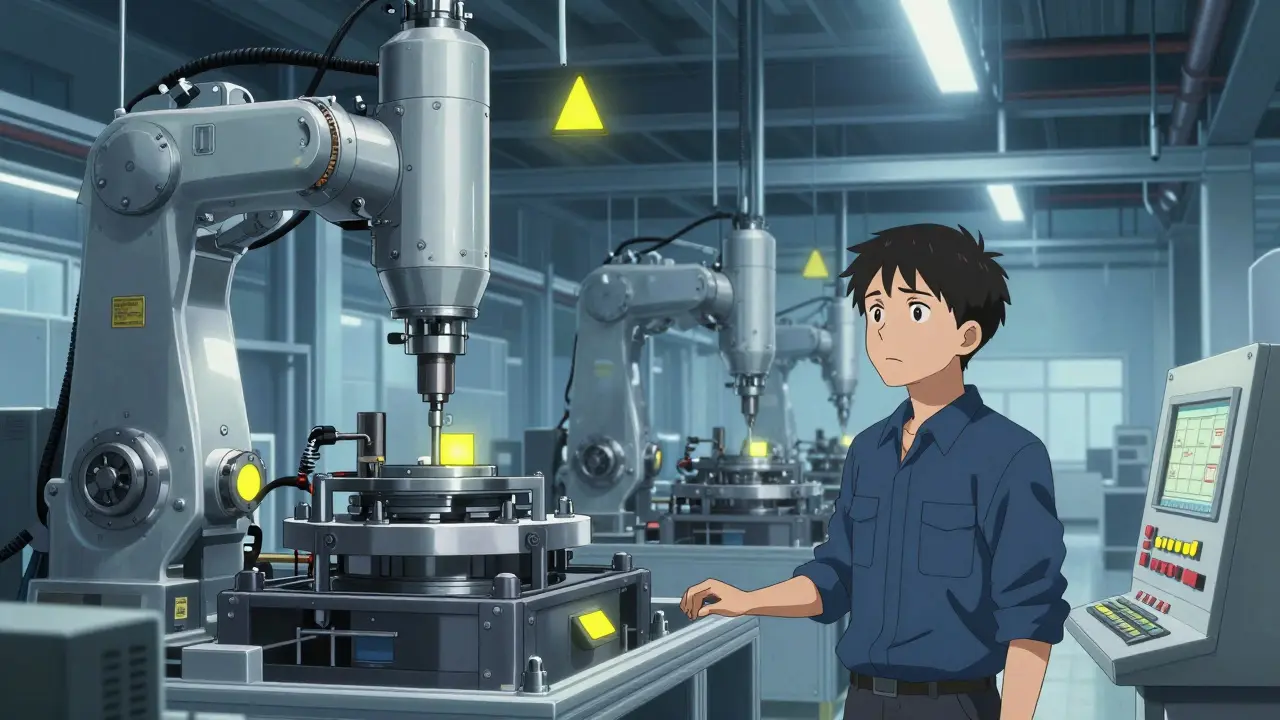
Imagine a factory floor where every machine is state-of-the-art, but the people operating them are struggling to keep up. It happens more often than you'd think. According to data from the National Association of Manufacturers, about 78% of manufacturers are currently feeling the pinch of skills gaps. When staff aren't properly qualified, you don't just lose time; you lose money through errors and, in the worst cases, compromise safety. The real challenge isn't just finding people who can push buttons-it's building a workforce that understands the "why" behind the process.
| Path | Typical Requirement | Primary Benefit | Estimated Time/Cost |
|---|---|---|---|
| Entry-Level | High School Diploma | Quick onboarding | Immediate / Low cost |
| Technical Certs | CPT / MT1 | High portability & wage potential | Months / Moderate cost |
| Process Mastery | Six Sigma (Green/Black) | Waste reduction & quality control | 100-240 hours / Variable cost |
| Advanced Degree | B.S. Industrial Engineering | Management & design capability | 4 Years / High cost |
The Baseline: Entry-Level and Technical Credentials
For many companies, a high school diploma is the starting line. In fact, 92% of employers accept this as the baseline. But here is the catch: relying solely on a diploma often leads to higher turnover-roughly 37% higher than for certified staff. To bridge this gap, industry-recognized certifications have become the gold standard. Certified Production Technician (CPT) is a nationally portable credential developed by the Manufacturing Skill Standards Council (MSSC) that validates skills in safety, quality practices, and maintenance. If you want a worker who can hit the ground running with minimal supervision, this is the benchmark.
Similarly, the Manufacturing Technician Level 1 (MT1) provides a structured way to validate a worker's ability to operate basic equipment. While these certifications might seem like extra paperwork, the payoff is concrete. Workers with formal certifications often show a 28% increase in productivity, measured by Overall Equipment Effectiveness (OEE). It's the difference between someone who "thinks" they know how to run the machine and someone who has been objectively tested on it.
Mastering Quality with Six Sigma and Lean
Technical skill is great for running a machine, but manufacturing staff qualifications must also include process improvement. This is where Six Sigma is a set of techniques and tools for process improvement that seeks to improve the quality of the process outputs by identifying and removing the causes of defects. It isn't a one-size-fits-all badge; it's a tiered system. A "White Belt" provides basic awareness, while a "Green Belt" or "Black Belt" involves deep statistical analysis and project management.
The financial impact here is significant. According to ASQ salary surveys, a Black Belt can earn a median salary of $110,000 compared to $85,000 for a Green Belt. However, this doesn't happen overnight. Preparing for a Black Belt can take up to 240 hours of study. For the business, the ROI is found in reduced waste and fewer defective parts. When you have a certified Six Sigma expert on the floor, you aren't just fixing mistakes-you're preventing them from happening in the first place.
The Critical Role of Safety Training
You can have the most skilled technician in the world, but if they cause an accident, the production line stops. Safety isn't just a checkbox; it's a core qualification. Training aligned with OSHA (Occupational Safety and Health Administration) standards is non-negotiable. Proper safety training has been shown to reduce workplace injuries by a staggering 52%.
A comprehensive safety program should cover four key pillars:
- PPE Mastery: Knowing not just what to wear, but when and why.
- Emergency Response: Immediate actions for chemical spills or machine malfunctions.
- Equipment Troubleshooting: Recognizing a failing part before it becomes a hazard.
- Recertification: Regular updates to keep safety top-of-mind, though surprisingly, only 38% of small manufacturers do this consistently.

Bridging the Gap: Technical vs. Soft Skills
Here is a truth that often gets ignored in training manuals: technical skill alone isn't enough. Dr. John P. Kotter from Harvard Business School pointed out that 70% of production failures actually stem from communication breakdowns, not technical errors. If your team can't communicate a machine glitch to the next shift, the best certification in the world won't save the batch.
The modern manufacturing environment requires a blend of mechatronics and interpersonal skills. With the rise of Industry 4.0, we're seeing a shift where digital literacy is just as important as mechanical aptitude. Younger workers often bring high digital literacy but lack the "mechanical feel" that veteran workers possess. The most successful plants are those implementing cross-training initiatives. Rotating workers through different stations not only increases versatility but reduces resistance to new technology by about 41%.
Implementing a Training Strategy That Works
Don't just throw your employees into a random course. The most effective training starts with a skill assessment. Use your current production metrics and incident reports to find where the holes are. Companies that target their training based on actual data report 33% faster skill acquisition.
If you're a smaller shop, financing these programs can be tough-about 63% of small manufacturers struggle with the cost. However, look into the Manufacturing Extension Partnership (MEP), which offers free consultations. For larger enterprises, the goal should be a "blended approach." This means combining on-the-job training (OJT) with formal certifications. This hybrid model ensures that the theory learned in a classroom actually translates to the specific machines on your floor.
The Future of Manufacturing Credentials
We are moving toward a world of "micro-credentials." Instead of one massive degree that takes four years, workers are earning stackable certifications. This allows them to gain a specific skill-like Python for data analytics or a specific robotic arm certification-and add it to their professional profile incrementally. By 2025, over 60% of manufacturers plan to adopt this model.
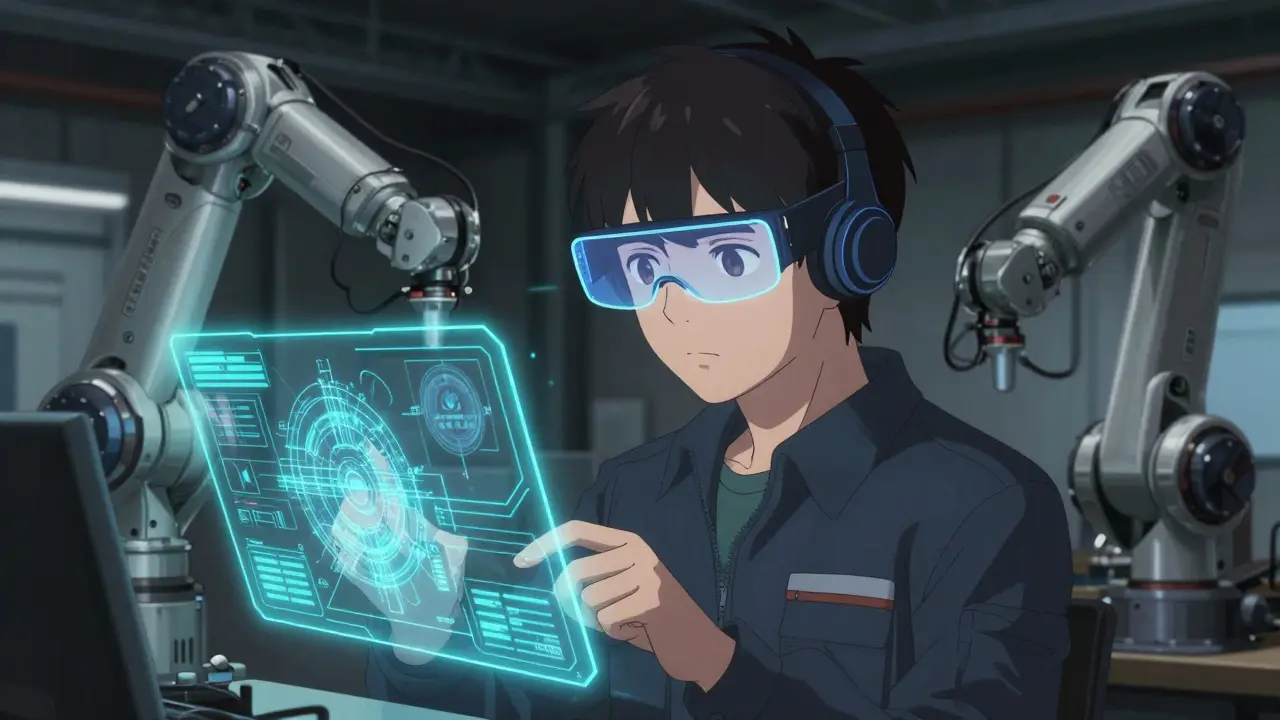
We are also seeing the integration of Augmented Reality (AR) for assembly training. Some reports suggest that using AR for complex tasks can reduce assembly errors by 39%. The goal is to move away from the "read the manual and hope for the best" method toward an interactive, validated system of learning.
Which certification is best for entry-level production workers?
The Certified Production Technician (CPT) from the MSSC is widely considered the best for entry-level staff because it is nationally recognized and covers the essential basics of safety, quality, and maintenance, making the worker more portable across different companies.
How long does it take to get Six Sigma certified?
It depends on the belt level. A Green Belt typically requires 100 to 160 hours of study and the completion of a real-world project. A Black Belt requires a more significant commitment, often ranging from 100 to 240 hours of preparation and a more complex project.
Does a university degree always beat a certification?
Not necessarily. While a bachelor's degree in Industrial Engineering is essential for high-level management and process design, technical certifications like MT1 or CPT provide more immediate, practical value on the factory floor and often lead to faster employment and higher initial wages for technicians.
How can small manufacturers afford these certifications?
Small businesses can leverage the Manufacturing Extension Partnership (MEP) for free consultations and look for state-funded incentives. Additionally, focusing on "stackable" micro-credentials allows the company to invest in smaller, more affordable training modules over time.
Why is soft skills training important in a technical environment?
Because technical skill only solves technical problems. Research indicates that up to 70% of production failures are actually caused by communication breakdowns. Teaching staff how to collaborate and communicate effectively reduces downtime and errors more effectively than technical training alone.
Next Steps for Implementation
If you are managing a team, start by creating a skills matrix. List every critical machine or process in your plant and grade your employees from 1 (no knowledge) to 4 (expert/trainer). You will likely find "single points of failure" where only one person knows how to run a key piece of equipment. Use this map to prioritize your training budget.
For the employees, the best move is to look for "stackable" credentials. Don't try to jump straight to a Black Belt if you haven't mastered the basics of the CPT or MT1. Build a foundation of safety and basic operation, then move into process improvement and digital analytics. This path not only makes you more valuable to your current employer but ensures your skills remain relevant as the industry shifts toward more automation.
Simon Jenkins
April 9, 2026 AT 15:30Absolutely tragic that we're even debating if a high school diploma is enough in the modern era. The sheer audacity of thinking a basic certificate equals competence is laughable. Real mastery comes from a rigorous academic pedigree, not some "stackable" badge you earn for attending a weekend seminar. It's an insult to the profession of engineering to pretend these shortcuts carry the same weight as a proper degree.
Sarina Montano
April 11, 2026 AT 08:14The bit about mechatronics is such a vibrant take on the current landscape! It's like watching a dance between the old guard's intuitive touch and the new gen's digital wizardry. I've seen some absolutely dazzling results when veteran techs pair up with the zoomers to troubleshoot a glitchy PLC. It's a kaleidoscope of skillsets that just makes the whole floor hum with a different kind of energy.
Ben hogan
April 11, 2026 AT 18:32Typical corporate drivel focusing on "metrics" while ignoring the ontological decay of the industrial worker. We've traded the soul of craftsmanship for the sterile efficiency of a Six Sigma belt. This isn't training; it's domesticating the workforce into predictable biological components of a machine. Pathetic.
Simon Jenkins
April 13, 2026 AT 02:31Finally, someone with a shred of intellectual honesty, though your "philosophical" approach is almost as tedious as the original post.
Will Gray
April 15, 2026 AT 00:13Funny how these "national standards" always seem to align with whatever some globalist board decides is the new norm. Wake up. They don't want a skilled workforce; they want a compliant one that can be replaced by a robotic arm from overseas the second the profit margin shifts by 0.1%. We're outsourcing our intelligence and our sovereignty one "micro-credential" at a time. Keep your eyes open to who actually benefits from these standardized certifications. It ain't the guys on the floor.
Franklin Anthony
April 16, 2026 AT 01:36it's all just a way to track us really the data is the real product here not the training and the way they push these digital tools is just another layer of surveillance’
Simon Stockdale
April 17, 2026 AT 22:03I gotta tell ya this whole thing is just a joke because we're talking about training when the real issue is that the govt is basically handing our industrial base to the highest bidder and then expecting some guy with a green belt to magically fix the fact that we can't even make our own basic screws anymore without some overseas shipping delay that takes three months and costs a fortune in customs fees and we just keep acting like a few OSHA posters on the wall is gonna save the American worker from total oblivion lol
danny Gaming
April 17, 2026 AT 22:21most these certs are useless garbage honestly... i seen guys with black belts who cant even fix a jam on a conveyer belt without calling a supervisor its all just corporate fluff for the resume
Robin Walton
April 19, 2026 AT 07:22I really feel for the smaller shops mentioned here. It's so stressful trying to keep up with technology when the budget just isn't there, but it's great to see the MEP mentioned as a resource for them.
Kelly DeVries
April 21, 2026 AT 06:03honestly the communication part is the real killer in every shop i ever worked in you can have a degree from mars but if you cant tell the night shift the machine is leaking oil you are useless lol
Chad Miller
April 23, 2026 AT 01:52who cares about a skills matrix its just more paperwork for the lead hand to fill out and then ignore for six months till the audit comes around
Suchita Jain
April 24, 2026 AT 00:26It is imperative that one considers the ethical implications of these training gaps. One must wonder why the management has allowed such a disparity to exist in the first place. It is a failure of leadership to expect entry-level staff to perform without the requisite foundational knowledge of the industry.
Victor Parker
April 24, 2026 AT 08:48AR training is just fancy goggles for the lizard people to program our brains 🦎 lol. But seriously these "micro-credentials" are just a way to pay more for less. The old way was better 🙄