
For years, treating type 2 diabetes meant focusing on one thing: lowering blood sugar. But that’s changed. Today, doctors aren’t just looking at HbA1c numbers-they’re asking, “Is this medicine protecting the heart and kidneys too?” The answer, for many patients, is yes-and it’s thanks to a class of drugs called SGLT2 inhibitors.
These medications, sometimes called gliflozins, weren’t originally designed to save hearts or kidneys. When dapagliflozin (Farxiga) hit the market in 2013, the goal was simple: help the body get rid of excess glucose through urine. But something unexpected happened. In clinical trials, patients didn’t just have better blood sugar control. Their risk of heart attacks, hospitalizations for heart failure, and kidney failure dropped-dramatically.
How SGLT2 Inhibitors Actually Work
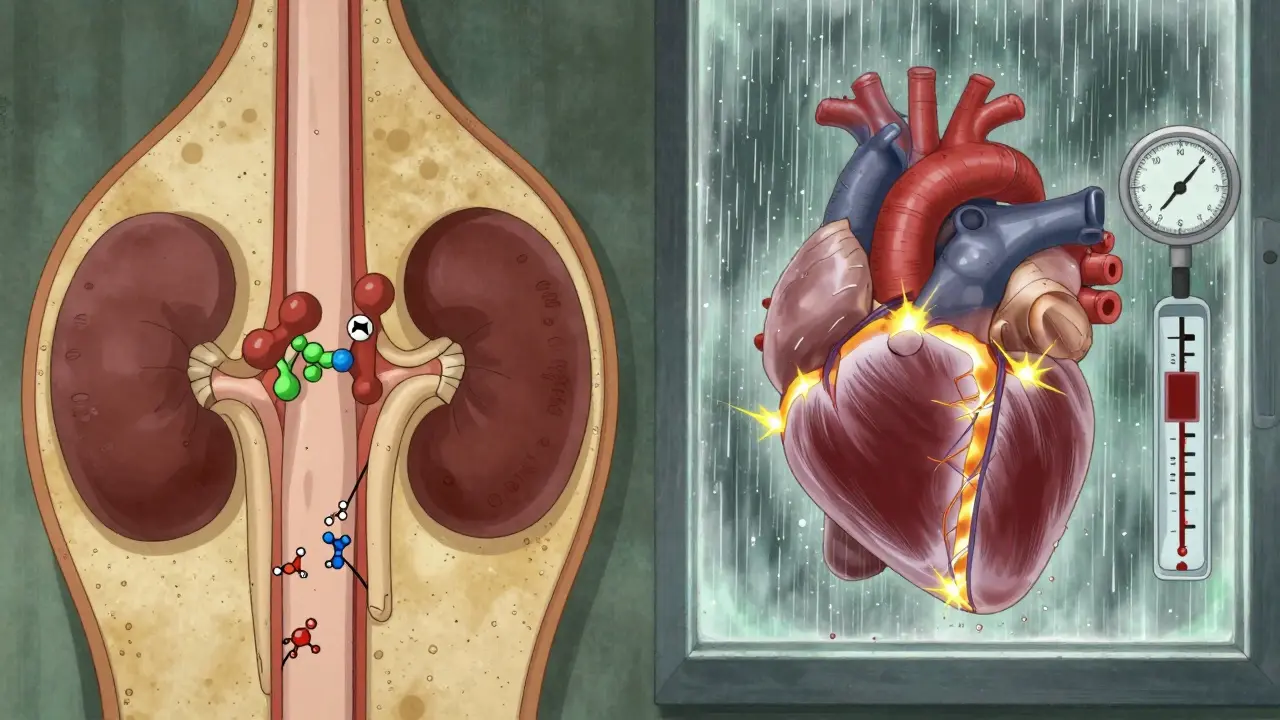
Unlike insulin or metformin, SGLT2 inhibitors don’t rely on the pancreas or liver. Instead, they work in the kidneys. Every day, your kidneys filter about 180 grams of glucose. Normally, nearly all of it gets reabsorbed back into your bloodstream. That’s thanks to a protein called SGLT2, found in the proximal tubule of the kidney.
SGLT2 inhibitors block that protein. When they do, about 60 to 90 grams of glucose escape through urine instead. That’s roughly 200 to 300 calories lost daily-without you having to diet or exercise. This mechanism lowers blood sugar without triggering hypoglycemia, which is why these drugs are safer for older adults or those with weak pancreatic function.
But here’s the twist: the same process that flushes out glucose also flushes out sodium and water. That’s why patients often see a drop in blood pressure (3-5 mmHg systolic) and lose 2-3 kg (4-7 lbs) in the first few months. It’s not magic. It’s physiology.
The Heart Benefits: More Than Just Better Sugar Control
The real game-changer came in 2015 with the EMPA-REG OUTCOME trial. Researchers gave empagliflozin (Jardiance) to over 7,000 people with type 2 diabetes and known heart disease. After three years, those taking the drug had a 38% lower risk of dying from heart-related causes and a 32% lower risk of dying from any cause. That’s not a small benefit. It’s one of the strongest mortality reductions ever seen in a diabetes drug trial.
Why? It’s not just about glucose. SGLT2 inhibitors change how the heart uses energy. They increase ketone production, which the heart burns more efficiently than glucose or fatty acids. They also reduce fluid overload, lower blood pressure, and decrease heart muscle stiffness-all factors that improve heart function.
Follow-up studies confirmed this. The DAPA-HF trial (2019) showed dapagliflozin reduced heart failure hospitalizations by 26% even in people without diabetes. The EMPEROR-Reduced trial (2020) did the same with empagliflozin. These results were so clear that the American Heart Association and European Society of Cardiology now recommend SGLT2 inhibitors for all patients with heart failure-regardless of whether they have diabetes.
Kidney Protection: Slowing Down the Silent Decline
Diabetic kidney disease is one of the most common causes of kidney failure. For decades, ACE inhibitors and ARBs were the only tools doctors had to slow it down. Then came CREDENCE (2019).
This trial tested canagliflozin in over 4,400 people with type 2 diabetes and early kidney damage. After 2.6 years, those on the drug had a 30% lower risk of reaching end-stage kidney disease, doubling serum creatinine, or dying from kidney causes. That’s a massive reduction. Even more surprising? The benefit was seen even in people whose blood sugar didn’t improve much. That suggests the kidney protection comes from something deeper than glucose control.
Researchers now believe SGLT2 inhibitors reduce pressure inside the kidney’s filtering units (glomeruli). High pressure damages these filters over time. By reducing that pressure, these drugs may literally shield the kidneys from further injury. The EMPA-KIDNEY trial (2023) went even further, showing empagliflozin helped patients with and without diabetes-opening the door to a future where these drugs are used for kidney protection in all high-risk patients.
How They Compare to Other Diabetes Drugs
Metformin is still the first choice for most people with type 2 diabetes. It’s cheap, safe, and reduces heart disease risk modestly. But it doesn’t come close to the organ protection seen with SGLT2 inhibitors.
Sulfonylureas like glipizide? They lower sugar but often cause low blood sugar and weight gain. DPP-4 inhibitors like sitagliptin? They’re neutral on weight and heart risk-but offer no kidney benefit.
GLP-1 receptor agonists (like semaglutide) also protect the heart and kidneys, but they’re injectable and cost more. SGLT2 inhibitors are pills, taken once daily, and now many are available as generics or through patient assistance programs.
Here’s a quick comparison:
| Medication Class | Weight Effect | Heart Failure Risk | Kidney Protection | Cost (Monthly) |
|---|---|---|---|---|
| Metformin | Neutral | Mild reduction | No proven benefit | $4-$10 |
| SGLT2 Inhibitors | Loss of 2-3 kg | 25-38% reduction | 28-30% reduction | $520-$600 (brand), $30-$50 (generic) |
| Sulfonylureas | Gain | No benefit | No benefit | $10-$15 |
| DPP-4 Inhibitors | Neutral | Neutral | Minimal | $350-$400 |
Side Effects and What to Watch For
These drugs are generally well-tolerated. But they’re not risk-free.
The most common issue? Genital yeast infections. About 4-5% of users-mostly women-get itching or discharge. It’s treatable and rarely serious. Drinking plenty of water and keeping the area dry helps prevent it.
A bigger concern is diabetic ketoacidosis (DKA). Normally, DKA happens when blood sugar is over 300 mg/dL. But with SGLT2 inhibitors, it can occur with glucose levels between 100-250 mg/dL. This is called euglycemic DKA. It’s rare-about 0.15% of users-but can be life-threatening. If you feel nauseous, have abdominal pain, or feel unusually tired while on these drugs, get checked immediately. The FDA requires a boxed warning for this.
Some patients report increased urination, especially at first. That’s normal. It usually improves after a few weeks. Also, canagliflozin has a small increased risk of leg amputations (6.3 vs. 3.4 per 1,000 patient-years). This risk is highest in those with prior amputations, poor circulation, or foot ulcers. If you have these issues, your doctor may avoid canagliflozin.

Who Should Take Them-and Who Shouldn’t
Current guidelines from the American Diabetes Association (2023) are clear: If you have type 2 diabetes and any of these conditions, SGLT2 inhibitors should be considered first-line:
- Heart failure (with reduced or preserved ejection fraction)
- Chronic kidney disease (eGFR ≥25 mL/min/1.73m²)
- High risk for cardiovascular events (history of heart attack, stroke, or multiple risk factors)
They’re also recommended for patients who need weight loss or have high blood pressure.
They’re not for:
- Type 1 diabetes
- Severe kidney impairment (eGFR below 25)
- People with history of recurrent DKA
- Those on very low-carb or ketogenic diets (increases DKA risk)
Start-up dosing matters too. For older adults or those with low blood pressure, doctors often begin with a lower dose to avoid dizziness or dehydration.
Real Patient Stories
One patient, Maria, 68, had type 2 diabetes for 15 years. Her A1c was 8.2%, her ejection fraction was 30%, and her urine albumin was high. After starting empagliflozin, her A1c dropped to 6.9%. Her heart function improved-her ejection fraction rose to 40%. Her nephrologist said her kidney markers stabilized. "I didn’t think I’d feel better," she said. "Now I walk my dog every morning without getting winded."
Another, James, 54, lost 14 pounds in four months. His blood pressure fell from 148/92 to 128/80. But he had two yeast infections. "It was annoying," he said. "But I’d take it again. My doctor says I’m less likely to have a heart attack now."
On the flip side, a Reddit user shared: "I got DKA after a stomach virus. I didn’t realize how dangerous it could be. I’m still on the drug, but now I never skip my insulin or stop drinking water when I’m sick."
The Future: Beyond Diabetes
These drugs are no longer just for diabetes. In 2021, the FDA approved dapagliflozin for chronic kidney disease in people with or without diabetes. In 2022, it approved empagliflozin for heart failure regardless of diabetes status. More approvals are coming.
By 2027, the global market for SGLT2 inhibitors is expected to hit $18.5 billion. Generic versions will start appearing in the U.S. between 2025 and 2028, cutting costs by 60-70%. That means more people will have access-not just those with good insurance.
Researchers are now testing whether these drugs can help with non-diabetic kidney disease, fatty liver disease, and even neurodegenerative conditions. Early data suggests they might reduce inflammation and oxidative stress system-wide. The mechanism? Still being studied. But the results so far are too promising to ignore.
For patients with type 2 diabetes, the message is clear: SGLT2 inhibitors aren’t just another pill. They’re one of the few treatments that don’t just manage the disease-they change its course. For the heart. For the kidneys. For life.
Can SGLT2 inhibitors be used if I don’t have diabetes?
Yes. In 2021, the FDA approved dapagliflozin for chronic kidney disease in patients with or without diabetes. In 2022, empagliflozin was approved for heart failure regardless of diabetes status. These approvals were based on trials showing clear benefits in kidney and heart outcomes-even in people who didn’t have high blood sugar.
Do SGLT2 inhibitors cause low blood sugar?
Not on their own. Unlike sulfonylureas or insulin, SGLT2 inhibitors don’t stimulate insulin release. So when taken alone, they rarely cause hypoglycemia. But if you’re also taking insulin or a sulfonylurea, your doctor will likely lower those doses to avoid low blood sugar.
Why do I need to drink more water on SGLT2 inhibitors?
These drugs make you pee out more glucose and sodium, which pulls water with it. This can lead to dehydration, especially in older adults or during hot weather or illness. Drinking enough fluids helps prevent dizziness, low blood pressure, and rare but serious issues like acute kidney injury. Aim for at least 8 cups of water daily unless your doctor says otherwise.
Are SGLT2 inhibitors safe for older adults?
Generally yes, but with caution. Older patients are more prone to dehydration and low blood pressure. Doctors often start with a lower dose and monitor kidney function and blood pressure closely. The heart and kidney benefits often outweigh the risks, especially in those with heart failure or kidney disease.
What should I do if I get sick while taking an SGLT2 inhibitor?
If you have a serious illness like infection, surgery, or vomiting, contact your doctor. You may need to temporarily stop the SGLT2 inhibitor to avoid euglycemic diabetic ketoacidosis. Don’t stop insulin or other diabetes meds unless told to. Stay hydrated and monitor for symptoms like nausea, confusion, or deep breathing.
matthew runcie
March 21, 2026 AT 08:43Still drink water like it's my job.
Nishan Basnet
March 22, 2026 AT 06:53Allison Priole
March 24, 2026 AT 02:29Turns out, I’m not. My ejection fraction went from 35 to 44. I walk my dog now. I nap without guilt. I even bought new sneakers.
Yeast infections? Yeah. But I’d take them again. And again. And again. 😌
Casey Tenney
March 25, 2026 AT 03:55Sandy Wells
March 26, 2026 AT 23:16People die from this. Not just ‘rare cases’.
Timothy Olcott
March 27, 2026 AT 06:07Generic is $35. Why are we letting Big Pharma rob us? 🤬
Also, I got a yeast infection. So did my wife. Coincidence? I think NOT. #pharmabro
Desiree LaPointe
March 28, 2026 AT 14:52How quaint. We’ve been treating diabetes like a spreadsheet for decades, then suddenly-oh, the kidneys do something interesting?
How revolutionary. 🙄
Jackie Tucker
March 30, 2026 AT 12:39Why not ask why people develop insulin resistance in the first place?
But no. Let’s just pharmacologically patch the symptoms while the system burns.
It’s elegant. And profoundly sad.
Thomas Jensen
April 1, 2026 AT 10:14These drugs are part of a larger plan to control populations.
They’re laced with microchips.
That’s why they cause dehydration-so you’ll be too weak to resist.
And the yeast infections? That’s just to make you paranoid.
Ask yourself: why did the FDA approve this after 2021? Coincidence? I think NOT.
shannon kozee
April 1, 2026 AT 22:38Just monitor hydration. And if you’re on insulin? Dose adjustments are key.
Simple. Effective. Life-changing.
trudale hampton
April 3, 2026 AT 10:51My doc said I’m ‘a poster child’ for the new guidelines.
Worth the 2 yeast infections? Absolutely.
My knees don’t ache like they used to. Weird. But good.
Johny Prayogi
April 4, 2026 AT 16:51It’s not magic. It’s science. And it’s working. 🙌
Generic is coming. So stop being scared. Start being informed.
And yes, drink water. I know, I know. 😅