Imagine taking a pill that saves your life but carries a tiny chance of causing severe harm. Now imagine that the people who tested it never saw that harm because they only watched a few thousand people for a short time. This is the reality of modern medicine. We rely on drugs to treat everything from high blood pressure to cancer, but we don't always know the full picture of their risks until millions of people start using them.
This gap between controlled lab results and messy real-life usage is where medication safety comes in. It’s not just about reading the label; it’s a complex science dedicated to figuring out whether a drug does more good than bad when used by regular people in the real world. Understanding this science helps patients, doctors, and regulators make smarter choices every day.
The Gap Between Trials and Reality
When a new drug is approved, it has passed through rigorous testing. But here’s the catch: those tests, known as Randomized Controlled Trials (RCTs), are like driving a car on a closed track. The conditions are perfect. The participants are carefully selected. In an average Phase III trial, researchers might follow only about 700 people for six to 24 months.
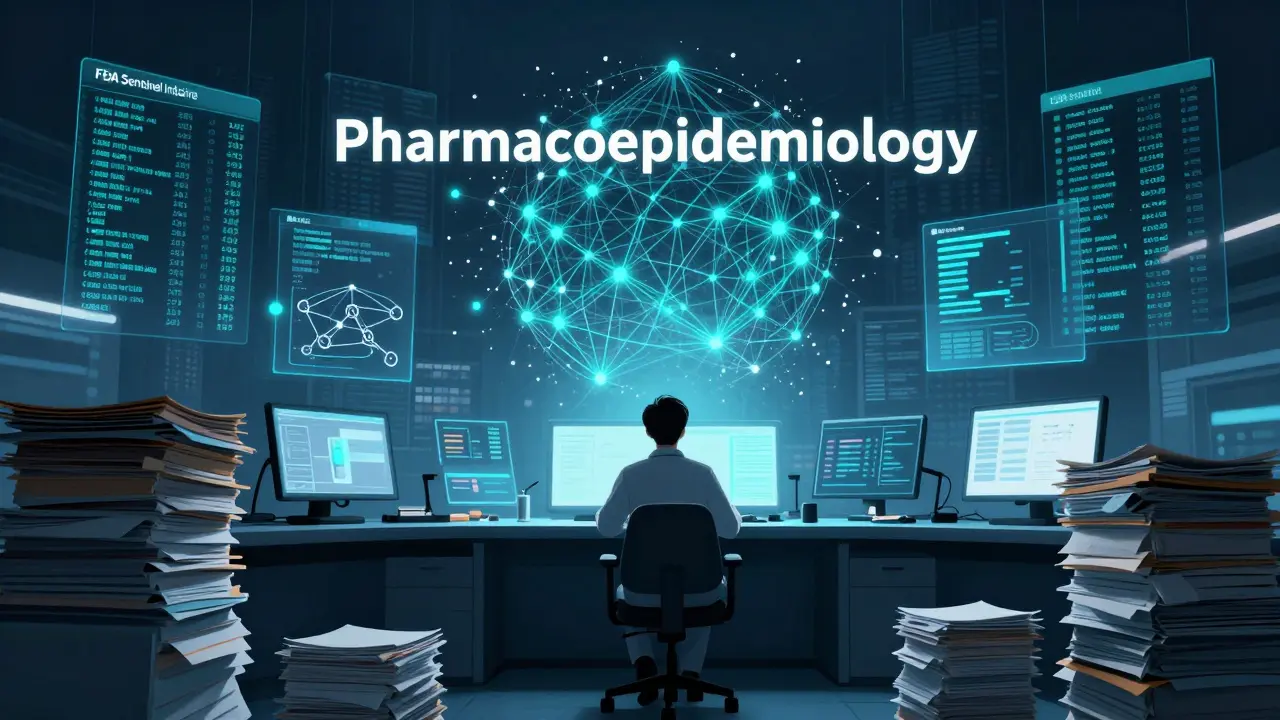
That sounds like a lot, but if a side effect happens in only one out of every 10,000 patients, you likely won’t see it in a group of 700. That’s why pharmacoepidemiology, which is the study of drug use and effects in large populations, was born. Think of it as taking that car off the track and putting it on busy city streets. You need to watch millions of drivers to find out what happens when someone takes the drug while drinking coffee, mixing it with other meds, or dealing with chronic illness.
This field became critical after tragedies like the thalidomide crisis in the 1960s, where birth defects went undetected in early trials. Today, organizations like the U.S. Food and Drug Administration (FDA) and the National Institutes of Health (NIH) rely heavily on post-market surveillance to catch these rare but serious issues.
How Scientists Spot Hidden Risks
So, how do we monitor safety without running another massive, expensive trial? Researchers use observational studies. Instead of assigning pills randomly, they look at existing data from hospitals, insurance claims, and electronic health records (EHRs).
There are a few main ways they do this:
- Cohort Studies: They track groups of people forward in time. For example, they might compare everyone who started Drug A last year against everyone who started Drug B to see who had more heart attacks.
- Case-Control Studies: They start with the problem. They find people who had a specific side effect and compare them to similar people who didn’t, looking back to see if they took the suspect drug.
- Self-Controlled Case Series (SCCS): This is a clever trick. They look at individuals who experienced an event and check if they were exposed to the drug right before the event compared to other times in their lives. Since each person serves as their own control, it removes many variables like age or genetics.
These methods leverage huge databases. The FDA’s Sentinel Initiative, for instance, covers over 190 million patients. Medicare data includes 57 million beneficiaries. By crunching these numbers, scientists can detect signals of danger much faster than waiting for patients to report problems voluntarily.
The Role of Technology and AI
Technology has changed the game. In the past, spotting a trend meant sifting through paper charts. Now, Electronic Health Records (EHRs) allow for real-time monitoring. As of 2023, 87% of U.S. hospitals have implemented Clinical Decision Support (CDS) systems designed to flag potential medication errors before they happen.
However, technology brings its own headaches. Have you ever clicked through a dozen warning pop-ups just to prescribe a simple antibiotic? That’s alert fatigue. Studies show prescribers override nearly 90% of drug interaction alerts because many are false alarms. If the system warns you about everything, you stop listening to anything.
To fix this, experts are turning to Artificial Intelligence. Early implementations of AI-driven predictive analytics have shown a 22-35% reduction in errors involving high-alert medications. Instead of generic warnings, AI can predict which specific patient is at risk based on their unique history, making the alerts actually useful.
Comparing Evidence Sources
Not all evidence is created equal. Here is how different methods stack up against each other:
| Method | Cost Estimate | Timeframe | Best For | Main Limitation |
|---|---|---|---|---|
| Randomized Controlled Trial (RCT) | $26M+ average | Months to Years | Proving efficacy and initial safety | Too small/expensive for rare side effects |
| Observational Cohort Study | $150k - $500k | Weeks to Months | Detecting long-term or rare risks in real world | Confounding factors (other causes may be blamed on drug) |
| Self-Controlled Case Series | Low (uses existing data) | Rapid | Vaccine safety and acute outcomes | Only works for temporary exposures |
While RCTs are the gold standard for proving a drug works, observational studies are the workhorses of safety monitoring. They account for 78% of FDA safety communications between 2015 and 2022. The key is combining both: using RCTs for internal validity (did the drug cause this?) and observational data for external validity (does this happen in real life?).
Real-World Impact: Successes and Failures
Does this science actually save lives? Yes, but it requires action. At Kaiser Permanente Washington, implementing a specific protocol for phenobarbital to treat alcohol withdrawal reduced severe withdrawal events by 42%. This wasn’t magic; it was data-driven policy change based on safety evidence.
On the flip side, barriers remain. Nurses often report that fragmented EHR systems and poor communication between departments lead to near-miss errors weekly. One survey found that medication safety competence among nurses directly correlated with safe care practices, explaining 61% of the variance in safety outcomes. Simply put, better training and smoother workflows save patients.
The stakes are high. Adverse Drug Events (ADEs) affect 15% of Medicare beneficiaries annually. Opioid-related harms contributed to 80,000 deaths in 2022 alone. Closing the gap between knowing a risk exists and preventing it is the ultimate goal of medication safety science.
The Future of Drug Safety
We are moving toward a more proactive model. The FDA launched Sentinel System 3.0 in 2023 to enhance real-time monitoring. Looking ahead, there is a push to incorporate patient-generated data from wearables into safety networks. Imagine your smartwatch detecting irregular heart rhythms and automatically flagging a potential interaction with your new prescription.
The market reflects this shift. The global pharmacovigilance market is projected to reach $11.7 billion by 2028. Pharmaceutical companies are investing heavily in this area, not just to comply with regulations, but to protect their reputation and patients. However, challenges like data privacy concerns and the lack of standardized protocols for observational studies remain hurdles that researchers and regulators must overcome together.
What is the difference between a clinical trial and pharmacoepidemiology?
Clinical trials are controlled experiments with a limited number of participants to prove if a drug works. Pharmacoepidemiology studies how drugs perform in large, diverse real-world populations after approval, focusing on detecting rare or long-term side effects that trials might miss.
Why are observational studies important for medication safety?
Observational studies allow researchers to analyze data from millions of patients using existing records. This makes it possible to detect rare adverse events that occur in small percentages of the population, which would be too costly and impractical to find in smaller clinical trials.
What is alert fatigue in healthcare?
Alert fatigue occurs when healthcare providers receive too many non-specific or low-risk warnings from computer systems. As a result, they may ignore or override critical alerts, potentially missing genuine medication errors or dangerous interactions.
How does AI improve medication safety?
AI improves safety by analyzing vast amounts of patient data to predict individual risks rather than issuing generic warnings. Early studies show AI-driven analytics can reduce high-alert medication errors by 22-35% by providing more precise, context-aware recommendations.
What is the FDA Sentinel Initiative?
The FDA Sentinel Initiative is a network of electronic health record data from over 190 million patients. It allows the FDA to actively monitor drug safety in real-time, identifying potential problems faster than traditional reporting methods.