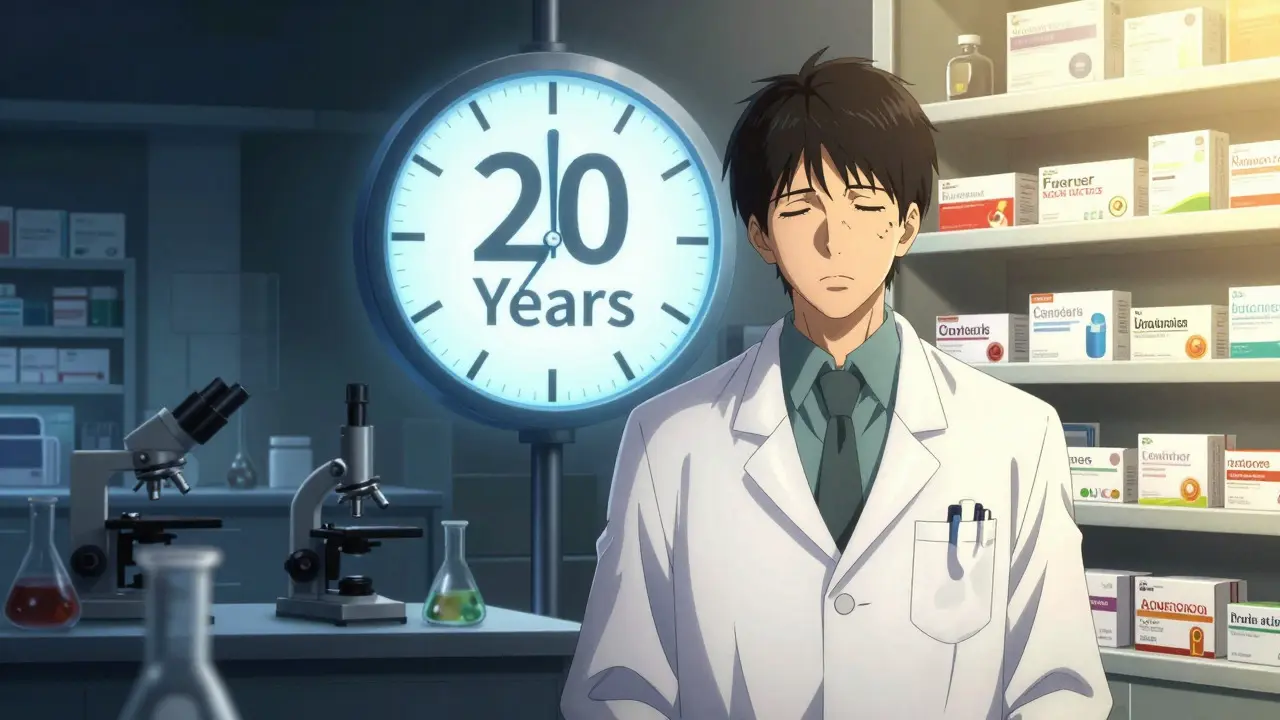
You’ve probably seen commercials for expensive new medications and wondered how long those high prices will last. The short answer is that a drug patent lasts for 20 years from the day it was filed. But here’s the catch: you don’t get 20 years of selling that drug on the market. By the time the government approves the medicine, half of that time has often already vanished.
This gap between filing and selling is where the real story lies. It explains why some drugs stay exclusive for a decade while others face competition sooner. It also determines when cheaper generic versions hit your local pharmacy shelves. Let’s break down exactly how this timeline works, why it feels so short, and what happens when the clock runs out.
The 20-Year Rule vs. Reality
In the United States, the law sets a standard patent term of 20 years. This rule comes from the Uruguay Round Agreements Act of 1994, which aligned U.S. laws with international standards. The clock starts ticking the moment a company files its first patent application with the United States Patent and Trademark Office (USPTO). This agency grants the legal right to exclude others from making or selling the invention.
However, developing a new drug takes a long time. It usually involves five to ten years of research, lab work, and clinical trials before the Food and Drug Administration (FDA) says the drug is safe for public use. If you file a patent in 2010, the protection ends in 2030. But if the FDA doesn’t approve the drug until 2022, you only have eight years left to sell it exclusively. That is a huge difference for a company that spent billions on development.
Because of this lag, the actual period of market exclusivity-the time when no one else can sell a copy-is typically between seven and twelve years. This reality check is crucial for understanding why pharmaceutical companies fight so hard to extend their timelines.
How Companies Get More Time: Extensions and Adjustments
Since losing half the patent term to testing seems unfair, lawmakers created ways to add time back. The most famous of these is the Hatch-Waxman Act, passed in 1984. This legislation established the Patent Term Extension (PTE). PTE allows companies to recover some of the time lost during regulatory review. You can add up to five extra years to the patent life, but there is a hard cap: the total exclusivity cannot exceed 14 years after the FDA approves the drug.
To get this extension, the company must apply within 60 days of approval. Miss that window, and the right is gone forever. Another mechanism is Patent Term Adjustment (PTA). If the USPTO takes too long to process the application-like failing to send an initial response within 14 months-they owe the applicant time. This ensures the bureaucracy doesn’t eat into the inventor’s rights.
These adjustments mean the "expiration date" isn’t just a simple calendar calculation. It requires tracking federal deadlines, court rulings, and agency responses. For patients, this means brand-name drugs might stay off-limits to generics longer than the basic 20-year math suggests.
The Patent Cliff: What Happens When Protection Ends?
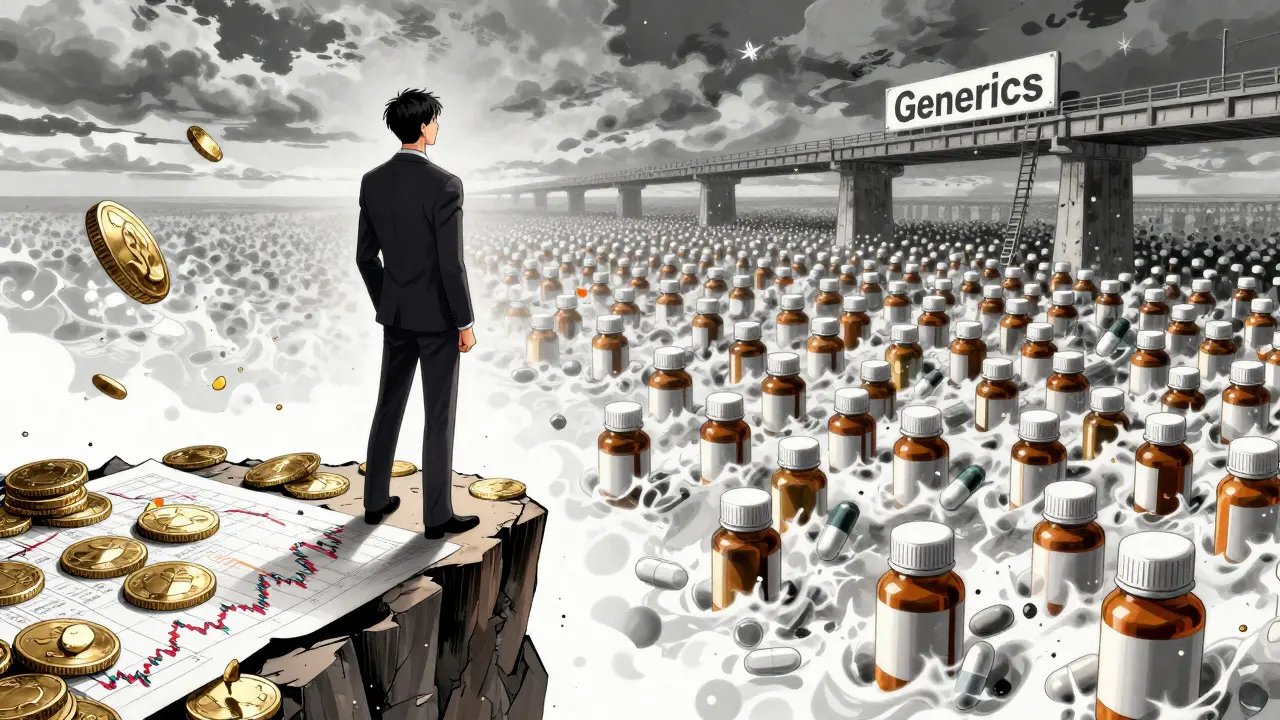
When the last enforceable patent expires, we call it the Patent Cliff. This is the moment generic manufacturers can legally enter the market. The economic impact is immediate and massive. Data from the National Bureau of Economic Research shows that prices for physician-administered drugs drop by 38% to 48% once generics arrive.
For small molecule drugs (the traditional pill form), generic competitors are quick to move. They often capture 80% to 95% of the market share within two years. Biosimilars (copies of complex biological drugs) take longer due to stricter regulations, usually reaching 40% to 60% share. Look at Eliquis, a blood thinner. After its patent expired in late 2022, generic versions took 35% of the market in just six months, and wholesale prices fell by 62% in the first year.
This shift helps lower healthcare costs significantly. However, it creates a revenue shock for the original manufacturer. Industry analysts predict the pharmaceutical sector could lose $268 billion in cumulative revenue between 2023 and 2028 due to these expirations. That pressure drives companies to find every possible way to delay the cliff.
Layered Defense: Why One Patent Isn't Enough
Smart pharma companies don’t rely on a single patent. They build a fortress around their drug using multiple layers of intellectual property. Think of it like a castle with several walls. Even if the outer wall falls, the inner keep remains protected.
- Compound Patents: These protect the active ingredient itself. This is the big one.
- Formulation Patents: These cover how the drug is made, such as a slow-release capsule versus a regular tablet.
- Method-of-Use Patents: These protect specific medical conditions the drug treats. A heart medication might get a new patent if doctors discover it also helps with anxiety.
- Manufacturing Process Patents: These protect the unique factory steps used to create the chemical.
Each of these gets its own 20-year term. So, even if the main compound patent expires in 2025, a formulation patent might block generics until 2028. This strategy, sometimes criticized as "evergreening," keeps competition at bay. For example, Spinraza, a treatment for spinal muscular atrophy, maintains a web of patents extending protection well into the 2030s despite earlier filings.
Regulatory Exclusivity: The Hidden Shield
Beyond patents, the FDA grants separate periods of exclusivity that function like temporary bans on generic applications. These aren’t patents, but they stop competitors just as effectively.
| Exclusivity Type | Duration | Purpose / Condition |
|---|---|---|
| New Chemical Entity (NCE) | 5 Years | Prevents FDA from accepting generic apps for new drugs. |
| Orphan Drug | 7 Years | For rare diseases affecting fewer than 200,000 people. |
| Pediatric | 6 Months | Added if the company tests the drug on children as requested. |
| New Clinical Investigation | 3 Years | For new studies needed for new indications or dosages. |
A common point of confusion for patients is pediatric exclusivity. Sometimes, insurance plans switch coverage based on these tiny windows. You might see a copay jump because a brand-name drug temporarily regained exclusivity thanks to a six-month pediatric bonus, blocking a cheaper generic alternative. While brief, these overlaps matter for budgeting and access.
Global Differences and Future Changes
The U.S. system is unique. Other countries calculate extensions differently. Japan, for instance, uses a "reference date" method to determine maximum permissible extensions, balancing innovation incentives with public health needs more aggressively. The World Health Organization has even suggested reducing global patent terms to 15 years to improve medicine access worldwide.
Back home, legislation is always shifting. Bills like the proposed "Restoring the America Invents Act" aim to tighten rules on patent term adjustments, potentially shaving off months of exclusivity. Meanwhile, the rise of combination therapies-mixing two drugs into one pill-creates new patent puzzles. AstraZeneca’s Tagrisso franchise, for example, uses combination strategies to keep protection alive through 2033, even though the core compound patent ended earlier.
Understanding these timelines helps everyone involved. Investors watch for the patent cliff to gauge stock risks. Policymakers debate how to balance profit with affordability. And patients wait for the day their prescription becomes affordable. The 20-year number is just the starting line; the real race happens in the courts, the labs, and the regulatory offices.
Does a drug patent really last 20 years?
Legally, yes. The patent term is 20 years from the filing date. However, because it takes 5-10 years to develop and approve a drug, the actual time the company can sell it without competition is usually only 7-12 years.
What happens when a drug patent expires?
Generic manufacturers can immediately start selling copies of the drug. This usually causes the price to drop by 38% to 48% or more, as competition increases. Generic versions often capture the majority of the market within two years.
Can pharmaceutical companies extend their patents?
Yes. Through the Hatch-Waxman Act, they can receive Patent Term Extensions (up to 5 years) to compensate for regulatory delays. They also use "layered" patents covering formulations or methods of use to create additional barriers to generic entry.
Why do some drugs stay expensive after the patent expires?
Sometimes, secondary patents on delivery mechanisms or specific uses expire later than the main compound patent. Additionally, for complex biologics, creating a biosimilar is harder and slower than making a generic pill, allowing the brand name to maintain higher prices longer.
What is the "Patent Cliff"?
The Patent Cliff refers to the sudden loss of revenue for a pharmaceutical company when its major patents expire and generic competition floods the market. It is a critical financial event that affects stock prices and future investment in new drugs.