
The goal here is medication adherence-which is just a fancy way of saying "actually taking your meds the way your doctor told you to." The problem is that polypharmacy (taking five or more medications daily) is skyrocketing. When you're juggling a handful of pills three or four times a day, your brain naturally starts to push back. By reducing the number of times you have to dose, you remove the friction and make staying healthy feel less like a full-time job.
The Best Ways to Cut Down Daily Dosing
Simplifying your routine isn't about skipping doses; it's about changing how those doses are delivered. There are a few proven ways to get those daily numbers down.
First, there are Fixed-Dose Combinations (FDCs). Think of this as a "2-in-1" shampoo, but for medicine. FDCs merge two or more different medications into one single pill. Instead of swallowing two separate tablets for blood pressure and cholesterol, you take one. This approach is used in about 33% of simplification strategies and has been a game-changer for chronic conditions like HIV, where it has boosted adherence rates by up to 25%.
Then you have the shift to once-daily dosing. This usually happens through Extended-Release Formulations. These are versions of a drug designed to leak slowly into your bloodstream over 24 hours, replacing the need for three separate doses of a short-acting version. While this is incredibly convenient, it's not possible for every drug due to how they are absorbed by the body, so it requires a pharmacist's green light.
If the medicine itself can't be changed, you can change the logistics. Medication Synchronization is a service where your pharmacy aligns all your refills to happen on the same day each month. It doesn't change the pill count, but it cuts pharmacy visits by about 60%, which removes a huge mental burden from the process.
| Method | How it Works | Adherence Boost | Main Trade-off |
|---|---|---|---|
| Fixed-Dose Combinations | Multi-drug single pill | 18-25% | Doses must align perfectly |
| Once-Daily Dosing | Extended-release versions | 15-30% | Not all drugs have ER versions |
| Med Synchronization | Aligned refill dates | Moderate | Requires pharmacy coordination |
| Compliance Packaging | Pre-sorted compartments | Up to 30% | Higher service costs |
Getting the Timing Right with the Universal Medication Schedule
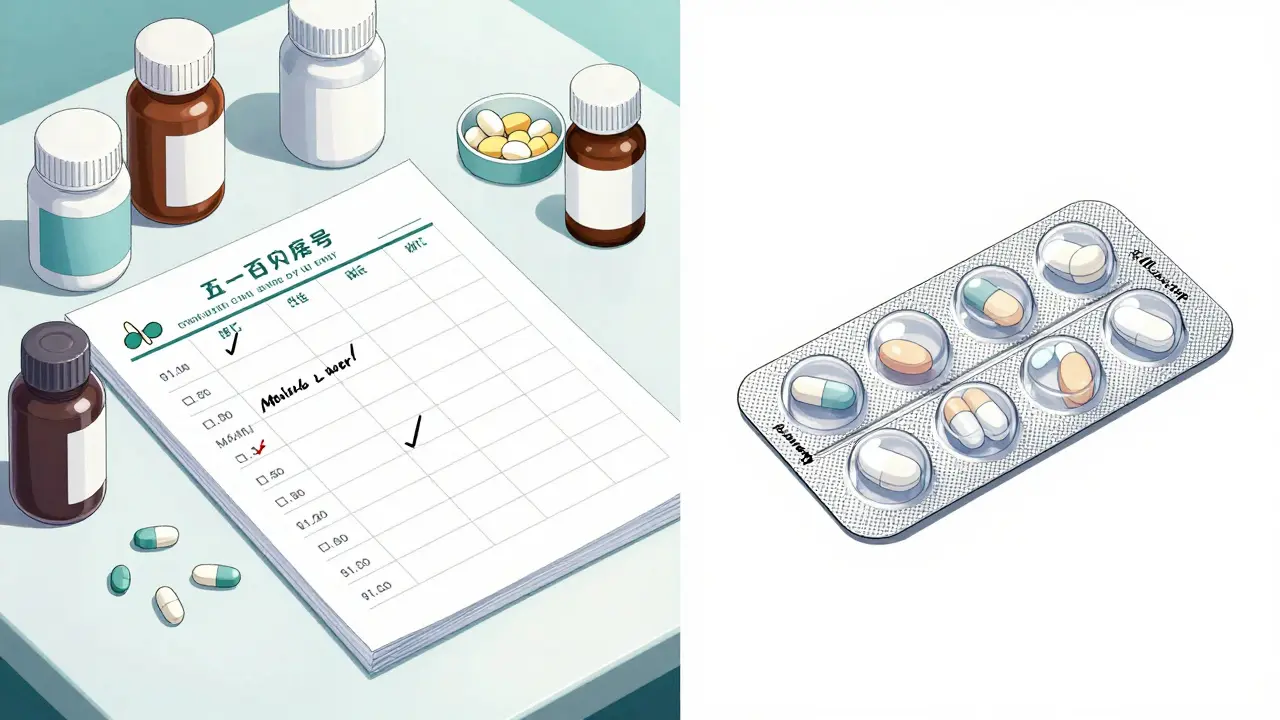
One of the biggest headaches in a complex regimen is the "random" timing. One pill is at 8 AM, another at 10 AM, one at 2 PM, and another at 7 PM. This fragmentation makes it almost impossible to stay on track. To fix this, many experts suggest the Universal Medication Schedule. This is a system that standardizes all medication administration into four specific windows: morning, noon, evening, and bedtime.
Why does this matter? Because when you move from seven random time slots to four predictable ones, you're much less likely to forget a dose. In hospital settings, this kind of alignment has been shown to reduce dosing errors by 35%. It turns a chaotic day of "pill alarms" into a simple routine tied to meals or sleep.
For those who still struggle with memory, Multi-Dose Compliance Packaging (like blister packs or pouch systems) provides a physical safety net. These organize medications into time-specific compartments. One caregiver reported that switching a parent from 12 separate bottles to a four-compartment organizer drastically reduced their confusion. However, be aware that these services can cost 15-20% more than traditional vials.
The Step-by-Step Path to a Simpler Regimen
You can't just decide to take three pills at once instead of throughout the day-that's a recipe for a medical emergency. Simplifying a regimen requires a professional, structured process. If you're working with a doctor or pharmacist, here is the workflow they should be following:
- Medication Reconciliation: This takes about 20-30 minutes. The goal is to find the gap between what the doctor *thinks* you're taking and what you're *actually* taking. It's common to find about six discrepancies per person here.
- Capacity Assessment: Spending 10-15 minutes evaluating if the patient (or caregiver) can realistically handle the current schedule.
- Opportunity Identification: Looking for those "quick wins"-can this be switched to an extended-release version? Is there a combination pill available?
- Recommendation Formulation: Creating a new, leaner schedule. Interestingly, 75% of these recommendations are just changes in timing, not changes in the dose itself.
- Implementation Coordination: This is the hardest part. For this to work, the doctor, pharmacist, and patient all have to be on the same page. When all three are involved, the success rate jumps from 12% to 50%.

The Reality Check: Pitfalls and Barriers
It sounds simple, but the road to fewer doses is often blocked by red tape. The biggest hurdle? Insurance. Many insurance plans deny coverage for the newer, extended-release formulations or FDCs because they are more expensive than the old-school generic versions. In one study, 45% of Medicare Advantage patients faced denials for the very medications needed to simplify their lives.
There's also the "clinical outcome" gap. Here's a controversial point: just because someone takes their pills more consistently doesn't always mean their health improves. Some research into antiretroviral therapy showed that while people were much better at taking their simplified once-daily meds, their actual clinical markers didn't always move. This means simplification is a tool for quality of life and adherence, but it doesn't replace the need for the right drug for the right person.
Finally, be wary of "DIY simplification." Some patients try to consolidate their own meds-taking a noon dose in the morning just to get it over with. This can be dangerous, especially with medications that need to be spaced out to avoid toxicity or to maintain a steady level in the blood. Always run a timing change by a professional.
Looking Ahead: AI and Smart Tech
We are moving toward a world where you won't have to guess if a regimen can be simplified. AI-powered tools are now being developed to analyze pharmacokinetics (how a drug moves through your body) to suggest the perfect consolidation. We're also seeing the rise of IoT-enabled medication organizers. These smart bins don't just hold your pills; they track when you open them and send real-time data to your care team.
The trend is clear: the medical industry is finally realizing that a treatment plan is only as good as the patient's ability to follow it. By moving away from the "pill-a-day" chaos and toward streamlined, patient-centered dosing, we can reduce the mental load of chronic illness and actually make health manageable.
Can all medications be switched to once-daily dosing?
No. Whether a drug can be taken once a day depends on its half-life-how long it stays active in your system. Some medications break down too quickly to be effective if taken only once, and there may not be an extended-release version available for every drug.
Will simplifying my regimen cost me more money?
It depends. Fixed-dose combinations or extended-release versions can sometimes be more expensive or have different insurance tiers. Additionally, multi-dose packaging services often charge a premium (around 15-20% more) for the convenience of pre-sorted pills.
What is the difference between medication synchronization and simplification?
Simplification focuses on reducing the number of times you take medicine or the number of pills you swallow. Synchronization focuses on the logistics of refills, ensuring all your prescriptions are ready for pickup on one single day each month.
Is it safe to take all my pills at the same time if I want to simplify?
Not necessarily. Some drugs interfere with each other if taken simultaneously, and others must be taken at specific times (like once in the morning and once at night) to work effectively. Always consult a pharmacist before combining doses.
How do I start the process of simplifying my meds?
Start by listing every medication, dose, and time you currently take. Bring this list to your primary care doctor or pharmacist and specifically ask for a "medication regimen review." Mention that you are struggling with the frequency of doses and want to explore extended-release options or FDCs.

Nikki Grote
April 15, 2026 AT 10:57The pharmacokinetic profile of a drug is the real bottleneck here. While FDCs are great, you have to consider the bioavailability and potential for drug-drug interactions when consolidating. It's not just about the pill count, it's about maintaining the steady-state concentration of the active pharmaceutical ingredient in the plasma. Most clinicians focus on the adherence side, but the therapeutic window is what actually dictates whether a once-daily ER formulation is viable or if it'll lead to sub-therapeutic levels by hour 20.
Kim Hyunsoo
April 16, 2026 AT 12:22This whole pill-juggling act sounds like a total nightmare 😵... it's like a daily chemistry experiment just to survive the morning! The idea of a '2-in-1' pill is honestly such a whimsical way to handle health
✨
Tama Weinman
April 18, 2026 AT 08:52Of course the insurance companies 'deny' these. Funny how they always find a way to push the more expensive options once they've locked you into a specific regimen. It's probably all a coordinated effort to keep us dependent on the pharmacy cycle while the AI 'smart bins' just collect our biometric data for some database in the cloud. Just follow the money and you'll see why the 'simplification' is actually just another layer of control.
Theresa Griffin MEP
April 20, 2026 AT 06:42Implementing these structured workflows is essential for patient safety. Precision in medication reconciliation saves lives.
Cheryl C
April 20, 2026 AT 19:26USA medical system is the best in the world even if the insurance is a pain in the butt 🇺🇸🇺🇸🇺🇸 just talk to ur doc and get it sorted out lol!! 💊🔥
Richard Moore
April 21, 2026 AT 20:13Absolutely agree that the mental load is the biggest hurdle here 💯. If we can just get the providers to actually communicate with the pharmacists, we can stop this chaos. It's high time the medical industry stopped ignoring the patient's daily experience in favor of just 'clinical markers' 😤!
Rob Schlautman
April 23, 2026 AT 00:11i dont see why people make such a big deal out of this because honestly it's just a matter of getting organized and if you can't even handle a few pills a day then maybe you need a full time nurse instead of a fancy blister pack that costs way too much money for what it actually does which is basically nothing other than putting things in plastic holes
Anmol Garg
April 24, 2026 AT 11:30It's really about finding a balance between the science of the medicine and the humanity of the person taking it. We often forget that a patient's peace of mind is just as important as the chemical efficacy of the drug. If a simplified routine reduces stress, that in itself can have a positive ripple effect on their overall healing process. We should approach these regimens with more empathy for the daily struggle.